
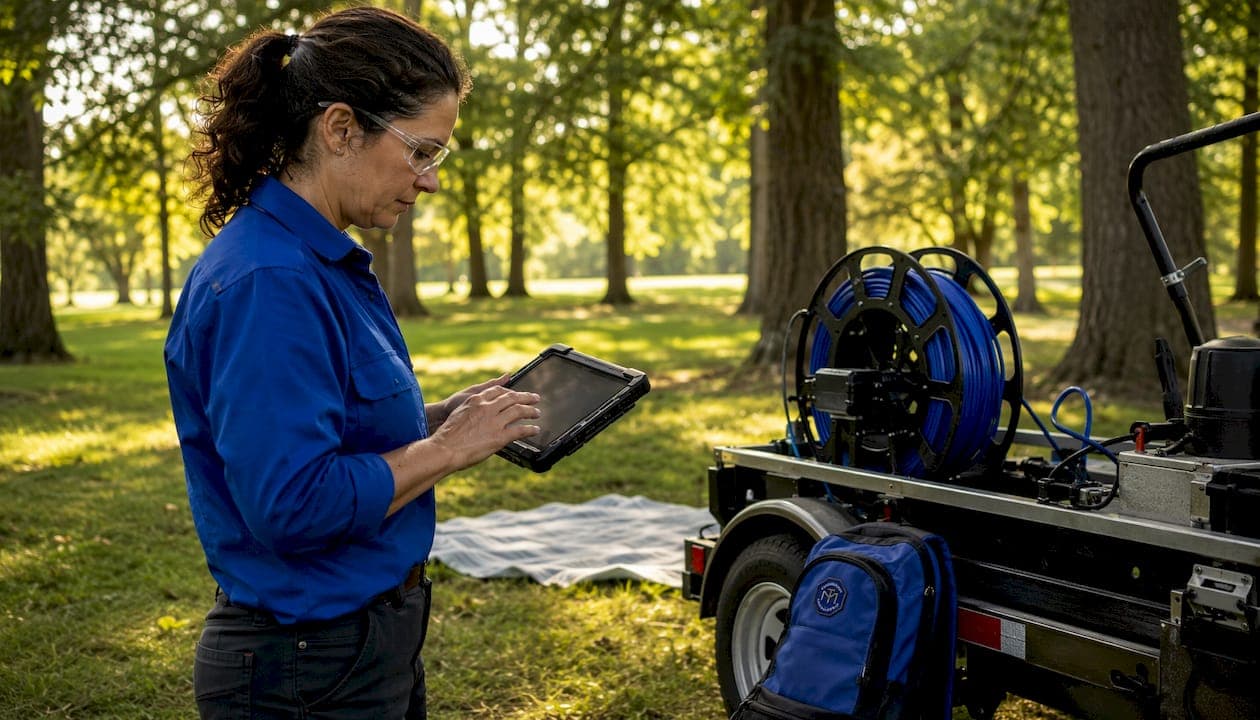
Choosing non-invasive (trenchless) sewer repair means you protect your landscaping, driveway, and foundation while keeping total project costs lower than most traditional excavation bids. Methods like CIPP lining and HD camera inspection let contractors diagnose and fix damaged pipes from the inside out, without tearing up your yard. Trenchlessmaine uses this approach across Maine to complete most jobs in a single day, backed by warranties up to 50 years.
The bottom line: Non-invasive trenchless repair preserves your property, eliminates costly site restoration, and gets your sewer line back in service faster than open excavation, making it the smarter total-cost choice for most property owners and managers.
Table of Contents
- Why non-invasive repair works: the methods behind the results
- Total project cost vs. repair-only cost: what you actually pay
- When non-invasive repair fits your situation and when it does not
- What to expect on the day of a non-invasive repair
- Questions to ask a contractor and red flags to watch for
- How Trenchlessmaine approaches non-invasive repairs
- Key Takeaways
- The case for doing this right the first time
- Get a free camera inspection and quote from Trenchlessmaine
- Sources and further reading
Why non-invasive repair works: the methods behind the results
Trenchless repair is not one single technique. It is a sequence of targeted steps, each designed to avoid the destruction that comes with open digging.
- HD sewer camera inspection: A high-definition camera travels the full length of your pipe, mapping internal geometry, cracks, root intrusion, joint offsets, and deformation. This footage drives every decision that follows.
- Hydro jetting: High-pressure water clears grease, mineral buildup, and root debris from the pipe walls, preparing a clean surface for lining. Hydro jetting is also used as a standalone solution for blockages that do not require structural repair.
- CIPP (cured-in-place pipe) lining: A resin-saturated liner is inserted into the existing pipe and inflated against the interior walls, then cured in place. The result is a pipe within a pipe, structurally sound and smooth-walled, with no excavation required.
- Drain clearing: For partial blockages or early-stage buildup, targeted drain clearing restores flow without any lining work.
The sequence matters: diagnose with the camera, clean with jetting, line and cure, then test. Skipping or rushing any step compromises the liner's bond and long-term integrity. Modern diagnostics and lining materials drive outcomes in ways earlier generations of trenchless technology simply could not match.
Pro Tip: Never accept a trenchless quote that does not include a pre-job camera inspection video. Without it, no contractor can reliably guarantee liner fit, cure quality, or the scope of work.
Total project cost vs. repair-only cost: what you actually pay
The biggest mistake property owners make when comparing bids is looking only at the repair line item. Total project cost includes every dollar spent to return the site to its pre-repair condition, and that number tells a very different story.
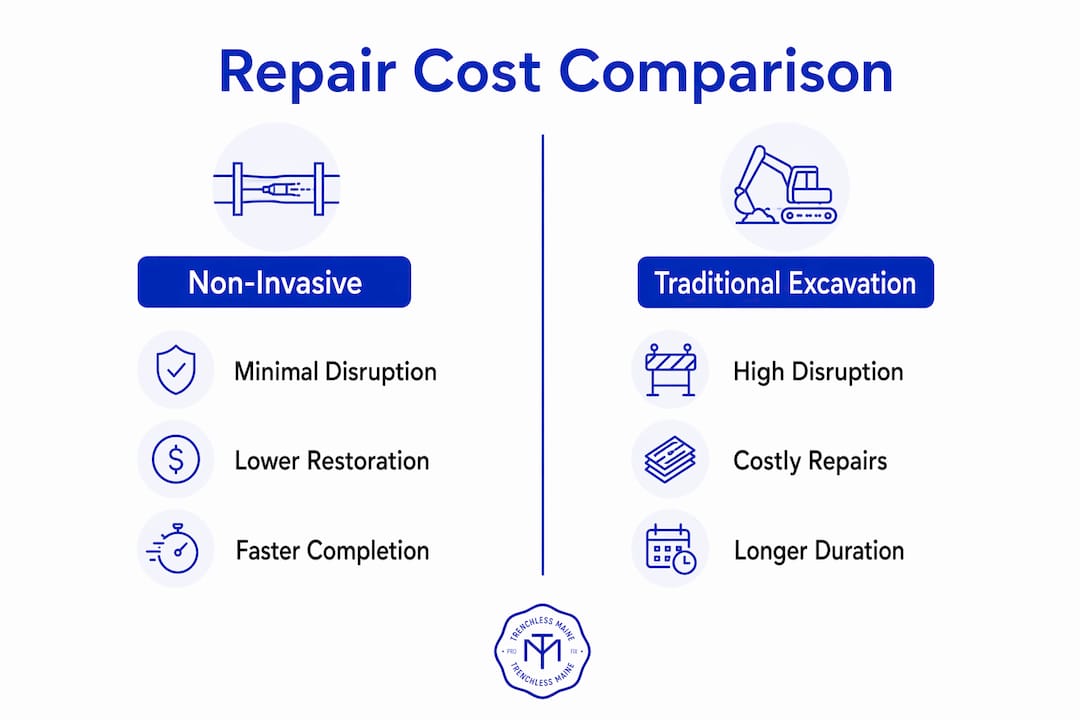
A traditional excavation job adds costs that rarely appear on the initial quote: concrete or asphalt cutting and replacement, lawn regrading and replanting, driveway restoration, and sometimes foundation patching. Those "hidden" restoration costs frequently exceed the marginal savings of a lower repair-only price.
| Cost category | Non-invasive (trenchless) | Traditional excavation |
|---|---|---|
| Site disruption | Minimal (access pits only) | Extensive trench across yard/driveway |
| Landscaping restoration | Rarely needed | Often required |
| Concrete/asphalt repair | Rarely needed | Typically required |
| Project timeline | Often 1 day | Several days to weeks |
| Tenant/business downtime | Hours | Days or longer |
| Long-term maintenance | Low (smooth new liner) | Moderate (disturbed soil, joints) |
Non-invasive repair minimizes property disruption and eliminates most of those restoration line items entirely. Even when the trenchless repair quote is slightly higher than a dig-and-replace bid, the total project cost is usually lower once you account for everything the excavation contractor is not pricing.
Pro Tip: Ask every contractor for an itemized "site restoration allowance" in the written estimate. If they cannot provide one, you are comparing an incomplete bid against a complete one.
When non-invasive repair fits your situation and when it does not
Trenchless methods work well for most residential and commercial sewer laterals, but not every pipe is a candidate. A professional assessment determines whether repair will be durable or whether full replacement is the only reliable path forward.
Use this checklist to screen your site before requesting a detailed quote:
- Pipe material: Clay, cast iron, PVC, and Orangeburg are all lineable in most conditions. Severely corroded metal or fully disintegrated clay may not hold a liner.
- Pipe diameter: Most residential laterals (4–8 inches) are well within the range of standard CIPP equipment.
- Continuous run with access points: Trenchless lining requires entry and exit points. Confirm your lateral has accessible cleanouts or that small access pits can be dug at each end.
- Degree of collapse: Partial deformation or sags are often lineable. A fully collapsed run with no interior passage cannot accept a liner without excavation first.
- Joint offsets: Minor offsets can be bridged by a liner. Severe separation or misalignment usually requires open repair at the joint.
- Root intrusion: Moderate root intrusion is cleared by hydro jetting before lining. Extensive root damage that has fractured the pipe wall may indicate structural failure.
- Unknown structural failure: If the camera reveals multiple failure points, extreme deformation, or a pipe that has shifted off its original grade, excavation is the safer call.
Warning: No contractor should give you a definitive "yes" or "no" on trenchless suitability without a professional HD camera inspection first. Any quote issued without one carries real risk of scope error and cost overruns.
What to expect on the day of a non-invasive repair
Most trenchless jobs follow a predictable sequence, and reduced downtime is one of the clearest advantages over open excavation.
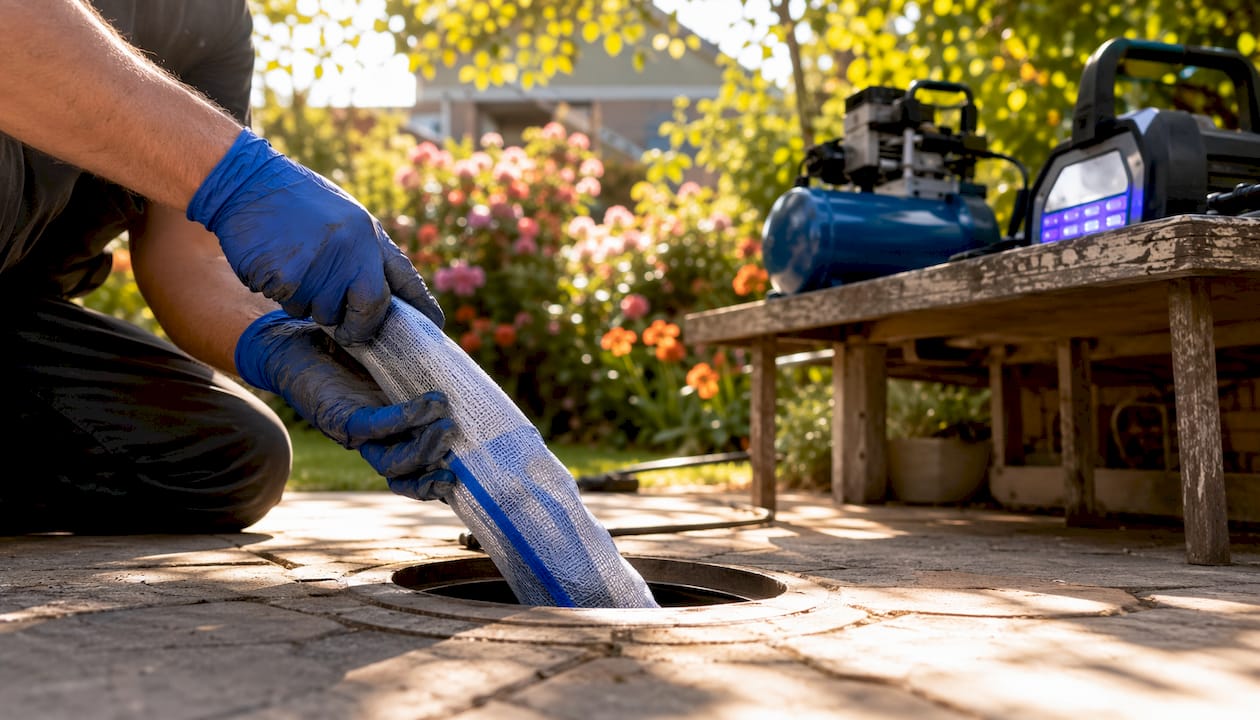
Day 1 (diagnostic): The camera inspection runs the full lateral. You receive footage and a written condition report. The contractor scopes the access points and confirms liner sizing.
Day 2 (or same day for straightforward jobs): Hydro jetting clears the pipe. The liner is measured, cut, and saturated with resin. It is inserted, inflated, and cured, typically within a few hours. A post-cure camera run confirms the liner has bonded correctly and the pipe is flowing.
For most residential laterals, the physical installation completes in a single day. Commercial or municipal runs with longer pipe sections may require a second day for curing and testing.
Trenchlessmaine offers industry-leading warranties up to 50 years on qualifying CIPP lining installations, a standard that reflects both material quality and confidence in the installation process.
Before you sign off on the job, request three documents: the post-cure camera video, written smoke or air test results, and a site restoration report confirming the access points have been backfilled and graded.
Questions to ask a contractor and red flags to watch for
Vetting a trenchless contractor before you sign anything protects you from scope surprises and poor workmanship. Here is what to ask and what to watch for.
Questions every contractor must answer:
- Can you provide the pre-job camera inspection video before quoting?
- What liner and resin specifications will you use, and what is the manufacturer's rated service life?
- What is your curing method (ambient, steam, or UV), and how does it affect cure time?
- What is the expected downtime for the line during installation?
- Does your quote include a site restoration allowance? What does it cover?
- What warranty do you offer, and is it in writing?
Red flags that should stop you from signing:
- No camera inspection offered before quoting
- Warranty described verbally but not provided in writing
- A one-line quote with no itemized scope or materials list
- Pressure to accept the bid without a site visit or inspection
- No proof of licensing, insurance, or permits for your municipality
Pro Tip: Request an "as-built" post-cure camera video and written test results as a condition of final payment. A contractor who objects to this deliverable is telling you something important.
How Trenchlessmaine approaches non-invasive repairs
Trenchlessmaine serves residential, commercial, and municipal clients across Maine, specializing in trenchless sewer repair with over 50 years of combined expertise. The team's core services cover HD camera inspection, CIPP lining, hydro jetting, and drain clearing, all delivered with a documented process and written warranties.
Every job starts with a diagnostic camera run. From that footage, Trenchlessmaine builds an itemized quote that includes the repair scope, liner specifications, and a site restoration allowance so you know exactly what you are paying for before work begins. Where site conditions allow, installation and curing complete in a single day, minimizing disruption to tenants, customers, or daily operations.
The 50-year warranty on qualifying installations is not a marketing claim. It reflects the quality of the liner materials, the precision of the HD-guided installation, and Trenchlessmaine's commitment to documented, testable outcomes. If you want to check whether your Maine address falls within the service area, the service area page has a lookup tool.
Key Takeaways
Non-invasive trenchless repair is the right choice for most Maine property owners when total project cost, property preservation, and downtime are factored in alongside the repair price itself.
| Point | Details |
|---|---|
| Compare total cost, not just repair price | Excavation adds landscaping, concrete, and asphalt restoration costs that rarely appear in the initial quote. |
| Camera inspection is non-negotiable | HD diagnostics determine suitability and scope; no reliable quote exists without one. |
| Most jobs complete in one day | CIPP lining typically cures and returns to service within hours, minimizing tenant and business disruption. |
| Warranties signal quality | Industry-leading warranties up to 50 years reflect liner quality and installation precision. |
| Trenchlessmaine is the local option | Serving Maine with 50+ years of combined expertise, itemized quotes, and post-job documentation. |
The case for doing this right the first time
There is a version of trenchless repair that cuts corners: no camera inspection, generic liner specs, a verbal warranty, and a one-line quote. That version is cheap until it fails, and when it fails, you are looking at excavation anyway, plus the cost of removing a failed liner.
The property owners and managers who get the most value from non-invasive methods are the ones who insist on documented diagnostics, written warranties, and itemized scopes before any work starts. The technology is genuinely good. The process discipline is what separates a 50-year liner from a 5-year problem.
Get a free camera inspection and quote from Trenchlessmaine
If your sewer line is showing signs of trouble, or you simply want to know its condition before a problem forces your hand, a camera inspection is the lowest-risk first step you can take.
Trenchlessmaine provides HD camera inspections, itemized trenchless repair quotes, and same-day or next-day installation across Maine for residential, commercial, and municipal properties. The process is straightforward: schedule an inspection, review the footage and written scope, and decide with full information in hand. No pressure, no vague estimates.
Request a free estimate or check whether your address is in the service area today.
Sources and further reading
Internal resources from Trenchlessmaine:
- Top non-invasive pipe repair methods for Maine homeowners — compares trenchless methods and explains how pipe condition guides method selection.
- CIPP lining installation: step-by-step guide for Maine homes — walks through the full installation sequence from camera run to post-cure testing.
- Trenchless sewer repair: protecting your landscaping in Maine — covers how trenchless methods preserve driveways, lawns, and plantings.
- Explaining minimally invasive sewer repair to homeowners — plain-language overview of trenchless concepts for first-time buyers.
External references:
- Mayo Clinic: Minimally invasive surgery — clinical evidence that minimally invasive techniques reduce recovery time and disruption compared with open procedures.
- Benefits of non-invasive foundation repair — property maintenance perspective on total project cost and avoided restoration expenses.
- Technologies for non-invasive sensing — peer-reviewed analysis of how advances in diagnostics and materials drive non-invasive outcomes.
- Valve repair vs. replacement: how surgeons choose — decision framework for repair vs. full replacement, applicable to infrastructure assessment.