
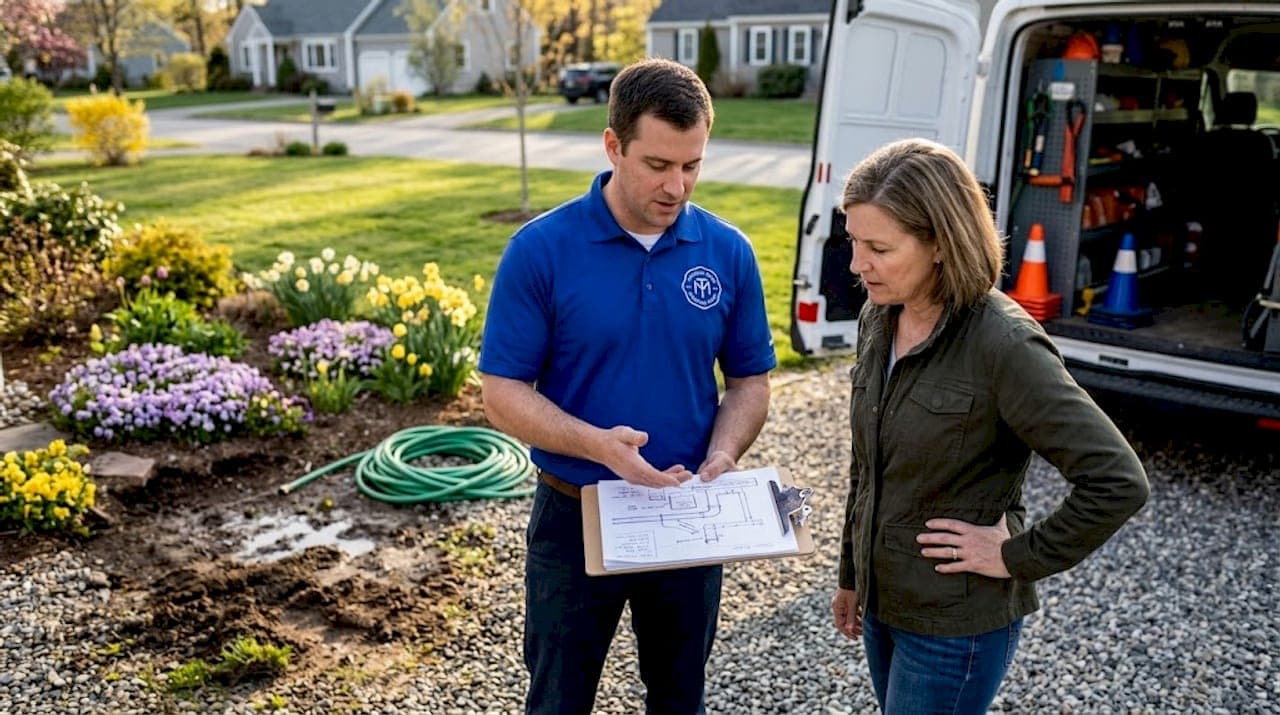
When your sewer line starts causing problems, most homeowners picture the worst: a crew ripping up their yard, destroying their driveway, and leaving behind a trench the size of a small canal. That image is exactly why explaining minimally invasive sewer repair matters. Modern techniques have changed what sewer work actually looks like, and most property owners simply haven't heard the full story yet. This guide breaks down how these methods work, what you can realistically expect, what they cost compared to traditional repairs, and when they make sense for your home.
Table of Contents
- Key takeaways
- Explaining minimally invasive sewer repair: the two main methods
- Benefits and real limitations of trenchless repair
- What the repair process actually looks like
- Trenchless vs. traditional repair: a direct comparison
- How to decide if trenchless repair is right for you
- My take on what homeowners get wrong
- See how Trenchlessmaine handles it for Maine homeowners
- FAQ
Key takeaways
| Point | Details |
|---|---|
| Trenchless methods protect your property | CIPP lining and pipe bursting require only small access pits, not full yard excavation. |
| Repairs finish far faster | Most minimally invasive sewer repairs complete in 1 to 2 days, compared to potentially weeks of traditional digging. |
| Camera inspection comes first | A professional sewer scope is always the starting point, determining which repair method fits your pipe's condition. |
| Not every pipe qualifies | Severely collapsed pipes, major misalignment, or significant bellying may still require some excavation. |
| Cost savings are real but indirect | The biggest financial benefit comes from avoiding thousands in landscaping, driveway, and hardscaping restoration. |
Explaining minimally invasive sewer repair: the two main methods
The phrase "minimally invasive" covers two distinct techniques used in modern sewer work: cured-in-place pipe (CIPP) lining and pipe bursting. Both skip the full trench, but they solve different problems and work in different conditions.
CIPP lining is the most widely used method. A resin-saturated felt liner is inserted into your existing damaged pipe through a small access point. The liner is then inflated against the pipe walls and cured, either with heat or UV light, creating a hard, jointless new pipe inside the old one. CIPP lining creates a permanent, seamless liner that blocks root intrusion and adds structural strength to the existing host pipe. It works well for:
- Pipes with cracks, fractures, or minor root intrusion
- Aging clay, cast iron, or Orangeburg pipes that still hold their shape
- Pipe sizes ranging from 40mm to 225mm in diameter, covering most residential sewer laterals
Pipe bursting takes a different approach. A hydraulic bursting head is pulled through the damaged pipe, fracturing the old pipe outward into the surrounding soil while simultaneously pulling a new high-density polyethylene (HDPE) pipe into place behind it. Pipe bursting replaces severely damaged pipes without requiring a full open trench. It's preferred when pipes are too deteriorated for lining or when upsizing the pipe diameter makes sense.
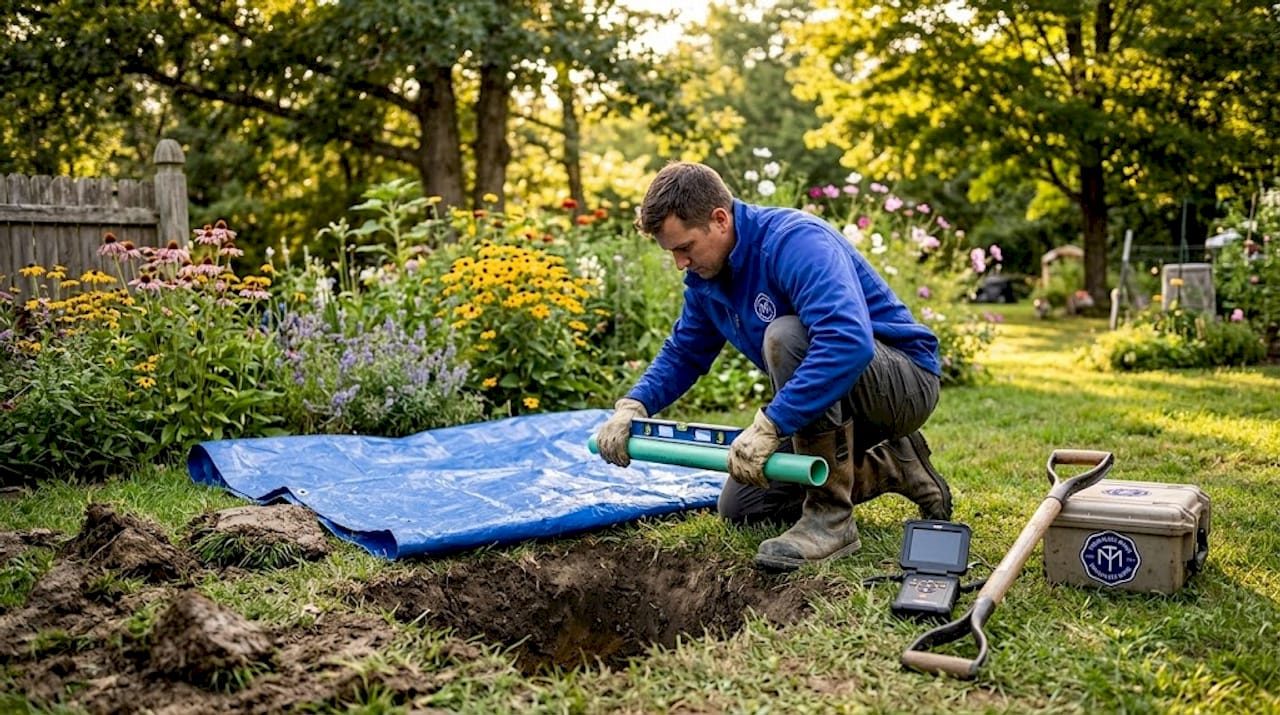
Both methods require at least one or two small access pits, typically around four feet in size, at each end of the repair zone. The term "no-dig" is a bit misleading. Trenchless repair requires small access pits, not zero ground disturbance. But that's a far cry from an open trench running 40 feet across your front yard.
Benefits and real limitations of trenchless repair
Understanding what trenchless methods genuinely offer, and where they fall short, helps you have a productive conversation with any plumber.
What you actually gain
Trenchless methods preserve driveways, patios, sidewalks, and mature trees by eliminating the need to excavate along the pipe's entire length. For homeowners in Maine, where mature landscaping and established hardscaping represent years of investment, that protection translates directly into savings. You won't need to reseed a lawn, replant garden beds, or repave a driveway after the job is done.
Speed is another concrete advantage. Traditional excavation projects can stretch across days or weeks depending on access and pipe depth. Most trenchless repairs wrap up in a single day. That means less time without usable plumbing and less disruption to your daily routine.
The financial picture is worth examining carefully. Trenchless repair sometimes costs more per linear foot than a comparable open-trench repair. But avoiding demolition and restoration is where the real savings appear. Driveway replacement, lawn restoration, and hardscaping repairs easily add thousands of dollars to a traditional job's total bill. When you factor in those hidden costs, trenchless often comes out ahead.
Pro Tip: Ask your contractor to give you a total project cost that includes all post-repair restoration. This makes the comparison between trenchless and traditional repair genuinely apples to apples.
Where trenchless methods hit their limits
| Situation | Trenchless Viable? | Notes |
|---|---|---|
| Cracks and fractures in intact pipe | Yes | CIPP lining is the standard solution |
| Root intrusion without collapse | Yes | Liner seals roots and strengthens pipe |
| Severely collapsed pipe sections | No | Pipe shape too distorted for liner insertion |
| Bellied or misaligned pipe | Usually no | Sags and misalignments may require excavation |
| Pipe requiring upsizing | Yes (pipe bursting) | New HDPE pipe can be larger than original |
| Pipe with active sewage flooding | Conditional | Cleaning and drying required first |
The key takeaway from this table: trenchless repair is not a universal fix. A professional camera inspection is what separates a good recommendation from a guess.
What the repair process actually looks like
One of the biggest sources of anxiety for homeowners is simply not knowing what to expect on the day of service. Here's a realistic step-by-step picture of how a typical CIPP lining job unfolds.
-
Sewer camera inspection. A technician feeds a high-definition camera through your sewer line. CCTV inspection guides method choice and confirms which sections of pipe are damaged, what type of damage exists, and whether CIPP lining is viable. This step is non-negotiable and takes roughly 30 to 60 minutes.
-
Hydro jetting. Before any liner goes in, the pipe walls need to be thoroughly cleaned. Hydro jetting uses high-pressure water to strip grease, scale, and debris from the interior surface. A clean pipe wall is critical because the resin liner bonds to the host pipe during curing. Rough or contaminated walls lead to poor adhesion and early liner failure.
-
Liner preparation and insertion. The felt liner is saturated with epoxy or polyester resin at the job site or in a controlled environment, then inserted into the pipe through an access point. At residential scale, this access point is often an existing cleanout or a small excavated pit.
-
Inflation and curing. An air bladder inflates the liner against the pipe walls, pressing it firmly into every curve and joint. Depending on the curing method used, heat steam or UV light travels through the liner to harden the resin. This phase typically takes two to four hours.
-
Post-cure camera inspection. Once the liner has cured, the camera goes back in to confirm full contact with the pipe walls, check that no gaps or wrinkles exist, and verify that water flow is unobstructed. This sign-off inspection is your documentation that the job was done correctly.
-
Site cleanup. Access pits are filled and compacted. Any surface disruption at the pit locations is addressed. The total timeline from arrival to departure for a standard residential job is typically six to eight hours.
Trenchless vs. traditional repair: a direct comparison
For homeowners weighing their options, side-by-side context is more useful than general claims about one method being "better."
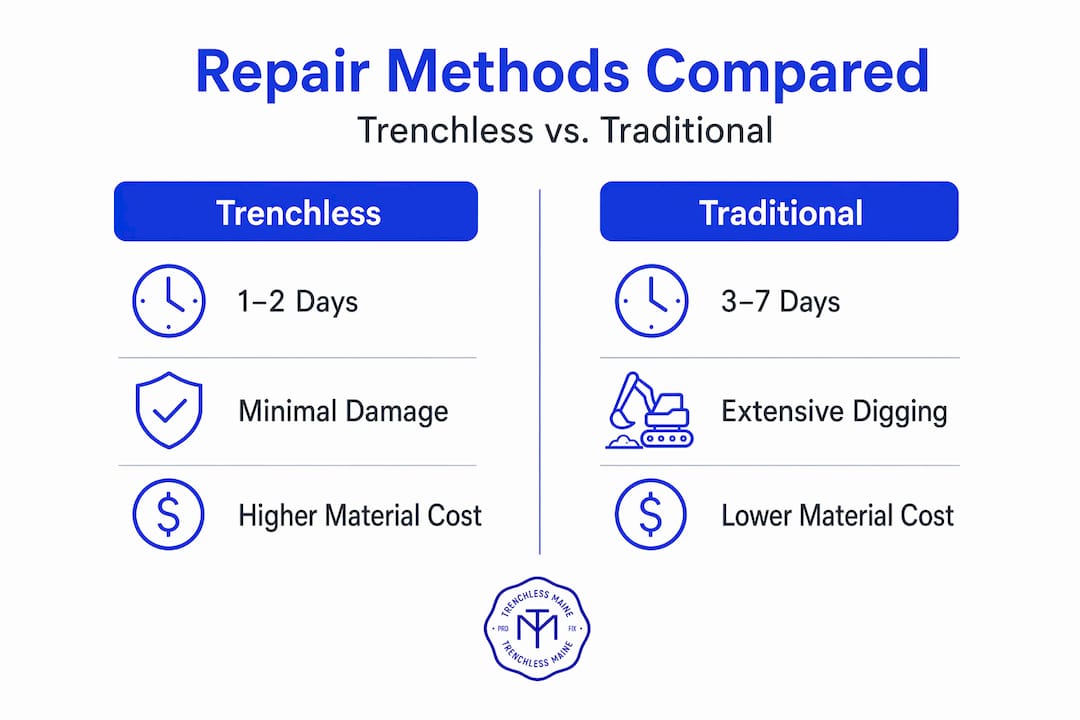
| Factor | Trenchless repair | Traditional open-trench |
|---|---|---|
| Project timeline | 1 to 2 days | Several days to weeks |
| Property disruption | Minimal: 1 to 2 small pits | Significant: full-length trench |
| Landscaping impact | Low | High: lawn, plants, hardscaping affected |
| Post-repair restoration needed | Minor pit fill only | Full surface restoration required |
| Pipe lifespan after repair | 50 years with quality CIPP | Depends on new pipe material |
| Environmental soil disturbance | Minimal | Significant |
| Upfront cost per linear foot | Moderate to higher | Lower per foot |
| Total project cost (with restoration) | Often lower overall | Often higher when restoration included |
The trenchless vs. excavation cost breakdown consistently shows that the restoration costs tied to traditional excavation push the total price well above what most homeowners expect when they get an initial trench repair estimate.
One factor that rarely comes up in contractor conversations is property value. A yard that has been trenched and restored never quite looks the same in the short term. For homeowners planning to sell, the visible disruption and recovery time have real implications for curb appeal.
How to decide if trenchless repair is right for you
You don't need to diagnose your own sewer line to make an informed decision. But knowing what questions to ask puts you in a much stronger position.
- Start with a camera inspection. Robotic and camera-based inspections have become the standard for identifying pipe damage type and severity before any repair work begins. This step prevents misdiagnosis and wasted money.
- Ask about your pipe material. Clay and Orangeburg pipes are excellent CIPP candidates. Cast iron often qualifies too. PVC pipes that have shifted or separated may be better candidates for pipe bursting or spot repair.
- Consider your property layout. If your sewer line runs under a driveway, mature trees, or a finished patio, the cost of protecting those features with trenchless methods becomes even more compelling.
- Request a warranty in writing. Quality trenchless repairs backed by reputable contractors carry warranties of 25 to 50 years. A contractor unwilling to offer a written warranty is a red flag.
- Ask specifically whether the full pipe section qualifies or just part of it. Some lines have one section suitable for lining and another that requires spot excavation. A transparent contractor tells you both.
The non-invasive sewer repair process works best when homeowners come to the conversation already understanding what questions matter most.
My take on what homeowners get wrong
I've seen the same pattern play out more times than I can count. A homeowner gets a quote for traditional trench repair, winces at the number, then discovers trenchless options online and assumes trenchless will always be cheaper up front. It isn't always. What trenchless saves you is the back end of the job: the driveway, the lawn, the landscaping, the disruption to your week.
The homeowners who make the best decisions are the ones who ask for the total cost, not just the repair cost. I've watched people choose traditional excavation because the quoted line item was $800 less, then spend $3,500 replacing a concrete section of driveway they didn't factor in. That math rarely works out in their favor.
The other misconception I hear regularly is that trenchless is a patch job. It isn't. A properly installed CIPP liner is a permanent structural solution. The resin creates a new pipe inside your old one, and the jointless design means tree roots have nowhere to re-enter. When the work is done right and the pipe qualifies, you're not buying time. You're buying decades.
My honest advice: don't let the word "trenchless" become a checkbox. Ask your contractor to show you the pre-repair camera footage and walk you through why they're recommending the method they're recommending. That conversation tells you a lot about who you're working with.
— John
See how Trenchlessmaine handles it for Maine homeowners
If you're dealing with a slow drain, a gurgling sewer, or a line that's been giving you trouble for a while, the right first step is a professional camera inspection, not a guess. Trenchlessmaine brings over 50 years of combined expertise to every job, using CIPP lining, hydro jetting, and pipe bursting to fix sewer problems across Maine with minimal disruption to your property.

Trenchlessmaine's sewer repair technology covers the full range of non-destructive solutions, and the team walks you through every option before any work begins. You can explore the full list of trenchless sewer services or schedule a sewer camera inspection to get a clear picture of your pipe's condition. Real results are worth more than descriptions. Take a look at the completed project gallery to see what minimally invasive repair looks like before and after.
FAQ
What does minimally invasive sewer repair mean?
Minimally invasive sewer repair refers to techniques like CIPP lining and pipe bursting that fix damaged sewer pipes without excavating a full-length trench. Work is completed through small access pits, preserving your yard, driveway, and landscaping.
How long does a trenchless sewer repair take?
Most trenchless sewer repairs complete in one to two days, compared to traditional excavation that can take several days or even weeks depending on pipe depth and length.
Can all sewer pipes be repaired with trenchless methods?
No. Pipes that are severely collapsed, significantly misaligned, or have major bellying may not qualify for trenchless repair. A professional camera inspection determines whether your pipe is a good candidate.
Is CIPP lining a permanent fix or a temporary patch?
CIPP lining is considered a permanent structural solution by industry professionals. The jointless, resin-hardened liner seals roots out and strengthens the host pipe, with quality installations backed by warranties up to 50 years.
What is the cost difference between trenchless and traditional sewer repair?
Trenchless repair may cost more per linear foot, but avoiding demolition and restoration costs typically makes the total project cost competitive or lower than traditional excavation when driveway, lawn, and hardscaping replacement are factored in.