

Facing a sewer problem in Maine is stressful enough without the added fear of watching your yard get torn apart. Traditional excavation repairs mean heavy equipment, destroyed landscaping, and weeks of disruption to your daily life. That's a lot to absorb, especially when you're already dealing with slow drains or sewage backups. Fortunately, non-invasive sewer repair technology has advanced significantly, and Maine homeowners now have real options that protect both their property and their budget. This article walks you through how to evaluate those options, what methods are available, how they compare side by side, and which solution fits your specific situation.
Table of Contents
- How to evaluate sewer repair options
- Overview of top non-invasive sewer repair methods
- Comparison table: Methods, costs, and fit for Maine homes
- Recommendations for common Maine homeowner scenarios
- A hard-won lesson: Why Maine homeowners shouldn't skip a camera inspection
- Next steps: Find reliable trenchless sewer repair in Maine
- Frequently asked questions
Key Takeaways
| Point | Details |
|---|---|
| Permit always required | All sewer repairs in Maine—including trenchless methods—need a permit from your local authority. |
| Assessment is critical | A professional camera and soil inspection is essential for picking the best non-invasive method. |
| Know each method’s limits | CIPP and pipe bursting work well, but not for collapsed or back-pitched pipes or very rocky soils. |
| Match to your property | The right repair depends on your soil type, existing landscaping, and pipe condition. |
How to evaluate sewer repair options
Choosing a sewer repair method isn't as simple as picking the newest technology. The right choice depends on several factors specific to your property, your pipes, and Maine's unique environment. Getting this wrong can mean paying twice, or worse, applying a repair method that fails within a few years.
Key factors to consider before choosing a repair method:
-
Property disruption tolerance. How much impact can your property absorb? If you have a mature garden, a paved driveway over your sewer line, or a finished basement near access points, minimizing surface disruption matters significantly. Trenchless methods generally require only one or two small access points, compared to open-cut excavation that can displace entire sections of your yard.
-
Pipe material and condition. Maine homes built before the 1970s often have clay or cast-iron pipes that are prone to root intrusion and joint failure. Pipes built in the 1980s and 1990s may use older PVC or Orangeburg (a fiber conduit material that deteriorates badly over time). The current condition of your pipe, including any collapse, misalignment, or deformation, directly determines which methods are viable.
-
Soil conditions. Maine's terrain includes rocky coastal areas, dense clay soils in the southern interior, and sandy or loamy soils near rivers. Rocky ground can make pipe bursting (a method described below) risky or impractical. Saturated soils near the coast can affect curing times for lining materials.
-
Maine permitting requirements. Many homeowners are surprised to learn that non-invasive repairs still require permits. According to Brunswick Sewer District specifications, permits are required for all sewer repairs, including trenchless methods, though routine maintenance has no permit fee. Skipping this step can create problems when you sell your home or if inspections are required later.
-
Who you hire. A contractor experienced only in traditional excavation may push that method regardless of whether it's the right fit. Always work with a specialist who has direct experience in Maine soil and pipe conditions.
One of the most common mistakes homeowners make is choosing a repair method based on cost alone, without accounting for soil conditions or pipe damage severity. A less expensive method that isn't suited to your pipe's condition can fail quickly, costing far more in the long run.
Following spring sewer maintenance tips specific to Maine is a good starting point for understanding how seasonal factors affect your sewer line's condition before you pursue any repair.
Pro Tip: Before committing to any repair method, request a camera inspection and onsite soil assessment from a local specialist. A qualified contractor should never recommend a specific method without seeing the inside of your pipe first.
Overview of top non-invasive sewer repair methods
Once you understand the evaluation criteria, it's time to look at the actual methods available to Maine homeowners. Three options stand out as the most widely used non-invasive approaches: CIPP lining, pipe bursting, and hydro jetting.
CIPP lining (cured-in-place pipe lining)
CIPP lining involves inserting a resin-saturated liner into your existing pipe and then curing it in place, usually with hot water, steam, or UV light. The result is a smooth, jointless pipe within your old pipe. Think of it as creating a new pipe inside the shell of the old one, without digging anything up.
Best for:
- Cracked, corroded, or root-intruded pipes that still maintain their basic shape
- Properties with landscaping, driveways, or structures above the sewer line
- Pipes between 4 and 36 inches in diameter
- Situations where the original pipe alignment and slope are still correct
Limitations to be aware of: CIPP is not appropriate for pipes that are fully collapsed (with more than 25 to 50 percent wall loss), severely misaligned, or back-pitched (meaning the pipe slopes the wrong direction, causing drainage problems). If your pipe has any of these issues, CIPP will not fix them and may actually lock problems into place.
Pipe bursting
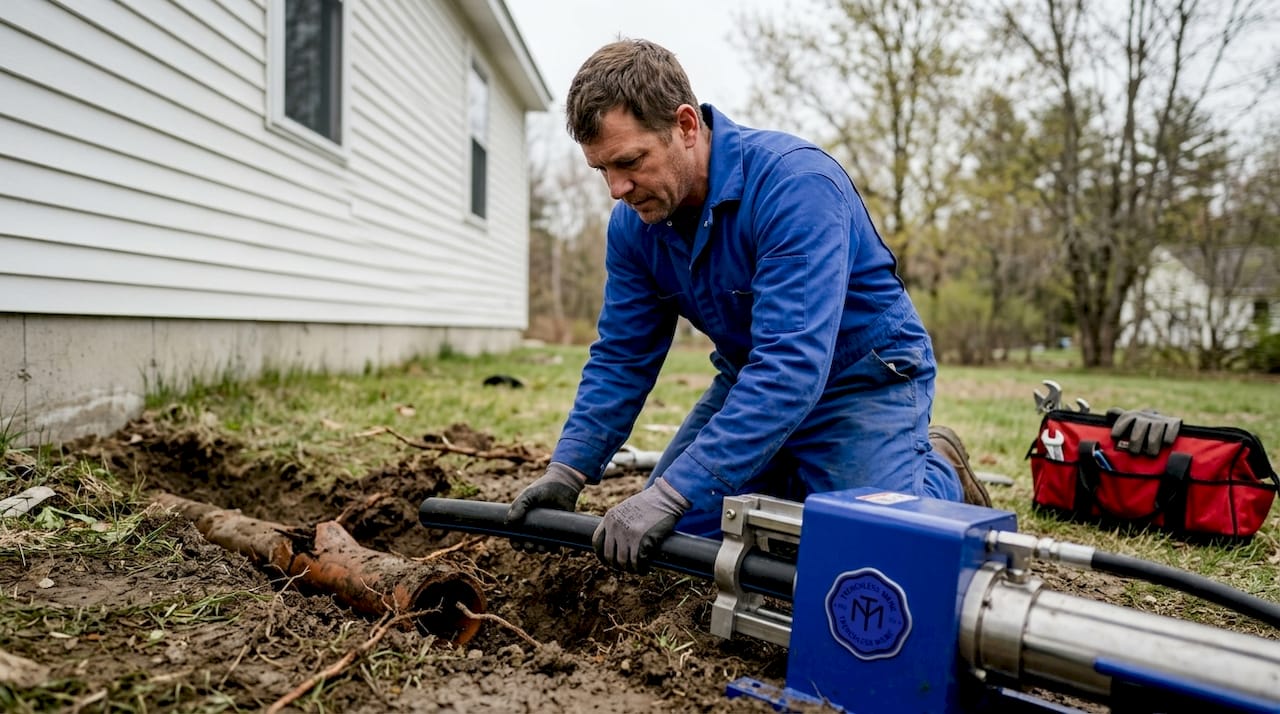
Pipe bursting is a method where a bursting head is pulled through the existing pipe, shattering it outward while simultaneously pulling a new pipe into place. It replaces, rather than repairs, the old pipe.
Best for:
- Pipes that are too deteriorated for lining
- Situations where you want to upgrade pipe size at the same time
- Properties where the soil allows the old pipe to fragment outward without damaging surrounding infrastructure
Limitations: Pipe bursting is unsuitable for rocky soil (common in many parts of Maine), cases with large root intrusion around the pipe exterior, or situations where slope correction is needed. In rocky ground, there's simply nowhere for the shattered pipe material to go, which can create new blockages.
Hydro jetting
Hydro jetting uses high-pressure water (typically 3,000 to 4,000 PSI) to blast through blockages, remove grease buildup, and clear root intrusion from inside the pipe. It's primarily a cleaning and preparation technique, not a structural repair. However, it's often used before lining or as a standalone maintenance solution when the pipe itself is structurally sound.
Best for:
- Clearing persistent or recurring blockages
- Preparing a pipe before CIPP lining
- Maintaining older pipes on a scheduled basis
Understanding the differences between septic vs. sewer systems in Maine is also worth reviewing, since the repair method landscape differs considerably between the two, and some homeowners aren't certain which system they have.
Our detailed hydro jetting guide covers the full process, typical costs, and when hydro jetting alone is sufficient versus when it needs to precede a lining or bursting job.
Pro Tip: In many Maine cases, the best outcome comes from combining methods. For example, hydro jet the line first to clear debris and roots, then run a camera inspection to assess the pipe's condition, and finally apply CIPP lining to seal cracks and prevent regrowth. This staged approach consistently produces longer-lasting results than any single method used in isolation.
Comparison table: Methods, costs, and fit for Maine homes
Here's a side-by-side comparison to help you quickly identify which method aligns with your property and situation.
| Feature | CIPP lining | Pipe bursting | Hydro jetting |
|---|---|---|---|
| Invasiveness | Very low (1-2 access points) | Low (entry and exit pits) | Minimal (single access point) |
| Typical cost range | $80 to $250 per linear foot | $60 to $200 per linear foot | $300 to $1,500 per session |
| Project duration | 4 to 24 hours | 4 to 8 hours | 1 to 3 hours |
| Structural repair? | Yes | Yes (full replacement) | No (cleaning only) |
| Works in rocky soil? | Yes | No | Yes |
| Works with collapsed pipe? | No | Yes (if accessible) | No |
| Slope correction possible? | No | No | No |
| Permit required in Maine? | Yes | Yes | Not typically |
| Typical warranty | 10 to 50 years | 10 to 25 years | N/A |
This table is a starting point, not a final answer. Your specific pipe diameter, depth, access, and soil conditions will all affect which option is truly viable. Keep in mind that permits are required for all sewer repairs, including trenchless methods in Maine, though routine cleaning and maintenance work typically does not require permitting.
If you're still sorting out the basics of your system, reviewing resources on how to compare septic and sewer systems can clarify what type of infrastructure you're dealing with before you request quotes.
Important callout: The cost ranges above assume standard residential sewer laterals (meaning the pipe connecting your home to the municipal main). Commercial or deeper pipes, or those requiring specialized equipment, can fall outside these ranges. Always get at least two quotes that include a camera inspection as part of the assessment process.
Recommendations for common Maine homeowner scenarios
Real decisions happen in real properties. Here are the most common situations Maine homeowners face and the repair approaches that fit each one best.
Scenario 1: Older home with mature trees nearby Root intrusion is one of the most frequent causes of sewer problems in older Maine neighborhoods. Tree roots follow moisture and naturally seek out small pipe cracks or joint gaps.
- Best approach: Hydro jet first to clear existing roots, then apply CIPP lining to seal cracks permanently and prevent regrowth
- Avoid: Pipe bursting, since large root masses around the pipe exterior can interfere with the bursting head
Scenario 2: Home in a rocky coastal or inland Maine area Rocky soil is a real constraint. Pipe bursting, which requires the old pipe material to displace outward into surrounding soil, simply doesn't work well when there's no soft soil to absorb the debris.
- Best approach: CIPP lining, which doesn't require the surrounding soil to shift at all
- Avoid: Pipe bursting in areas with significant ledge or dense rock near the pipe
Scenario 3: Winter frost and frozen ground Maine winters are severe, and ground frost can penetrate several feet deep. Trying to schedule a repair during deep freeze is rarely practical.
- Best approach: Address issues in fall before ground freezes, or wait for spring thaw. Knowing how to deal with winter sewer issues can help you manage the situation until conditions allow proper repair.
- Note: Some CIPP lining can proceed in cold weather with the right equipment, but curing times extend and quality control becomes harder.
Scenario 4: Shared or older municipal sewer grid in downtown areas Older Portland, Bangor, or Lewiston neighborhoods often have aging shared lines and complex grid connections.
- Best approach: Full camera inspection first to map junctions, then targeted CIPP spot repairs or full-line lining depending on findings
- Important: Confirm with your municipality which portion of the line is your responsibility before committing to repairs
Scenario 5: Pipe with significant deformation but not full collapse If your pipe has lost shape but retains enough structural integrity for a liner to bond properly, CIPP is still viable.
- Best approach: Camera inspection to confirm wall loss percentage, then CIPP lining if under the 25 to 50 percent wall loss threshold
Steps to confirm eligibility for non-invasive repairs:
- Schedule a professional sewer camera inspection to document pipe condition throughout the full length of the lateral.
- Request a written assessment identifying pipe material, diameter, slope, any misalignment, and percentage of wall loss.
- Confirm soil conditions with your contractor, especially if you live in a rocky or high-water-table area.
- Check permitting requirements with your local municipality before work begins.
- Review at least two proposals from licensed contractors who have specific Maine experience.
Pro Tip: Always ask contractors directly whether they have experience with Maine's soil and seasonal conditions. A contractor who primarily operates in southern New England may not account for Maine's frost depth, coastal soil types, or local permitting requirements when recommending a method through local trenchless repair services.
A hard-won lesson: Why Maine homeowners shouldn't skip a camera inspection
Here's something most articles won't tell you directly: the method matters far less than the assessment that precedes it. We've seen too many cases where a homeowner chose CIPP lining based on a neighbor's recommendation, only to discover the pipe had a back-pitch issue that lining simply cannot fix. The liner went in, the pipe looked repaired on paper, and the drainage problem came right back within months.
The real risk isn't choosing the wrong method because it's expensive. The risk is that a failed repair delays finding the actual problem until it becomes a more serious and more costly one. A proper camera inspection reveals collapsed sections, misalignment, slope problems, and root penetration patterns that no surface assessment can detect.
"Only a camera inspection gives you the ground truth about what's inside your pipe. Everything else is a guess."
Understanding your insurance for sewer repairs is also critical before any work begins. Some policies cover certain repair types or conditions, and knowing this in advance can meaningfully affect which method you choose and how you budget for it.
The lesson is simple: insist on a camera inspection and soil condition review before any contractor recommends a specific repair method. If they're recommending a method before they've seen the pipe, that's a serious red flag.
Next steps: Find reliable trenchless sewer repair in Maine
You now have a solid framework for understanding, comparing, and selecting the right non-invasive sewer repair method for your Maine home. The next step is connecting with specialists who actually know Maine's conditions and can put this into practice for your property.

Trenchless Maine's sewer repair specialists serve homeowners throughout the state and bring over 50 years of combined expertise to every project. Before you commit to any repair, take a look at our no-dig technology details to understand exactly how each method works and what you can expect. You can also browse our before and after results to see real completed projects from Maine properties similar to yours. Request a free quote today and get a proper assessment from a team that knows Maine's soil, climate, and permitting requirements inside and out.
Frequently asked questions
Is a permit required for trenchless sewer repair in Maine?
Yes, a permit is required for all sewer repairs in Maine, including trenchless methods. According to Brunswick Sewer District specifications, only routine maintenance work is exempt from permitting fees.
What makes a pipe ineligible for CIPP trenchless repair?
Pipes that are fully collapsed, severely misaligned, or back-pitched cannot be repaired with CIPP lining, as the liner requires a structurally intact pipe shape to bond correctly and function properly.
How do I know which sewer repair method is best for my Maine home?
A professional camera inspection and onsite evaluation are the only reliable ways to match the right repair method to your specific pipe condition, soil type, and property layout. No contractor should recommend a method without this step.
Are trenchless repairs available across all of Maine?
Yes, trenchless sewer repairs are available throughout Maine. Companies including NETR Inc., Northeast Sewer & Drain in Gorham, and Portland ME Plumbing offer these services. Coverage extends across southern Maine to northern regions, and you can check service availability for your specific address before scheduling.