
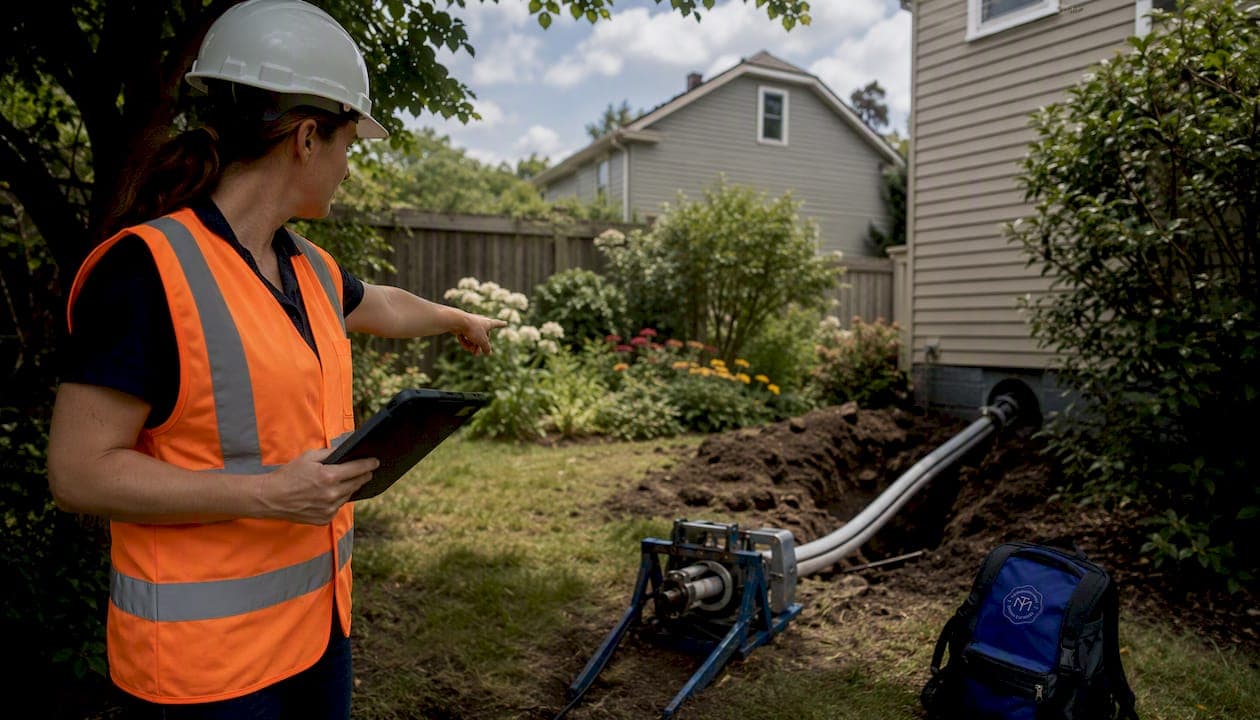
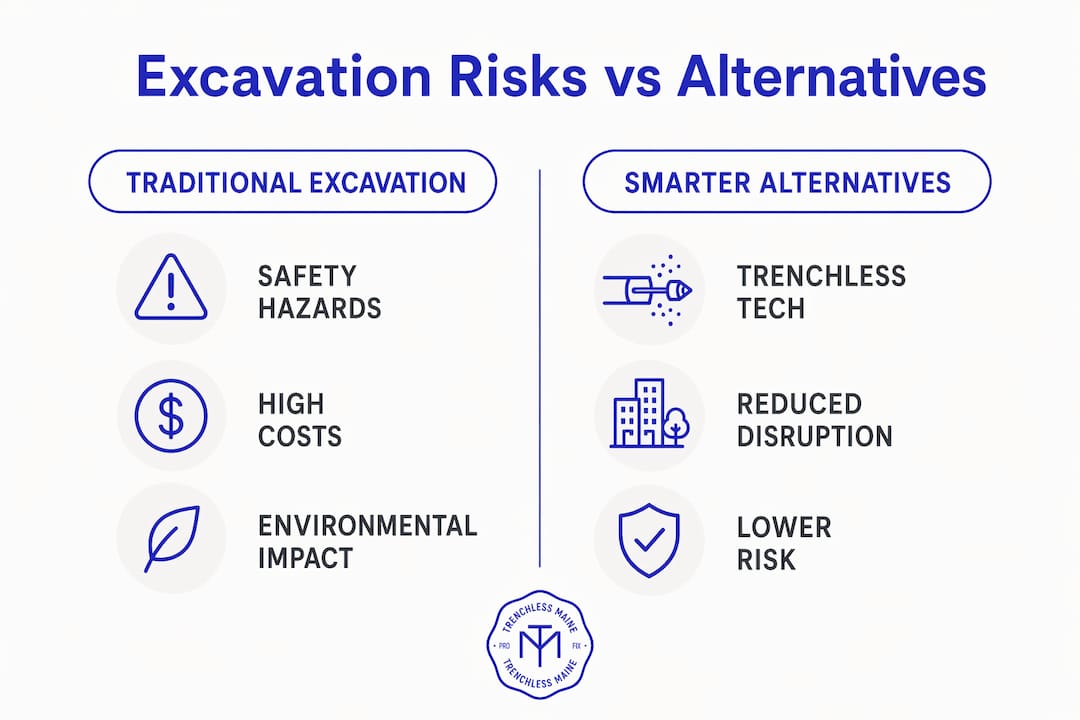
For most utility and sewer repair projects on developed property, traditional mechanical excavation is the wrong first choice. Cave-in fatalities, accidental utility strikes, torn-up landscaping, and restoration costs that dwarf the original repair price all make the case for looking at alternatives before you pick up a shovel or call a backhoe.
Here is the short version:
- Worker safety: Trench collapses are a leading cause of excavation fatalities; a cubic meter of soil can weigh more than 1.5 tons.
- Utility strikes: Mechanical buckets cannot distinguish a gas line from clay soil.
- Property destruction: Driveways, sidewalks, and mature landscaping are collateral damage, not incidentals.
- Hidden costs: Restoration, delays, and liability routinely push the true total above the upfront equipment rate.
- Environmental harm: Open trenches generate erosion, sediment runoff, and site flooding when unmanaged.
Safer alternatives exist for most residential and commercial sewer work: Cured-in-Place Pipe (CIPP) lining, pipe bursting, slip lining, hydro (vacuum) excavation, and horizontal directional drilling (HDD) each address specific scenarios without tearing your property apart.
Table of Contents
- What does traditional excavation actually involve?
- Why traditional excavation creates serious risks you may not expect
- What non-destructive alternatives should you consider?
- When is traditional excavation still the right call?
- How do you choose between excavation and a non-destructive method?
- What should you do if traditional excavation is unavoidable?
- How Trenchlessmaine's experience shows the difference in practice
- Key Takeaways
- The industry shift that property owners are still catching up to
- Trenchlessmaine can handle your sewer repair without the excavation
- Useful sources and standards
What does traditional excavation actually involve?
Traditional excavation means using mechanical force to remove soil: backhoes, trenchers, excavators, and hand-digging for tight spots. On a typical small-to-medium sewer repair, the sequence runs like this:
- Utility locate (call 811, mark lines)
- Mechanical dig to expose the pipe
- Repair or replace the damaged section
- Backfill in compacted lifts
- Surface restoration (grade, seed, repave, replant)
Mechanical methods genuinely excel at large-volume earthmoving, rock removal, and new construction on open, utility-free sites. The problem is precision. A backhoe bucket is 24–48 inches wide; a gas line or fiber-optic conduit is a fraction of that. On any developed lot, that gap is where damage happens.
OSHA's 29 CFR 1926 Subpart P governs all trenching and excavation work in the United States and sets the baseline safety requirements referenced throughout this article.
| Step | What happens | Where risk enters |
|---|---|---|
| Utility locate | Lines marked by 811 | Marks are approximate; private lines often unmarked |
| Mechanical dig | Backhoe removes soil | Bucket can strike utilities; trench walls can collapse |
| Open trench | Pipe exposed for repair | Workers in trench; weather degrades walls |
| Backfill | Soil replaced in lifts | Improper compaction causes settlement |
| Surface restore | Paving, grading, planting | Adds days to weeks and significant cost |
Why traditional excavation creates serious risks you may not expect
Worker safety: cave-ins kill
OSHA identifies cave-ins as the primary cause of excavation-related fatalities. Soil is deceptively heavy, and even a shallow, unprotected trench can collapse without warning. A buried worker faces suffocation before a rescue team can reach them. The "zone of influence" compounds the danger: spoil piles or equipment placed too close to a trench edge add load to already-stressed walls, triggering collapses that a properly shored trench would have prevented.
Statistic callout: According to OSHA, workers in unprotected trenches five feet or deeper are at serious risk of being crushed by a cave-in. Soil weight alone makes even a partial collapse potentially fatal.
Utility strikes: the most expensive mistake on a developed lot
A mechanical bucket cannot feel the difference between compacted clay and a 4-inch gas main. When it hits one, the consequences cascade: service outages, emergency repair crews, potential fire or explosion, and liability that falls squarely on the contractor and property owner. Private utility lines (irrigation, low-voltage lighting, secondary electric) are rarely marked by 811 and are struck far more often than public mains.
Property and landscape destruction
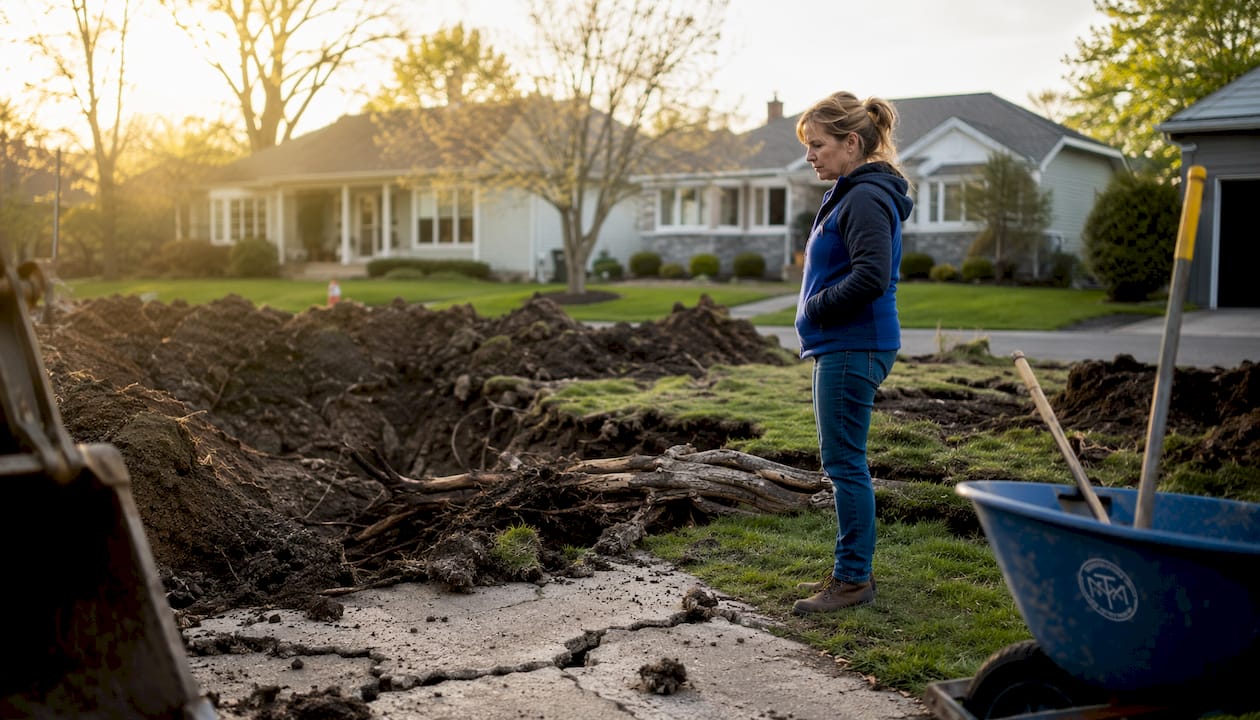
Mechanical excavation does not just open a trench. It compacts surrounding soil, severs tree roots, cracks driveways, and disrupts irrigation systems. Restoring a 40-foot trench through a mature lawn in Maine can mean regrading, reseeding, and waiting a full growing season for results. Hardscape restoration (concrete, asphalt, pavers) adds cost on top of that. The trenchless vs. excavation cost breakdown for Maine projects shows restoration regularly adds thousands of dollars to what looked like a straightforward repair.
Environmental impacts: erosion, runoff, and disturbed soil
Excavation causes soil erosion, silty stormwater runoff, site flooding, and soil contamination when not actively managed. An open trench after a Maine rainstorm is a sediment delivery system straight to the nearest storm drain. Heavy diesel-powered equipment also generates noise, dust, and greenhouse gas emissions that non-destructive alternatives reduce significantly.
Hidden costs: the real price of digging
The hourly rate for an excavator looks reasonable until you add restoration, project delays, utility strike repairs, and liability exposure. Industry analysis confirms that while non-destructive equipment costs more upfront, it typically reduces labor, downtime, and remediation costs on utility-dense projects. Contractors who have made the comparison often describe CIPP lining as an insurance policy against the cascading costs of full-site restoration.
Pro Tip: Before accepting any excavation quote, ask for a line-item breakdown that includes surface restoration, utility protection, and a contingency for utility strikes. If those items are absent, the quote is incomplete.
What non-destructive alternatives should you consider?
Method cards at a glance
Cured-in-Place Pipe (CIPP): A resin-saturated liner is inserted into the existing pipe and cured in place, creating a new pipe within the old one. No digging required for most residential sewer laterals. Learn more about the pipe lining process and how it works step by step.
Slip lining: A smaller-diameter pipe is inserted inside the existing host pipe and grouted in place. Simpler than CIPP but reduces flow capacity slightly.
Pipe bursting: A bursting head fractures the old pipe outward while simultaneously pulling a new pipe into position. Requires access pits at each end and works best when the host pipe is structurally compromised.
Hydro (vacuum) excavation: Pressurized water breaks up soil and a vacuum system removes it as slurry. Safe to use within inches of live utilities. Ideal for exposing pipes before repair and for potholing to verify utility locations.
Air (vacuum) excavation: Compressed air loosens soil without damaging buried infrastructure; a vacuum collects the material. Particularly precise in congested urban sites or industrial areas with complex subsurface networks.
Horizontal directional drilling (HDD): A steerable drill head bores a path underground, then pulls a new pipe or conduit through. Used for new installations under roads, rivers, and landscaped areas without surface disruption.
Pro Tip: For residential sewer laterals in Maine, CIPP is usually the fastest path. Many lining projects finish in as little as 24 hours with minimal yard disturbance, compared to days or weeks for mechanical excavation and restoration.
Comparison: how these methods stack up
| Method | Disruption to property | Utility strike risk | Worker safety | Typical timeline | Relative cost (equipment + restoration) | Best suitability |
|---|---|---|---|---|---|---|
| Traditional excavation | High (full trench) | High | High (cave-in, strike) | Days to weeks | High when restoration included | Open sites, large earthmoving |
| CIPP lining | Very low | Very low | Low | 1–2 days | Low to moderate | Residential/commercial sewer laterals |
| Slip lining | Low | Low | Low | 1–3 days | Low | Gravity sewers, moderate damage |
| Pipe bursting | Low (access pits only) | Low | Low | 1–2 days | Moderate | Structurally failed pipes |
| Hydro excavation | Low | Very low | Low | Hours to 1 day | Moderate upfront, low total | Utility-dense, congested sites |
| Air excavation | Very low | Very low | Low | Hours | Moderate | Precision utility exposure |
| HDD | Very low | Low | Low | 1–3 days | Moderate to high | New installations under obstacles |
Caveats worth knowing: CIPP does not correct pipe alignment or grade issues. Pipe bursting requires access pits and a pipe condition assessment beforehand. HDD costs rise sharply in rock. Hydro excavation reduces utility strike risk and environmental disruption substantially, but the equipment mobilization cost is higher than a simple hand-dig.
When is traditional excavation still the right call?
Mechanical excavation is not always wrong. There are clear situations where it remains the practical or only option:
- Large-scale earthmoving: New construction, grading, and site preparation with no buried infrastructure.
- Major structural foundation work: Underpinning, basement waterproofing, or footing repair where full exposure is required.
- Extensive rock removal: Trenchless methods cannot fracture bedrock; mechanical equipment is necessary.
- Pipe replacement requiring grade correction: If the existing pipe is misaligned and the grade must change, a new pipe in a new trench is the only fix.
- Severely collapsed pipe with no host structure: CIPP and slip lining need a host pipe to line; a fully collapsed section may require open excavation first.
A quick decision checklist: if the site has low utility density, no mature landscaping, no hardscape to restore, and the scope involves significant volume of soil removal, traditional excavation is likely appropriate. If any of those conditions flip, investigate alternatives first.
How do you choose between excavation and a non-destructive method?
Work through these steps before committing to a method or signing a contract.
- Site assessment: Walk the property. Identify mature trees, irrigation lines, hardscape, and any structures within 10 feet of the work zone.
- Utility locating: Call 811 at least three business days before any digging. For private lines, hire a locator or use ground-penetrating radar (GPR) to map the subsurface.
- Camera inspection: A sewer camera inspection tells you the pipe's condition, the type and location of damage, and whether lining or bursting is viable before anyone digs.
- Method suitability: Match the damage type to the method. Cracks and root intrusion? CIPP. Structurally failed pipe? Pipe bursting or open cut. New installation under a road? HDD.
- Budget and timeline trade-offs: Get a full-scope quote that includes restoration. A cost-effective pipe lining approach often costs less in total than excavation once restoration is priced in.
- Warranty and remediation planning: Ask what the contractor warrants and for how long.
Questions to ask any contractor before signing
- Are you licensed and insured for trenchless work in Maine?
- What utility locating method do you use, and do you pothole before mechanical digging?
- What is your shoring and cave-in protection plan if excavation is required?
- What does your restoration scope include, and is it in writing?
- What warranty do you offer on the repair?
Red flags: No utility locate on record, no shoring plan for any trench deeper than five feet, a quote with no restoration line item, or pressure to start immediately without a camera inspection first.
What should you do if traditional excavation is unavoidable?
When mechanical digging is the only option, these controls reduce the biggest risks.
OSHA-required protections under 29 CFR 1926 Subpart P
- Designate a competent person before work begins. Per OSHA's definition, this individual must be able to identify hazards and has authority to stop work immediately.
- Use sloping, benching, shoring, or trench shielding for any excavation five feet or deeper. The method depends on soil classification.
- Conduct daily inspections at the start of each shift and after any rain event or other hazard-increasing condition.
- Maintain a rescue plan and ensure workers can exit the trench within 25 feet of a ladder or ramp.
- Keep spoil piles and equipment at least two feet from the trench edge to avoid adding load to the walls.
Utility protection before the bucket goes in
Use hydro or air excavation to pothole and visually confirm utility locations before any mechanical digging begins near marked lines. Vacuum excavation exposes utilities safely within inches of live infrastructure, a precision level no backhoe can match.
Erosion and environmental controls
Install silt fencing and inlet protection before opening the trench. Limit the length of open trench at any one time. Cover exposed soil overnight if rain is forecast. Backfill and compact in lifts as soon as the repair is complete, and apply temporary erosion control seeding if the trench will remain open more than a few days.
Statistic callout: OSHA notes that spoils and equipment placed too close to a trench edge can cause a cave-in or roll back onto workers, resulting in serious injury or death. Keeping materials at least two feet from the edge is a minimum, not a best practice.
How Trenchlessmaine's experience shows the difference in practice
Trenchlessmaine has completed residential sewer lining projects across Maine where CIPP avoided complete landscaping restoration. A homeowner with a cracked 4-inch sewer lateral running under a mature garden would have faced full trench excavation, root severance, and weeks of restoration under traditional methods. With CIPP, the liner is installed through a single cleanout access point, cured, and the line is back in service, often the same day. The yard stays intact.
On projects where some soil exposure is necessary before lining, Trenchlessmaine uses hydro-vac potholing to expose the pipe precisely. Practitioners consistently report that vacuum excavation performs better than expected for sensitive work, exposing utilities cleanly without the guesswork of a mechanical bucket. That precision has prevented gas-line strikes on jobs where the 811 marks were off by more than a foot.
Trenchlessmaine backs its lining work with warranties up to 50 years. That figure matters for total cost of ownership: a CIPP liner installed today should outlast multiple rounds of surface restoration that a repeated dig-and-repair cycle would require. For property owners evaluating pipe lining benefits, the long-term math consistently favors the non-destructive approach.
Key Takeaways
Traditional excavation carries safety, cost, and environmental risks that make non-destructive alternatives the better choice for most utility and sewer repair projects on developed property.
| Point | Details |
|---|---|
| Cave-in risk is real | OSHA identifies trench collapses as a leading cause of excavation fatalities; unprotected trenches five feet deep are dangerous. |
| Hidden costs add up fast | Restoration, utility strike repairs, and delays push the true cost of traditional excavation well above the upfront equipment rate. |
| CIPP and hydro excavation fit most residential jobs | CIPP lining can finish in as little as 24 hours with minimal yard disturbance; hydro excavation exposes utilities safely within inches. |
| Always locate before you dig | Camera inspection and utility locating (GPR + 811) should precede any method decision, not just mechanical digging. |
| Trenchlessmaine offers trenchless repair in Maine | CIPP lining, hydro-vac potholing, camera inspection, and drain clearing with warranties up to 50 years for residential and commercial clients. |
The industry shift that property owners are still catching up to
The construction industry's move toward non-destructive methods is not a trend. It is a response to the reality that modern infrastructure is too dense and too interconnected for brute-force digging to be the default. What surprises me most, after years of watching this play out on actual job sites, is how often property owners and even experienced project managers still reach for the excavator first, not because it is the right tool, but because it is the familiar one.
The conventional wisdom that "trenchless costs more" is outdated. It was true when the equipment was rare and the operators were few. Today, when you price a job correctly and include restoration, utility strike contingencies, and the time cost of a torn-up property, the non-destructive option is frequently cheaper in total. The one thing I would tell any property owner evaluating competing quotes: insist that every scope include a written restoration plan and a warranty on the repair itself. A contractor who cannot provide both is asking you to absorb the risk they are not willing to price.
Trenchlessmaine can handle your sewer repair without the excavation
Digging up your yard to fix a sewer line is rarely necessary, and in Maine's short construction season, the restoration timeline alone can stretch a simple repair into a months-long project. Trenchlessmaine offers a faster, less disruptive path for homeowners, property managers, and commercial clients across Maine.

Services include CIPP pipe lining, hydro-vac potholing, HD sewer camera inspection, hydro jetting, and drain clearing. An on-site assessment starts with a camera inspection to confirm pipe condition, followed by a utility locate, a method recommendation, and a written quote with a restoration plan. Most residential lining jobs are complete within 24 hours, with no trench to fill and no lawn to reseed.
If you are weighing your options, start with the facts about trenchless sewer repair in Maine and what to expect from a professional assessment. Contact Trenchlessmaine to schedule a camera inspection and get a written quote before any digging begins.
Useful sources and standards
The following sources back the claims in this article and are worth consulting directly for your project planning.
- OSHA Trenching and Excavation Safety (29 CFR 1926 Subpart P): The governing US federal standard for all trenching and excavation work. Covers cave-in protection, competent person requirements, and daily inspection rules.
- OSHA eTool: Construction Trenching and Excavation: Interactive guidance on soil classification, protective systems, and the five key trench safety requirements.
- IAARC Comparative Analysis: Hydro Excavation vs. Traditional Methods: Peer-reviewed industry paper comparing safety, environmental impact, and total cost of ownership between hydro/vacuum excavation and mechanical digging.
- Yale Environmental Health & Safety: Soil Management and Excavation: Documents the environmental consequences of unmanaged excavation, including erosion, runoff, and soil contamination.
- Ash Industries: Hydro-Excavation vs. Traditional Excavation: Practical contractor guide on hydro excavation benefits, timelines, and project suitability.
- Trenchlessmaine: Trenchless vs. Excavation Cost Breakdown for Maine: Side-by-side cost comparison including restoration costs for Maine projects.
- Trenchlessmaine: What Is Trenchless Sewer Repair?: Service landing page explaining CIPP and trenchless options for Maine homeowners.
| Source | Type | Why it matters |
|---|---|---|
| OSHA 29 CFR 1926 Subpart P | Federal regulation | Sets legal safety minimums for all US excavation work |
| IAARC comparative paper | Peer-reviewed industry research | Quantifies safety and cost differences between methods |
| Yale EHS soil management guide | Institutional guidance | Documents environmental risks of unmanaged excavation |
| Ash Industries hydro-excavation guide | Contractor field guide | Practical timelines and suitability notes for hydro excavation |
| Trenchlessmaine cost breakdown | Local contractor data | Maine-specific restoration cost comparisons |