
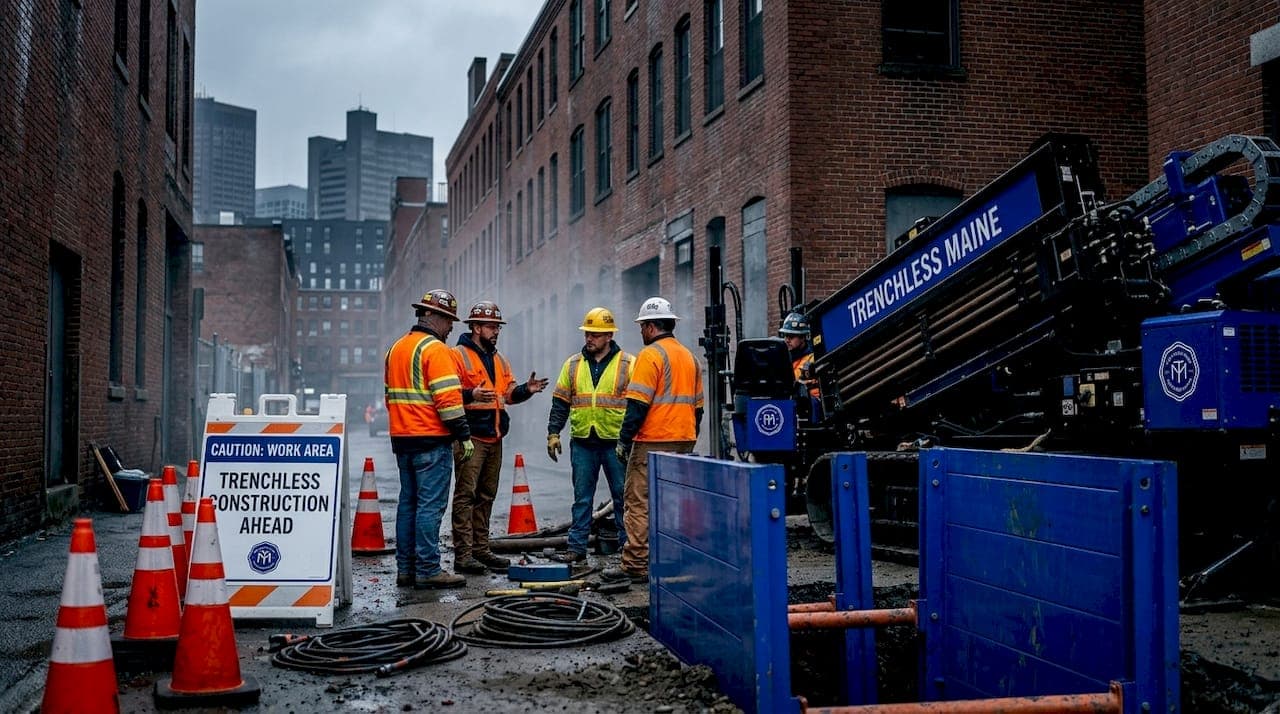
Safety considerations in trenchless projects are defined by the integration of engineered protective systems, geotechnical planning, and OSHA-aligned protocols to prevent worker injury and infrastructure damage during underground construction. Methods like horizontal directional drilling (HDD), jack-and-bore, and pipe bursting eliminate most open-cut excavation, but they introduce distinct hazards at access pits, underground bores, and utility corridors that demand structured risk management. The regulatory foundation starts with OSHA Subpart P, which governs excavation safety and applies directly to the pits and shafts that every trenchless project requires. Trenchless construction safety is not a single checklist. It is a layered system built from upstream planning through daily field execution.
What are the core safety considerations in trenchless projects?
Trenchless failure incidents predominantly originate at access pits and shafts, not the underground bore itself. This finding reframes where safety officers must concentrate their attention. The bore machine runs remotely, but workers stand inside pits, and those pits carry the same cave-in, atmospheric, and egress risks as any open excavation.
The major hazard categories in trenchless work are cave-ins at launch and reception pits, utility strikes during bore path setup, confined space atmospheric exposure, and ground settlement threatening surface infrastructure. Each category requires a separate control strategy. Treating all four as one generic "excavation hazard" is the most common planning failure safety officers encounter in the field.
OSHA Subpart P defines the regulatory floor. It requires protective systems at excavations 5 feet or deeper and mandates competent person oversight at every stage. Permitting requirements for trenchless work vary by state and municipality, but OSHA standards apply federally and set the minimum bar regardless of local rules.
How to protect workers at access pits and shafts
Trenchless pits must be treated as full excavation environments under OSHA Subpart P, with protective systems selected based on soil classification and pit depth. A competent person classifies soil as Type A, B, or C using visual and manual tests, then specifies the appropriate protective system. Skipping this classification step is a direct OSHA violation and a leading cause of preventable cave-ins.
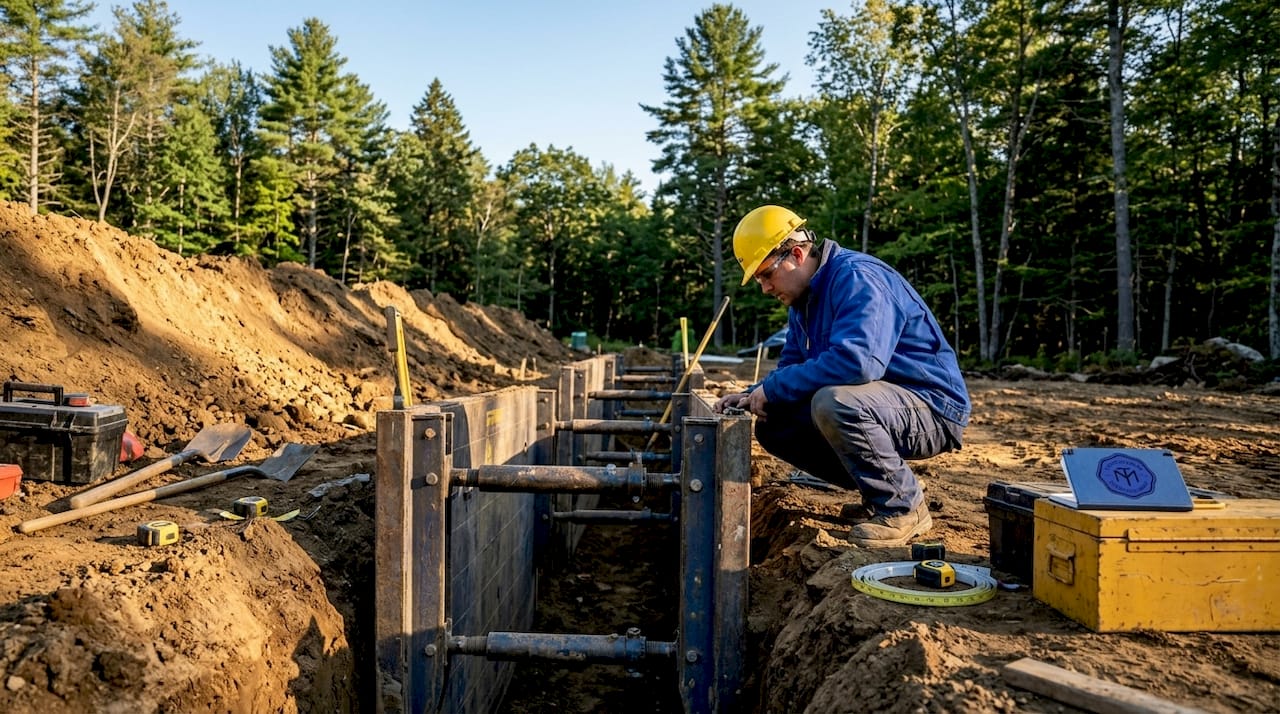
The three primary protective systems and their appropriate soil conditions are compared below:
| Protective system | Best soil condition | Key limitation |
|---|---|---|
| Sloping (1.5:1 ratio) | Type C (granular, unstable) | Requires significant surface space |
| Benching | Type A or B only | Not permitted in Type C soils |
| Hydraulic shoring or trench box | Any soil type | Must be installed before workers enter |
For egress, ladders or stairs must be placed within 25 feet laterally of any worker in a trench 4 feet or deeper. This rule is one of OSHA's most frequently cited violations on trenchless job sites, and it is also one of the easiest to correct with proper pre-shift setup.
Follow this sequence when preparing any access pit for worker entry:
- Classify soil type using the competent person's visual and manual test results.
- Select and install the appropriate protective system before any worker enters the pit.
- Confirm egress points are within 25 feet laterally of all work positions.
- Inspect the pit before each shift and after any rain, vibration, or observable soil change.
- Document all inspections with the competent person's signature and timestamp.
Pro Tip: Place spoil piles at least 2 feet from the pit edge to prevent surcharge loading on the pit walls. This single step reduces lateral soil pressure and lowers cave-in risk without any additional equipment.
Why geotechnical investigations are non-negotiable for trenchless safety
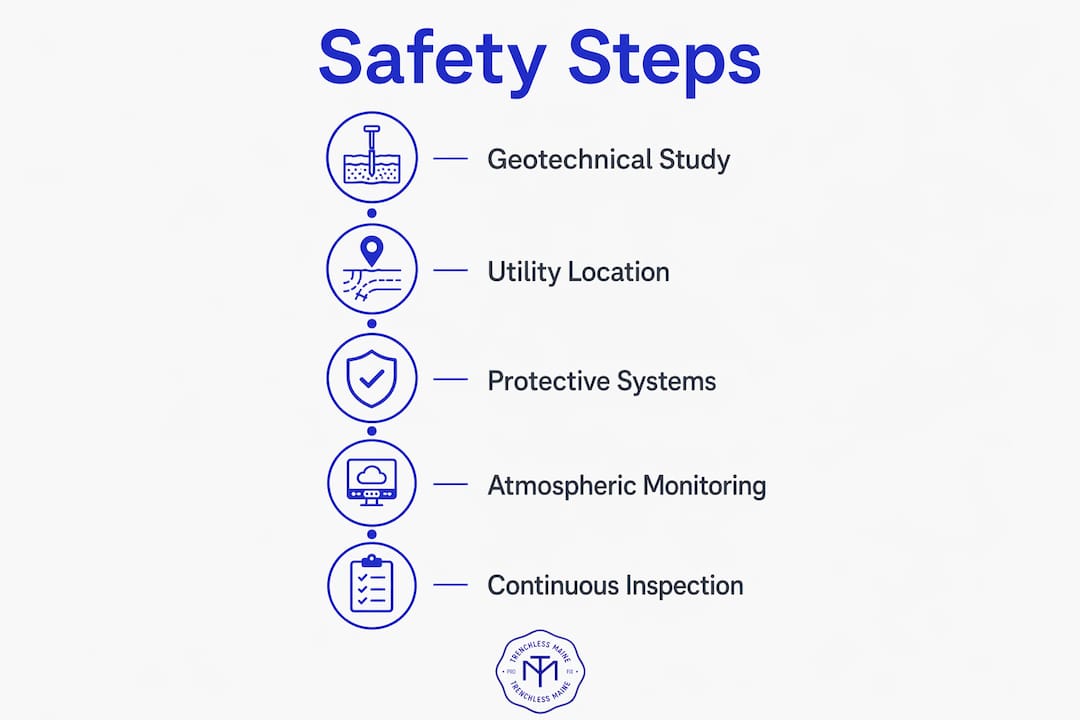
Trenchless safety begins upstream with a thorough geotechnical investigation and a formal Geotechnical Design Report before any bore path is finalized. This is not a paperwork formality. The data from soil borings directly determines bore path design, pit protective system selection, and the likelihood of ground loss or settlement during drilling.
Proper geotechnical investigations for HDD projects include borings at each bore side extending 15 feet below bore depth, with intermediate borings every 500 feet in complex geology. Skipping or underscoping this exploration increases the risk of bore deviation, inadvertent returns (drilling fluid surfacing), and ground settlement that can damage surface structures and endanger workers.
Key geotechnical data points that directly affect trenchless project risk management include:
- Soil classification and layering across the full bore path
- Groundwater depth and seasonal variation
- Rock hardness and fracture patterns for HDD in mixed-face conditions
- Existing underground voids or karst features that could cause sudden ground loss
- Proximity of bore path to building foundations or buried utilities
"Skipping or underscoping geotechnical exploration increases the risk of unsafe outcomes like settlement or bore deviation threatening workers and infrastructure." — Trenchless Technology, 2025
Integrating geotechnical findings into risk reduction strategies at the design stage prevents the most expensive and dangerous field surprises. A geotechnical report that arrives after pit design is finalized has already missed its primary safety window.
What utility location protocols prevent strikes in trenchless work?
Excavation damage prevention requires strict adherence to locating accuracy, excavation control, and rapid strike response. The Federal Register pipeline safety advisory specifically cites Common Ground Alliance Best Practices, including Practice 4-11 (nondestructive excavation in tolerance zones) and Practice 5-23 (pre-construction coordination meetings), as the standard for preventing utility strikes during trenchless and open-cut excavation.
Actionable responsibilities for operators and contractors in trenchless installation safety measures include:
- Call 811 and obtain utility locate tickets before any ground disturbance, including pilot bore setup.
- White-line the proposed bore path on the surface before the locate crew arrives to improve marking accuracy.
- Use vacuum excavation or hand digging within the tolerance zone (typically 18 inches on each side of a marked utility).
- Hold a pre-construction meeting with all utility owners to review bore path conflicts and contingency plans.
- Inspect for utility strikes after any unexpected bore resistance, even when no visible damage or leak is present.
- Document all locate tickets, field marks, and pre-construction meeting records in the project safety file.
Pro Tip: Request as-built drawings from utility owners rather than relying solely on 811 marks. As-built records often reveal depth and offset information that field marks cannot capture, particularly for older infrastructure in Maine municipalities.
Post-strike inspection is a legal and safety requirement even when a utility appears undamaged. Gas lines in particular can sustain internal damage from bore contact that does not produce an immediate leak but creates a delayed failure risk.
How to manage confined space hazards in jack-and-bore operations
Jack-and-bore pits qualify as OSHA-defined confined spaces requiring atmospheric monitoring, ventilation, rescue planning, and trained personnel before any worker entry. The confined space designation applies because these pits have limited means of egress and can accumulate hazardous atmospheres from soil gases, nearby utilities, or equipment exhaust. This risk does not disappear simply because the bore itself is mechanized.
Trenchless operations expose workers to confined space hazards at pits that require air quality monitoring and emergency readiness. Remote excavation methods reduce surface disruption but do not remove the atmospheric risk at the entry point where workers operate the boring equipment.
Follow this confined space entry sequence for every jack-and-bore pit:
- Classify the pit as a permit-required confined space if it meets OSHA criteria (limited egress, hazardous atmosphere potential).
- Test the atmosphere for oxygen level, combustible gases, and toxic vapors before entry.
- Establish continuous ventilation using forced-air blowers positioned to push fresh air to the work level.
- Issue a written confined space entry permit signed by the entry supervisor before each shift.
- Station a trained attendant at the surface who maintains communication with workers inside at all times.
- Develop and rehearse a non-entry rescue plan using retrieval systems before work begins.
The LA Metro D Line tunneling project documented 200-plus gas alerts during construction, suspending work after each alert and resuming only after CalOSHA reviewed and approved the documented controls. That project demonstrates that a well-documented operational safety system allows rapid regulatory clearance and work resumption, rather than prolonged shutdowns.
Pro Tip: Calibrate atmospheric monitors against certified reference gas before each shift. An uncalibrated monitor that reads "safe" in a hazardous atmosphere is more dangerous than no monitor at all.
How continuous monitoring keeps trenchless operations safe
Competent person inspections must be conducted daily before each shift and after any event that could increase hazard levels, including rain, nearby vibration sources, or observable changes in soil or pit wall condition. This is not a suggestion. OSHA enforces it as a mandatory element of excavation safety programs.
Effective monitoring across a trenchless project covers four parallel tracks:
- Pit and soil conditions: Visual inspection of wall stability, water infiltration, and spoil pile position before each shift.
- Surface settlement: Survey monuments or settlement plates placed along the bore path to detect ground movement above the bore.
- Equipment alignment: Laser-guided steering systems on HDD and jack-and-bore rigs confirm bore path accuracy and prevent unplanned utility conflicts.
- Atmospheric quality: Continuous gas monitors in confined pits with alarm thresholds set below OSHA permissible exposure limits.
Stop-work authority is the procedural control that ties all monitoring together. Every worker on a trenchless job site must have the explicit authority to halt operations when they observe a condition that exceeds established safety parameters. This authority must be documented in the project safety plan and reinforced in pre-shift briefings. Projects that treat stop-work as a management-only decision consistently experience more incidents than those that distribute the authority to field crews.
Documentation practices matter as much as the inspections themselves. A competent person inspection that is not recorded provides no legal protection and no data for identifying recurring hazard patterns across a project.
Key takeaways
Effective trenchless construction safety requires treating access pits as full OSHA excavation environments, investing in geotechnical investigation before bore path design, and maintaining documented monitoring from the first shift to the last.
| Point | Details |
|---|---|
| Pit hazards dominate incident data | Most trenchless failures occur at access pits, not the bore, so apply full OSHA Subpart P protective systems at every pit. |
| Geotechnical data drives safe design | Commission borings at each bore side extending 15 feet below bore depth before finalizing any bore path or pit design. |
| Utility locating requires nondestructive methods | Use vacuum excavation or hand digging within 18 inches of any marked utility, and document all locate records. |
| Confined space protocols are mandatory at pits | Jack-and-bore pits require entry permits, atmospheric monitoring, and a trained surface attendant for every shift. |
| Stop-work authority belongs to every worker | Distribute and document stop-work authority at the field level to catch hazards before they become incidents. |
What I've learned from managing trenchless safety in the field
I have reviewed enough post-incident reports to say with confidence that the majority of trenchless injuries were preventable with decisions made weeks before the first bore began. The pattern is consistent. A project skips or compresses geotechnical investigation to save time. The bore path encounters unexpected soil conditions. The crew improvises. Someone gets hurt.
The second most common failure is treating access pits as temporary inconveniences rather than full excavation environments. I have seen experienced crews skip trench box installation in a 6-foot pit because "it's only for a few hours." OSHA does not recognize duration as a mitigating factor, and neither does physics.
What actually works is embedding OSHA-aligned protocols into the daily rhythm of the project rather than reserving them for inspection days. Competent persons who conduct genuine pre-shift inspections, not checkbox exercises, catch the conditions that lead to incidents. Workers who trust that stop-work authority is real and supported by management use it. Projects with that culture run safer and, consistently, more efficiently.
The upstream investments in geotechnical data and utility coordination pay back in avoided delays, avoided strikes, and avoided injuries. That is not a philosophical argument. It is the operational record of projects that do this well versus those that do not.
— John
How Trenchlessmaine supports safe trenchless work in Maine
Trenchlessmaine brings over 50 years of combined expertise to trenchless sewer repair and pipe lining projects across Maine, with safety protocols embedded at every stage of service delivery.
From CIPP lining and hydro jetting that minimize excavation exposure to camera inspections that locate utility conflicts before any ground is disturbed, Trenchlessmaine's methods are designed to reduce worker and property risk from the first site visit. The team's no-dig technology supports geotechnical assessment and utility locating as standard pre-project steps, not optional add-ons. If you are managing a trenchless sewer repair or municipal infrastructure project in Maine and need a contractor who treats safety as a technical discipline rather than a compliance exercise, contact Trenchlessmaine for a project consultation.
FAQ
What does OSHA Subpart P require for trenchless access pits?
OSHA Subpart P requires protective systems at all excavations 5 feet or deeper, including trenchless access pits. A competent person must classify soil type and select sloping, shoring, or shielding before any worker enters the pit.
How deep must a trench be before egress equipment is required?
Ladders or stairs are required in any trench or pit 4 feet or deeper, and they must be positioned within 25 feet laterally of every worker. This is one of OSHA's most frequently cited excavation violations.
When does a jack-and-bore pit become a confined space?
A jack-and-bore pit qualifies as an OSHA permit-required confined space when it has limited means of egress and the potential for a hazardous atmosphere. Atmospheric monitoring, ventilation, entry permits, and a trained surface attendant are all required before worker entry.
Why is geotechnical investigation a safety requirement in HDD projects?
Inadequate geotechnical data increases the risk of bore deviation, ground loss, and settlement that can injure workers and damage surface infrastructure. Borings should extend 15 feet below bore depth on each side and include intermediate borings every 500 feet in complex geology.
What should you do immediately after a suspected utility strike?
Stop boring operations and inspect for damage even if no visible leak or break is present. Gas lines can sustain internal damage from bore contact that creates a delayed failure risk, so post-strike inspection is a legal and safety requirement regardless of visible evidence.