
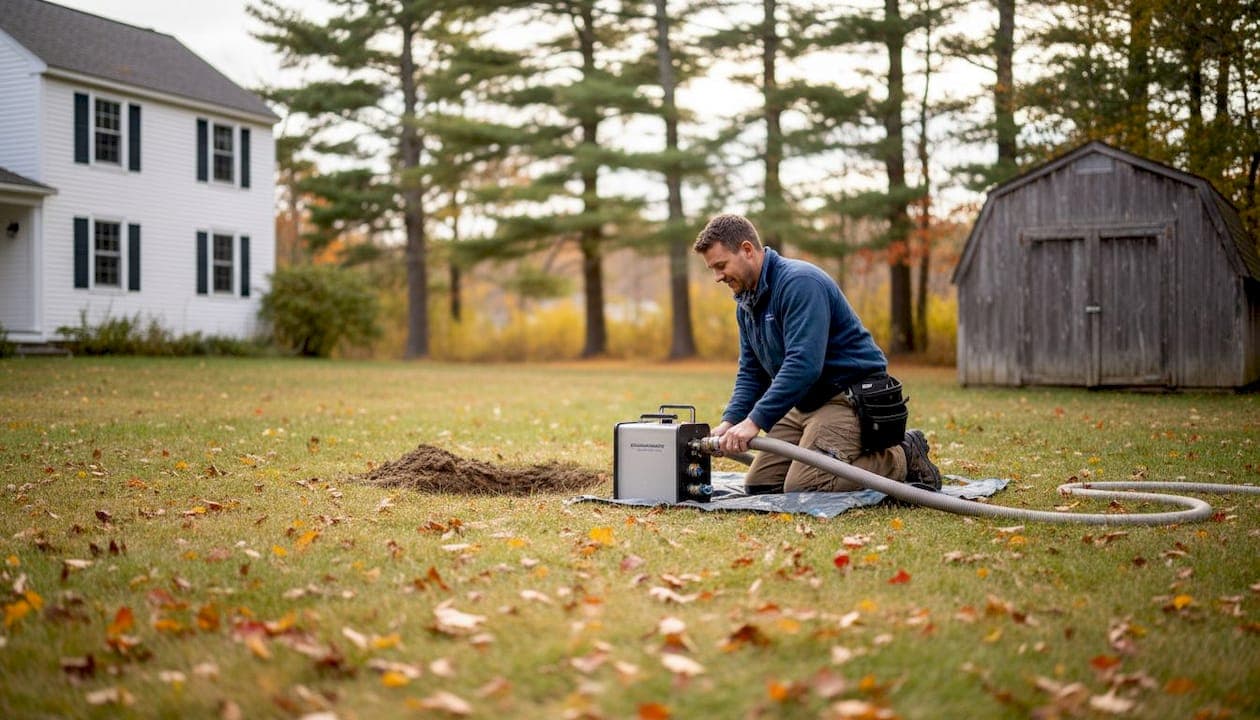
Most Maine homeowners assume a broken sewer line means a torn-up yard, a cracked driveway, and a bill that makes your stomach drop. That assumption is understandable but outdated. Trenchless sewer repair has quietly become the preferred approach for residential pipe problems across the country, and it offers real advantages for homeowners dealing with Maine's rocky ground, frozen soil, and aging infrastructure. This article explains what trenchless repair actually is, walks through the two main methods, covers where it works and where it doesn't, and helps you figure out whether it's the right call for your home.
Table of Contents
- Understanding trenchless sewer repair
- Main trenchless methods: CIPP lining vs. pipe bursting
- Where trenchless works and where it doesn't
- Trenchless sewer repair costs and long-term value
- A Maine expert's take: What most people miss about trenchless sewer repair
- Explore Maine's trusted trenchless sewer repair solutions
- Frequently asked questions
Key Takeaways
| Point | Details |
|---|---|
| Minimally invasive | Trenchless sewer repair fixes pipes through small access points, protecting your yard and driveway. |
| Method matters | CIPP lining is best for cracks or root intrusions, while pipe bursting works for more severe damage. |
| Not always possible | Older or fully collapsed pipes sometimes still need traditional excavation. |
| Value over time | Upfront costs may be higher, but trenchless saves money and hassle in the long term. |
| Hire local expertise | A Maine-based specialist can inspect and recommend the ideal trenchless solution for your home’s unique needs. |
Understanding trenchless sewer repair
Traditional sewer repair means digging a long trench across your property to expose the damaged pipe. It's disruptive, time-consuming, and expensive once you factor in restoring your lawn, driveway, or landscaping afterward. Trenchless repair takes a completely different approach.
Trenchless sewer repair is a category of minimally invasive pipeline rehabilitation and replacement methods that avoid full-length open-cut excavation, using small access points instead. In plain terms, technicians reach the damaged pipe through one or two small entry points, then use specialized equipment to fix or replace it from the inside out, without digging up your entire yard.
For Maine homeowners, this matters more than it might in other states. Here's why:
- Rocky and frozen ground makes traditional excavation expensive and slow, especially during winter months when the ground can be nearly impossible to dig through.
- Older homes throughout Maine often sit on aging clay or cast iron pipes that are long overdue for rehabilitation.
- Property value takes a hit when your landscaping, driveway, or hardscape gets torn apart, even temporarily.
- Disruption is a real cost. Days or weeks without normal sewer function affects your household in ways that go beyond the repair bill.
A common misconception is that any sewer problem automatically requires major excavation. That's not true. About 70% of residential sewer repairs are now handled using trenchless methods. The technology has matured significantly, and qualified contractors can address root intrusion, pipe deformation, cracks, and joint failures without breaking ground.
"Trenchless sewer repair gives Maine homeowners a way to fix serious pipe problems without turning their property into a construction zone. The access points are small, the equipment is precise, and the results last."
Understanding the cost difference versus excavation is one of the first things homeowners should look at before deciding on a repair approach. The numbers often tell a different story than people expect.
Main trenchless methods: CIPP lining vs. pipe bursting
With the core idea down, what are the actual methods used, and how do they differ? There are two primary trenchless approaches you'll encounter: cured-in-place pipe lining (CIPP) and pipe bursting. Both avoid major digging, but they work very differently.
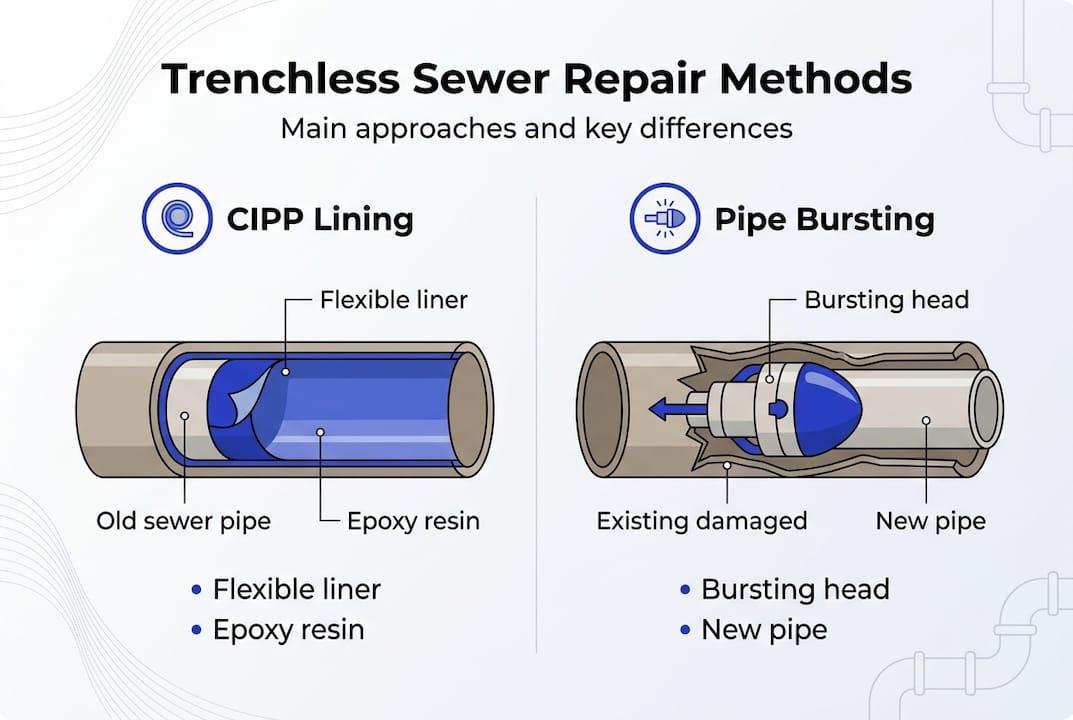
CIPP lining involves inserting a flexible liner soaked in epoxy resin into the damaged pipe. Once in position, the liner is inflated and cured, either with heat, UV light, or steam. The result is a new pipe formed inside the old one. The original pipe stays in place; its interior is essentially replaced. CIPP is ideal for cracked pipes, root intrusion, and joint failures where the host pipe still holds its general shape.
Pipe bursting takes a more aggressive approach. A bursting head is pulled through the old pipe, fracturing it outward while simultaneously pulling a new pipe, typically high-density polyethylene (HDPE), into place behind it. This method works well when the existing pipe has failed badly and can't support a liner.
CIPP lining forms a new pipe inside the existing one; pipe bursting fractures the old pipe while pulling in a new one. Each method has its strengths depending on your pipe's condition and your property's layout.
| Factor | CIPP lining | Pipe bursting |
|---|---|---|
| Best use case | Cracks, root intrusion, joint failure | Severe pipe failure, full replacement |
| Property disruption | Minimal | Low, but requires two access pits |
| Pipe diameter impact | Slightly reduced interior | Can upsize the new pipe |
| Typical lifespan | 50+ years | 50+ years |
| Maine soil suitability | Excellent for rocky ground | Good, but watch for nearby utilities |
| Restoration needed | Very little | Minimal |
For Maine properties with heavy tree cover, handling tree root intrusion is one of the most common reasons homeowners call us. CIPP lining seals off root entry points permanently. Pipe bursting eliminates the old pipe entirely, which also solves the root problem but requires more planning around utility lines.
Pro Tip: Always get a camera inspection before choosing a method. The pipe's actual condition determines which approach will work and which could fail. No reputable contractor should recommend a method without seeing the pipe first.
You can review all trenchless services available to understand which approach fits your specific situation before making any decisions.
Where trenchless works and where it doesn't
Now that you know the main methods, it's important to understand their limits. Trenchless repair is genuinely impressive technology, but it isn't a universal fix for every sewer problem.
CIPP lining requires that the host pipe still have enough structural integrity to support the liner during installation. If the pipe has fully collapsed, the liner has nothing to hold it in shape while it cures. Similarly, pipes with severe offset joints, meaning sections that have shifted significantly out of alignment, may not allow the liner to pass through or cure properly.
CIPP is unsuitable for fully collapsed, severely offset, or misaligned pipes as the liner needs an intact host; bursting is better in those cases but risks ground heave near utilities and requires access pits.
Here's a quick breakdown of when each approach fits and when traditional excavation may still be necessary:
- CIPP works well when: the pipe has cracks, root intrusion, or minor joint gaps but still holds its basic shape and alignment.
- Pipe bursting works well when: the pipe has failed significantly but runs in a relatively straight line with no nearby utility conflicts.
- Traditional excavation may be needed when: the pipe has fully collapsed, there are major misalignments, or the access points required for trenchless equipment can't be established safely.
- Maine-specific factors: Frozen or rocky ground can complicate access pit excavation even for trenchless work. Older homes in cities like Portland, Bangor, or Augusta often have clay or Orangeburg pipes that require a camera inspection before any method is chosen.
"A camera inspection isn't optional. It's the only way to know what you're actually dealing with before committing to a repair method."
Reviewing spring sewer maintenance tips can help you catch problems early, before they reach the point where your options narrow. If you want to see how these methods play out in real Maine properties, the before and after project gallery shows actual results from local jobs.
Trenchless sewer repair costs and long-term value
Understanding where trenchless works is key, but how does it hit your wallet today and over time?
| Cost factor | Trenchless repair | Traditional excavation |
|---|---|---|
| Upfront repair cost | $4,000 to $12,000+ | $3,000 to $8,000+ |
| Landscaping restoration | Minimal to none | $1,000 to $5,000+ |
| Driveway/hardscape repair | Rarely needed | Often required |
| Time off work | 1 to 2 days | Up to 1 to 2 weeks |
| Warranty | Up to 50 years | Varies, often shorter |
| Long-term pipe lifespan | 50+ years | Depends on material |
To make this concrete, consider two Maine homeowner scenarios:
- Homeowner A in South Portland chose traditional excavation for a cracked sewer lateral. The repair itself cost $5,500, but restoring the driveway added $3,200 and reseeding the lawn added $800. Total out-of-pocket: over $9,500, plus two weeks of disruption.
- Homeowner B in Yarmouth chose CIPP lining for a similar crack. The repair cost $7,000 upfront. No driveway work. No lawn restoration. The job was done in one day, and the liner carries a 50-year warranty. Total out-of-pocket: $7,000.
The gap narrows or reverses quickly when you factor in restoration. You can dig deeper into the trenchless vs excavation costs breakdown on our blog.
One more factor worth checking: insurance coverage for sewer repair varies by policy. Some Maine homeowners have partial coverage for sewer line failures, which can offset the upfront trenchless cost significantly. Call your insurer before assuming you're paying the full bill out of pocket.
A Maine expert's take: What most people miss about trenchless sewer repair
Here's something most guides won't tell you: trenchless repair isn't automatically the right answer just because it sounds better. We've seen homeowners pushed toward CIPP lining on pipes that were too far gone to support a liner, and the result was a failed job that still required excavation. The method has to match the pipe's actual condition, not just the homeowner's preference for minimal disruption.
There's also an environmental nuance worth knowing. Some CIPP curing processes use styrene-based resins, and styrene emissions during certain CIPP curing methods are a legitimate concern in enclosed or poorly ventilated areas. Ask your contractor what resin system they use and whether it's a low-emission or UV-cured option.
Another thing homeowners often overlook: CIPP lining slightly reduces the interior pipe diameter, but in most cases it actually improves flow because the smooth liner surface has less friction than corroded or root-damaged pipe walls. Pipe bursting, on the other hand, allows you to upsize the pipe if your current line is undersized. These are details worth discussing with your contractor before signing anything. Check the warranty assurance terms carefully too. A solid warranty reflects a contractor's confidence in their work.
Explore Maine's trusted trenchless sewer repair solutions
If this article has helped you understand your options, the next step is straightforward. Whether you're dealing with a slow drain, a suspected crack, or a pipe that hasn't been inspected in years, getting a professional assessment is the only way to know what you're actually working with.

At Trenchless Maine, we offer a free quote with no obligation, so you can understand your options before committing to anything. Browse our before and after photos to see real results from Maine properties just like yours. You can also explore the technology used in our repairs, from CIPP lining to hydro jetting and camera inspections. We know Maine's soil, weather, and aging infrastructure because we work in it every day. Our warranties back that up.
Frequently asked questions
Is trenchless sewer repair always possible for old Maine homes?
No. Pipes that are fully collapsed or severely misaligned may not support a trenchless liner, and traditional excavation may still be required in those cases.
How long does trenchless sewer repair take compared to traditional methods?
Trenchless repairs typically take 1 to 2 days because small access pits minimize work time on site, compared to a week or more for traditional excavation.
Does trenchless sewer repair damage my yard or driveway?
Rarely. Trenchless methods avoid full-length excavation, preserving your landscaping and hardscapes by working through small entry points instead of long trenches.
Are trenchless repairs more expensive up front?
Yes, but lifecycle costs are lower because you avoid restoration expenses like driveway repair and lawn reseeding that traditional excavation almost always requires.
Does insurance cover trenchless sewer repair in Maine?
It depends on your policy. Coverage for sewer line repair varies, so contact your insurance provider directly to find out what your specific plan includes before scheduling repairs.