
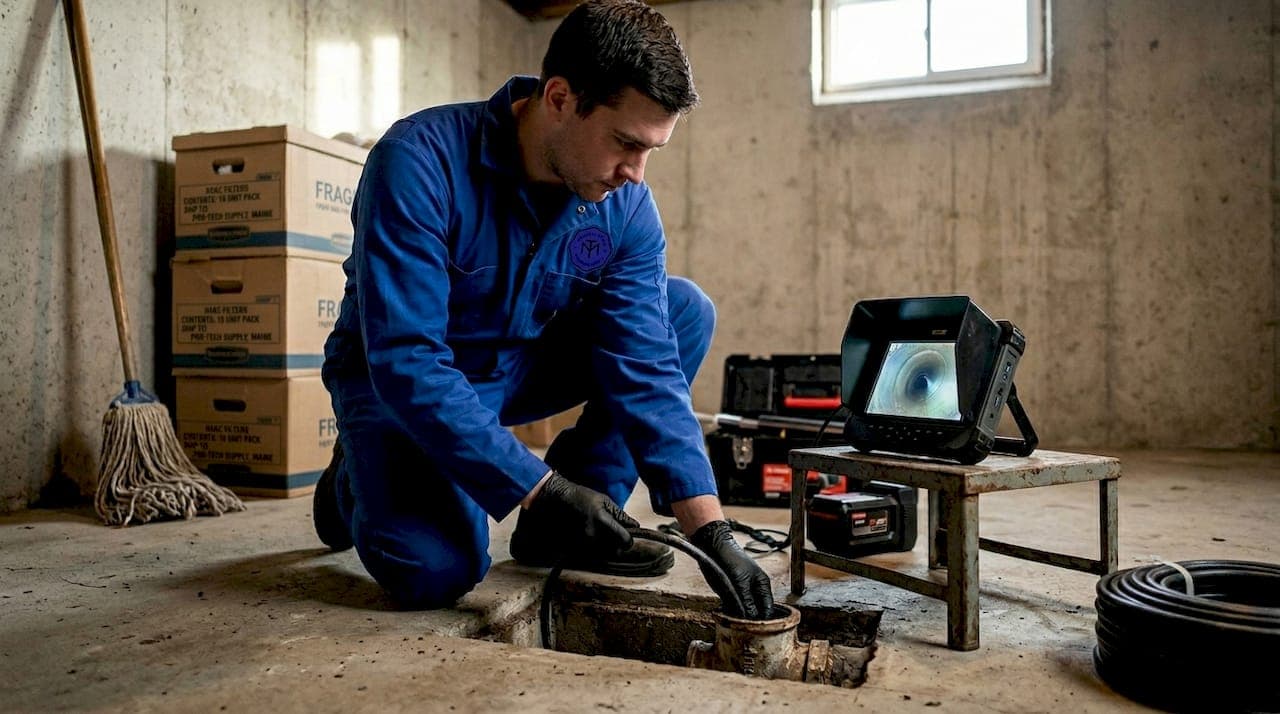
Most homeowners in Maine picture the same thing when they hear "sewer repair": a backhoe tearing through the yard, weeks of disruption, and a landscaping bill that rivals the plumbing cost itself. That picture is outdated. Modern pipe lining technology lets licensed crews restore your sewer lateral (the underground pipe connecting your home to the main sewer line) without digging up a single foot of your property. This guide walks you through exactly how the process works, what to expect at each stage, and why it's become the go-to solution for residential and commercial property owners across Maine.
Table of Contents
- What is pipe lining? Understanding the basics
- A step-by-step overview of the pipe lining process
- Comparing inversion and pull-in-place methods
- How pipe lining minimizes disruption and delivers long-term results
- Why most people underestimate the value of pipe lining
- Explore trenchless options for your Maine property
- Frequently asked questions
Key Takeaways
| Point | Details |
|---|---|
| No digging required | Pipe lining uses trenchless technology to repair pipes without disturbing landscaping. |
| Fast, efficient process | Most pipe lining jobs are complete in just one or two days with minimal home disruption. |
| Long-term durability | CIPP liners can last 50 years or more, greatly extending the life of your pipes. |
| Two main methods | Inversion and pull-in-place are the most common installation techniques. |
| Ideal for Maine conditions | Pipe lining is especially effective for Maine’s climate and older housing stock. |
What is pipe lining? Understanding the basics
Traditional sewer repair meant one thing: excavation. Crews would dig a trench along the entire length of the damaged pipe, pull out the old material, and drop in a replacement section. For a typical Maine home with mature landscaping, a paved driveway, or a deck above the sewer line, that approach could cost tens of thousands of dollars in landscape and surface restoration alone, on top of the plumbing work itself.
Pipe lining is a completely different approach. Instead of removing the old pipe, technicians insert a flexible liner saturated with a structural resin directly into the existing pipe. Once that liner is positioned and cured (hardened), it forms a brand-new pipe wall inside the old one. The damaged host pipe essentially becomes the mold, and the new liner becomes the functional pipe going forward.
You'll hear this technology referred to as cured-in-place pipe, or CIPP. That's the technical industry term for the method. The liner material is typically a felt or fiberglass tube, and the resin hardens into a rigid, smooth surface that resists corrosion, root intrusion, and the kind of cracking that aging clay and cast iron pipes are prone to in Maine's climate.
Here's where pipe lining makes the most sense for Maine properties:
- Older homes with clay or cast iron laterals that have deteriorated after decades underground
- Properties with mature trees where root intrusion has cracked or blocked the pipe
- Homes with decks, patios, or driveways directly above the sewer line
- Commercial properties where shutting down operations for extended excavation is not practical
- Municipal and multi-unit buildings needing fast, scalable solutions
The key trenchless sewer repair benefit is this: you preserve your property above ground while permanently fixing the problem below it.
Did you know? CIPP installation methods include inversion and pull-in-place, with curing done via hot water, steam, or UV light depending on the liner system used. Each approach has specific advantages depending on pipe geometry and depth.
A step-by-step overview of the pipe lining process
Now that you understand what pipe lining is, it's worth knowing exactly what happens during a project. Understanding each stage helps you ask the right questions and set realistic expectations for your property.
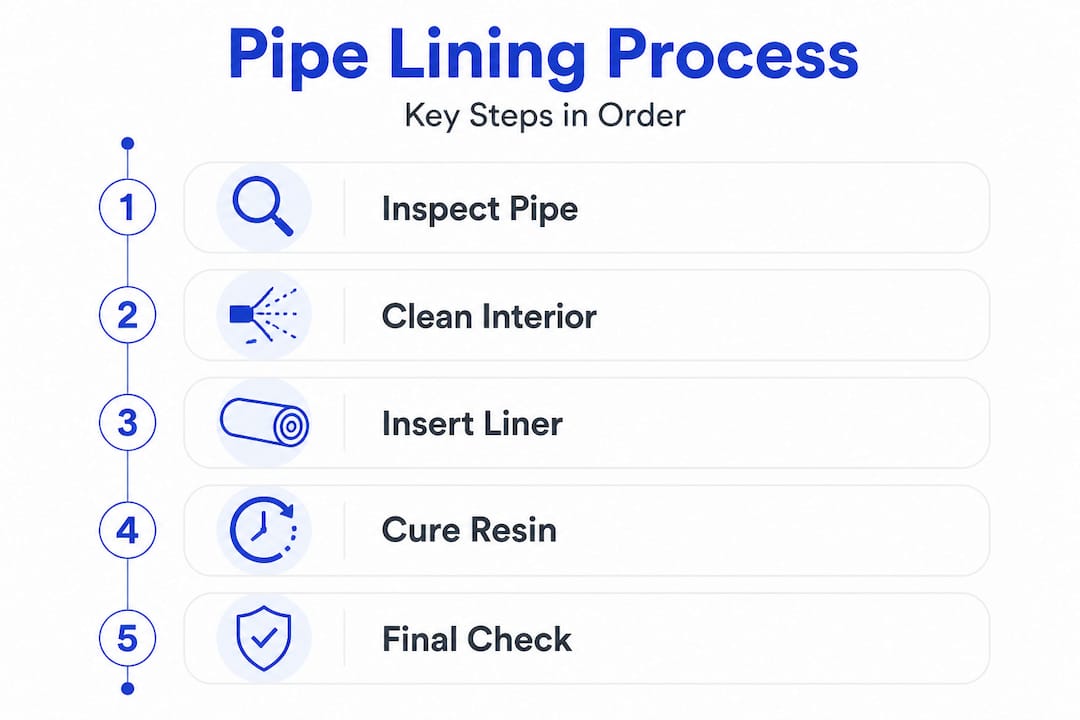
The CIPP lining process for Maine homes typically follows these steps:
-
Camera inspection. A waterproof video camera is fed through the pipe to locate cracks, root intrusion, pipe deformation, joint offsets, or any blockages. The crew reviews the footage to map the damage and determine whether lining is the appropriate solution.
-
Hydro jetting and cleaning. High-pressure water is blasted through the pipe to remove debris, roots, grease buildup, and any loose material from the pipe walls. A clean surface is critical; if the pipe isn't properly cleaned, the resin liner won't bond correctly.
-
Liner preparation. A felt or fiberglass tube is cut to length and saturated with a two-part epoxy or polyester resin. This step is precise work. Too little resin creates weak spots; too much can cause problems during curing.
-
Liner insertion. Here's where the two main installation methods come in. With inversion, the liner is turned inside-out as pressurized water or air pushes it through the pipe from one end to the other. With pull-in-place (PIP), the liner is pulled into position using a cable, then inflated with a bladder to press it firmly against the pipe walls. CIPP sewer repair professionals choose the method based on pipe diameter, depth, and access points available on your property.
-
Curing. Once the liner is seated against the host pipe walls, it must harden. Curing is done using hot water, steam, or UV light. UV curing is the fastest, sometimes completing in under an hour. Hot water or steam curing typically takes two to four hours. The resin solidifies into a hard, jointless pipe within the old pipe.
-
Cutting lateral connections. Any branch connections (like cleanouts or connections from other fixtures) that were covered by the liner are reopened using a remote-controlled cutter guided by the camera. This restores full flow to all connected lines.
-
Final camera inspection. A post-installation video inspection confirms that the liner cured correctly, that there are no wrinkles or voids, and that all lateral connections are clear and fully open.
The entire process for a standard residential sewer lateral in Maine takes one to two days. Compare that to traditional excavation, which can run a week or more once you factor in digging, pipe replacement, backfill, and surface restoration.
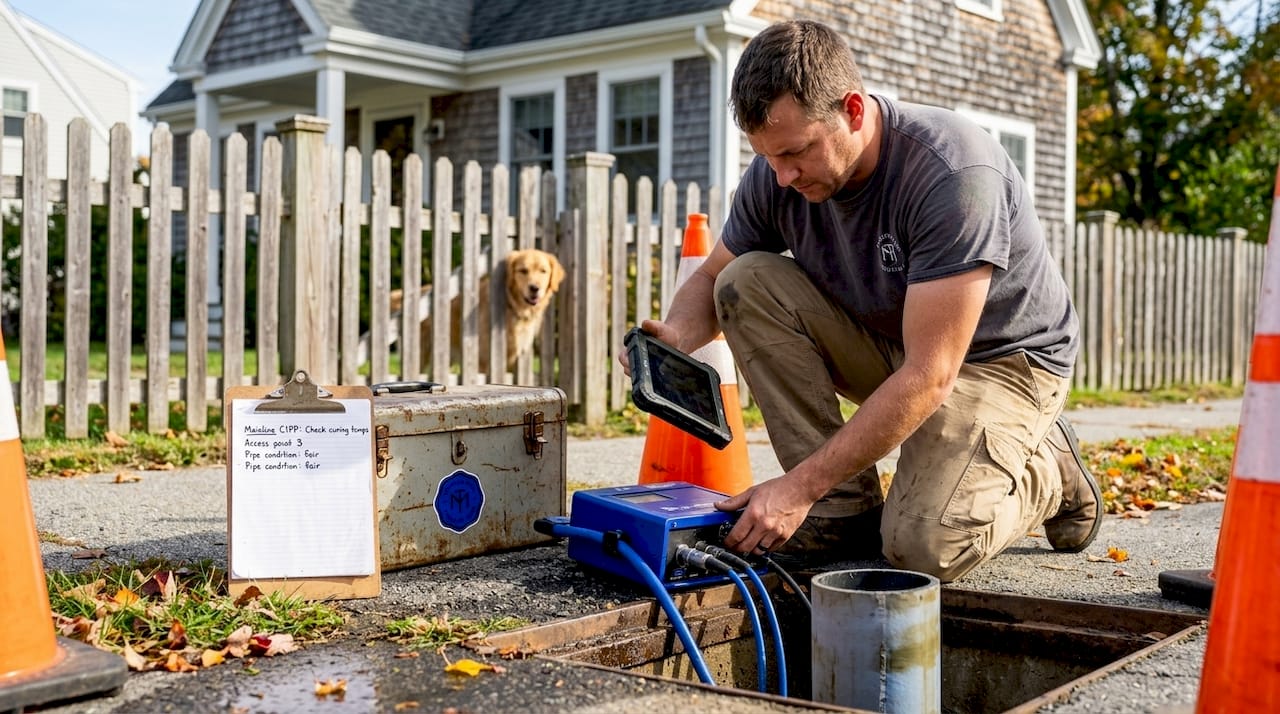
Pro Tip: Before any pipe lining project starts, ask your contractor for the pre-lining camera inspection footage. Reviewing it with them helps you understand the scope of the damage, confirm the recommended method is appropriate, and gives you a baseline for future inspections. You can review pipe lining best practices to know exactly what questions to ask.
Comparing inversion and pull-in-place methods
Now that you know the process, it's important to understand that there are options for how the liner is installed. The choice between inversion and pull-in-place affects speed, cost, and how well each method suits your specific pipe layout.
| Feature | Inversion method | Pull-in-place (PIP) method |
|---|---|---|
| How liner enters pipe | Turned inside-out under pressure | Pulled in using cable, then inflated |
| Access points needed | Single access point | Two access points typically required |
| Best for | Longer runs, simpler layouts | Shorter sections, bends, and complex geometry |
| Curing method | Hot water, steam, or UV | Hot water, steam, or UV |
| Typical residential use | Main sewer laterals | Branch lines and shorter pipe sections |
| Disruption level | Very low | Very low |
Both methods fall under the CIPP umbrella. According to industry standards, both inversion and pull-in-place installation are widely accepted approaches, with the curing system selected based on the liner material and project specs.
For most Maine homes, the inversion method is used on the main sewer lateral because it handles longer pipe runs efficiently from a single cleanout access point. Pull-in-place is often the better fit for shorter branch lines, pipes with multiple bends, or cases where the pipe diameter is on the smaller end of the range.
What makes this relevant for your property is the layout question. Maine homes often have complicated sewer routing due to older construction, frost depth requirements, and the presence of ledge rock that forces pipes to follow unusual paths. A qualified technician will assess your specific situation before recommending which method fits your lateral.
Trenchless approaches like these have reshaped how sewer work gets done across the state. Explore the no-dig sewer technology available today to understand what options are realistic for your home's specific pipe configuration and access conditions.
How pipe lining minimizes disruption and delivers long-term results
Understanding the methods is only half the story. Here's why pipe lining stands out for delivering real-world, long-lasting advantages that matter to homeowners and property managers in Maine.
The practical benefits break down clearly:
- No excavation. Your lawn, garden, driveway, and deck stay intact. There's no trench to fill, no sod to replace, and no pavers to reset.
- Faster completion. Most residential projects wrap up within one to two days compared to a week or more for traditional pipe replacement.
- Lower total cost. While the lining work itself may carry a similar price to some excavation jobs, you avoid the significant restoration costs that follow digging.
- Seamless pipe wall. The cured liner creates a smooth, joint-free surface that resists future root intrusion and buildup better than older segmented pipe systems.
- Minimal odor and mess. Because the work is done through access points rather than open trenches, there's far less exposure to sewer gases and waste material on your property.
Here's a realistic look at timelines and expected performance:
| Project type | Typical completion time | Expected liner lifespan |
|---|---|---|
| Residential sewer lateral (single family) | 1 to 2 days | 50 years or more |
| Commercial building lateral | 2 to 3 days | 50 years or more |
| Branch line repair | Half day to 1 day | 40 to 50 years |
| Municipal main line segment | 2 to 5 days | 50 years or more |
The trenchless repair results speak for themselves: properties that looked completely untouched after a full sewer lateral rehabilitation, completed in a single day.
After installation, your pipe is essentially brand new inside. But that doesn't mean it's maintenance-free forever. The cured liner is durable, but you should still protect your investment.
- Avoid flushing wipes, grease, or other non-degradable materials that can build up on any pipe surface over time.
- Monitor drain speed in your fixtures annually. Slow drains are often an early warning that something is building up or shifting underground.
- Keep a record of your post-installation camera inspection report so future plumbers or inspectors have a baseline to compare against.
Pro Tip: Schedule a camera inspection every five to seven years after your lining is installed. It's a low-cost check that catches any early-stage issues before they become expensive problems, and it confirms that your trenchless sewer services investment is holding up as expected.
Why most people underestimate the value of pipe lining
Here's a perspective that most guides leave out entirely. When homeowners and property managers weigh pipe lining against traditional replacement, they usually compare upfront costs and project timelines. That's the right starting point, but it misses the bigger picture by a wide margin.
Maine's climate adds a dimension to this decision that other states don't face at the same level. The freeze-thaw cycle, where ground temperatures repeatedly rise above and drop below freezing throughout late fall and early spring, creates soil movement that is relentless and cumulative. Every time the ground shifts, traditional segmented pipes absorb stress at every joint. That's where cracks originate and where roots gain entry year after year.
A CIPP liner eliminates those joints entirely. You end up with a continuous, smooth tube that flexes slightly with ground movement rather than fracturing at vulnerable points. Over 20 or 30 years in a Maine climate, that structural advantage compounds. The pipe that a traditional replacement would have cracked and compromised again might hold perfectly under a relined system.
The second thing most people underestimate is the question of asking the right things before committing to a contractor. Not all resin materials are equal. Not all liner thicknesses are appropriate for every pipe diameter. Some installers apply thinner liners to cut costs, which reduces the structural strength and longevity of the finished product. Before you sign anything, ask your contractor specifically what resin system they're using, what liner wall thickness is being applied for your pipe diameter, and what warranty covers the finished installation.
We've seen properties where a homeowner chose the lowest bid without asking those questions and ended up with a liner that failed within a decade. Reviewing pipe lining best practices before your first consultation puts you in a much stronger position to evaluate what you're being offered.
Pipe lining isn't just about fixing today's problem. Done correctly with the right materials, it's a 50-year infrastructure decision. Treat it like one.
Explore trenchless options for your Maine property
Now that you understand how pipe lining works and what it can do for your property, the logical next step is seeing what's possible for your specific situation.
At Trenchless Maine, we bring over 50 years of combined expertise to every project across the state. Whether you're dealing with a cracked sewer lateral in Portland, root intrusion in Bangor, or aging pipes on a commercial property in Augusta, we have the equipment and experience to handle it without tearing up your property. Browse our before & after gallery to see real Maine projects and real results. Explore our no-dig solutions to learn which method fits your pipe layout, or check our full range of trenchless services to get started. Contact us today for a free quote and find out if your area is covered.
Frequently asked questions
How long does a typical pipe lining project take?
Most residential pipe lining projects are completed within one to two days, minimizing disruption to your daily routine and property.
What types of pipes can be relined using CIPP technology?
CIPP works on a wide range of pipe materials, including clay, cast iron, and PVC commonly found in Maine homes. The CIPP installation method is adaptable to most pipe diameters and configurations encountered in residential and commercial properties.
Is pipe lining more affordable than traditional sewer replacement?
Pipe lining often costs less overall because it eliminates landscape restoration expenses and significantly reduces the labor involved compared to full excavation and pipe replacement.
How long does a relined pipe last?
Relined pipes using CIPP can last 50 years or more with proper maintenance, making them a long-term infrastructure solution. The CIPP liner lifespan depends on liner thickness, resin quality, and the conditions of the host pipe at the time of installation.
What preparation is needed before pipe lining starts?
A thorough camera inspection and hydro jetting cleaning are required before lining begins, ensuring the resin bonds correctly to the pipe walls and the finished liner performs as intended.