
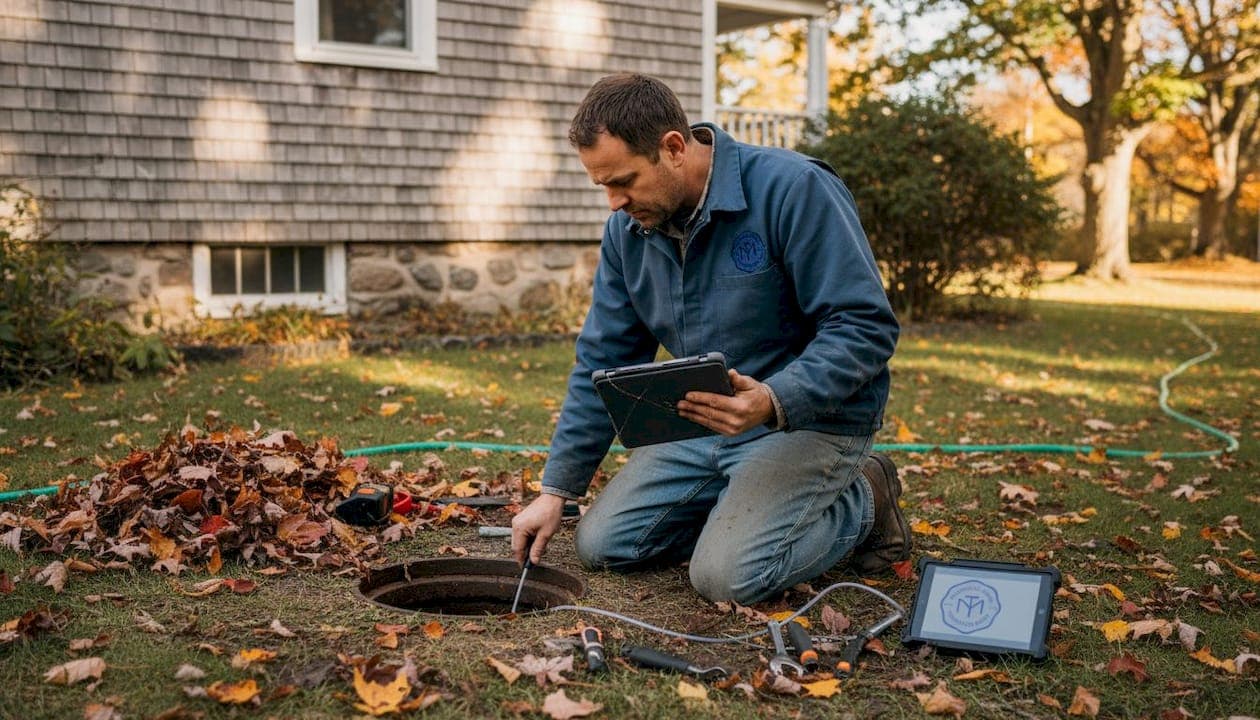
A sewer problem doesn't wait for a convenient moment. Slow drains, sewage odors, or soggy patches in your yard can signal serious pipe damage underneath your property, and the clock starts ticking the second you notice. Traditional sewer repairs meant days of digging, torn-up landscaping, and disruption to your daily routine. Today, trenchless technology offers Maine homeowners faster, cleaner alternatives that get the job done without destroying your yard. This guide walks you through the leading non-invasive repair methods, how to choose between them, and when excavation might still be unavoidable.
Table of Contents
- How to evaluate sewer repair methods
- Cured-in-place pipe (CIPP) lining
- Pipe bursting: a solution for collapsed pipes
- CIPP vs. pipe bursting: side-by-side comparison
- When is excavation still necessary?
- The real cost of speed and minimal disruption in Maine sewer repair
- Ready for a non-invasive solution? Get help from Maine's trenchless experts
- Frequently asked questions
Key Takeaways
| Point | Details |
|---|---|
| Non-invasive repairs | Modern trenchless methods fix most sewer issues without major digging in your yard. |
| Method depends on damage | CIPP works for cracks, while pipe bursting is for collapsed pipes—different problems need different solutions. |
| Know the limits | Severely damaged or hard-to-access pipes may still require traditional excavation. |
| Expert evaluation is key | A camera inspection and professional assessment ensure you pick the best long-term fix. |
How to evaluate sewer repair methods
Not every repair method works for every situation. Before you commit to any solution, you need to measure it against a clear set of criteria. The wrong choice can cost you more money in the long run, or worse, leave the underlying problem unsolved.
Here are the key factors to weigh when evaluating your non-invasive sewer repair options:
- Speed of service: How quickly can the repair be completed? For active sewage backups, same-day or next-day service matters.
- Pipe condition: The extent of damage determines which methods are even viable. Cracks and leaks call for different solutions than full pipe collapse.
- Impact on your landscape and structures: Will the repair require removing a patio, driveway, or landscaping? Non-invasive methods should protect what you've already invested in.
- Long-term durability: A quick patch that fails in three years is not a bargain. Ask about warranty coverage and expected service life.
- Budget and insurance considerations: Some repairs may be partially covered by homeowner's insurance. Get documentation of the pipe condition before work begins.
- Pipe diameter trade-offs: Some trenchless methods slightly reduce internal pipe size, which matters for high-flow systems.
According to industry guidance, CIPP suits cracked pipes with leaks or limited structural damage, but it is not suitable for pipes with more than 25% wall loss or full collapse. It also results in a 6-12% reduction in pipe diameter. Pipe bursting, on the other hand, handles collapsed pipes, but requires soil stability and clearance from nearby utilities.
Pro Tip: Always ask your contractor whether the chosen method will reduce your pipe's internal diameter. For most residential sewer laterals (the pipe connecting your home to the main sewer line), a slight reduction is acceptable, but for older homes with narrower pipes, it could affect drainage performance.
Cured-in-place pipe (CIPP) lining
CIPP lining is one of the most widely used trenchless repair methods available in Maine, and for good reason. It addresses the most common causes of sewer pipe damage without requiring any significant digging.
Here is how it works: a flexible liner saturated with resin is inserted into the damaged pipe through an existing access point. The liner is then inflated and cured in place using hot water, steam, or UV light, forming a rigid new pipe inside the old one. The result is a smooth, jointless pipe that resists root intrusion, corrosion, and future cracking. You can explore how this fits within a broader trenchless technology overview on the Trenchless Maine website.
CIPP lining works best when:
- Your pipe has cracks, leaks, or minor deformation but retains most of its original shape
- Root intrusion has occurred but has not caused structural collapse
- The pipe is located under a driveway, garden, or finished basement floor
- You need a fast turnaround, since most CIPP jobs are completed in a single day
CIPP lining is not the right choice when:
- The pipe has experienced more than 25% wall loss
- There is a full or near-full collapse that has flattened the pipe
- The pipe has severe offset joints that prevent liner insertion
As noted in trenchless repair resources, pipe lining suits intact pipes with cracks or leaks, not full collapses, and carries a 6-12% diameter reduction as a trade-off.
Key consideration: That 6-12% diameter reduction sounds significant, but for most standard residential sewer laterals running at 4 to 6 inches in diameter, the practical impact on flow capacity is minimal. A clean, smooth CIPP-lined pipe actually flows better than a corroded, root-invaded old pipe, even after accounting for the slight reduction in size.
Pro Tip: Before scheduling CIPP lining, insist on a video camera inspection of the pipe. This confirms whether the pipe is structurally sound enough to hold a liner and reveals any offsets, root masses, or debris that need to be cleared first. Skipping this step is one of the most common and costly mistakes homeowners make.
CIPP lining: pros and cons
| Pros | Cons |
|---|---|
| No major digging required | Not suitable for fully collapsed pipes |
| Typically completed in one day | 6-12% internal diameter reduction |
| Long service life (50+ years with quality installation) | Requires clean, accessible pipe entry |
| Resists root intrusion and corrosion | Higher upfront cost than temporary fixes |
| Minimal disruption to yard and structures | Resin requires proper curing time |
Pipe bursting: a solution for collapsed pipes
When CIPP lining is not an option because the pipe is too far gone, pipe bursting steps in as the next best trenchless solution. This method is designed specifically for pipes with serious structural damage, including those with more than 25% wall loss or complete collapse.
Here is how pipe bursting works: a bursting head is pulled through the old, damaged pipe using a cable or hydraulic rod. As it moves forward, it fractures and pushes the old pipe outward into the surrounding soil. At the same time, a new pipe (typically HDPE, or high-density polyethylene) is pulled in directly behind the bursting head, replacing the old pipe in the same location.
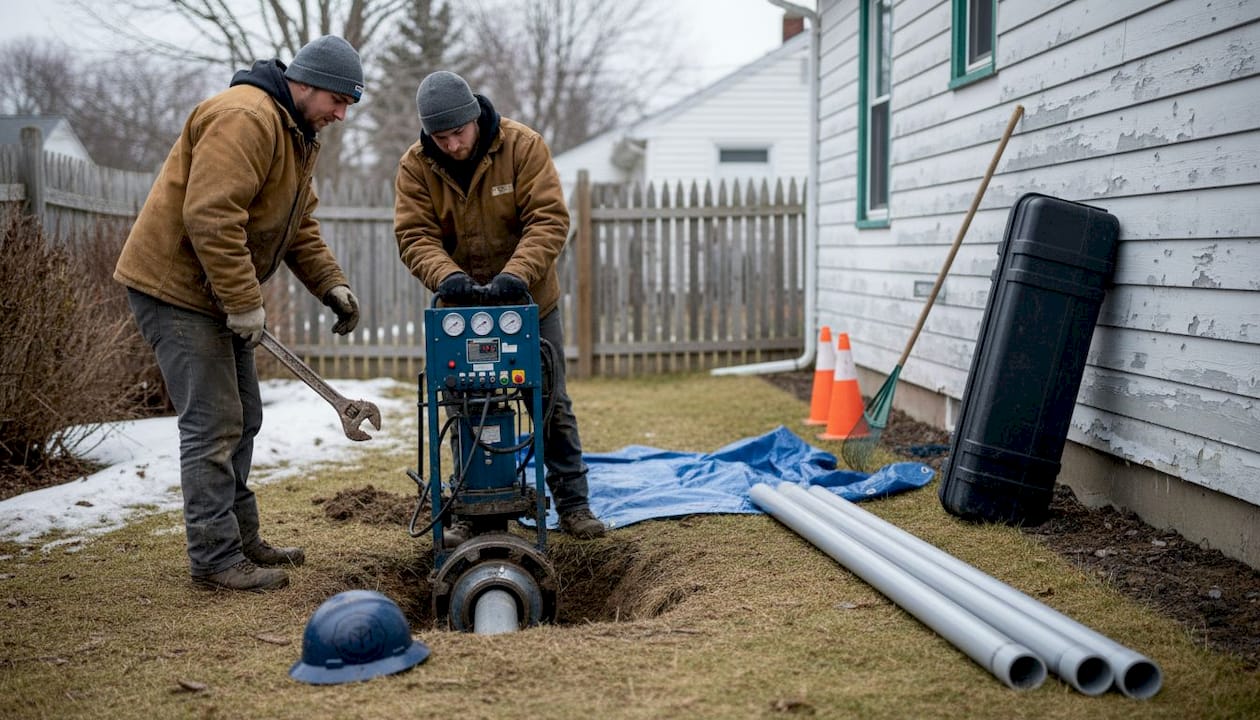
The result is a brand-new pipe with the same or even larger diameter than the original, installed without the need for a full open trench. You can review specific project applications through trenchless sewer services offered across Maine.
When pipe bursting makes sense:
- The existing pipe has collapsed or has more than 25% wall loss
- The pipe material is old clay, cast iron, or Orangeburg (a bituminous fiber pipe common in mid-century construction)
- You need a full pipe replacement, not just a repair
- The pipe route is relatively straight with accessible entry and exit pits
Important requirements and limitations:
- Soil stability is critical. Pipe bursting displaces the old pipe outward, so loose or highly saturated soil can cause complications.
- Clearance from other utilities (gas lines, water mains, electrical conduits) must be confirmed before work begins. Trenchless repair project timing is also affected by utility locating requirements, which can add time to the planning phase.
- The method works best on relatively straight runs. Sharp bends or multiple direction changes can make bursting difficult or impossible.
As industry sources confirm, pipe bursting handles collapsed pipes but requires soil and utility clearance before proceeding.
| Factor | Details |
|---|---|
| Best pipe condition | Greater than 25% wall loss or full collapse |
| New pipe material | HDPE (high-density polyethylene) |
| Typical timeline | 1 to 2 days depending on length and access |
| Surface disruption | Small entry and exit pits only |
| Soil requirement | Stable, not waterlogged or sandy |
| Utility clearance | Required before any work begins |
CIPP vs. pipe bursting: side-by-side comparison
With both methods clearly explained, it helps to see them compared directly. Choosing the right method is not always obvious, especially when pipe damage sits in a gray zone between moderate and severe.
| Feature | CIPP lining | Pipe bursting |
|---|---|---|
| Best use case | Cracks, leaks, minor deformation | Collapse, severe wall loss |
| Disruption level | Minimal, access point only | Small entry and exit pits |
| Pipe diameter change | Reduces by 6-12% | Same or larger than original |
| Typical timeline | 1 day | 1 to 2 days |
| Soil requirements | Low | Moderate (stable soil needed) |
| Utility clearance needed | Lower risk | Required |
| Service life | 50+ years | 50+ years |
| Cost range | Moderate | Moderate to higher |
| Ideal material | Clay, cast iron, PVC with damage | Clay, cast iron, Orangeburg |
Both methods have specific pipe condition requirements that determine which is appropriate. The wrong choice wastes time and money.
For a detailed look at how these methods compare financially, the cost breakdown for trenchless vs excavation is a useful resource before you get contractor quotes.
How to decide between CIPP and pipe bursting:
- Schedule a professional video camera inspection to assess actual pipe condition.
- Confirm the percentage of wall loss or structural deformation with your contractor.
- Check soil conditions and have utilities located on your property.
- Ask for quotes for both methods if your pipe condition falls in a gray area.
- Factor in the long-term warranty, not just the upfront cost.
- Make your final decision based on pipe condition first, then budget.
When is excavation still necessary?
Modern trenchless methods are impressive, but they are not a solution for every situation. There are real circumstances where open excavation remains the only viable option. Being aware of these scenarios helps you set realistic expectations and avoid surprise costs.
Excavation may be unavoidable when:
- The pipe has collapsed so severely that neither a liner nor a bursting head can be inserted
- The pipe is located in an area that trenchless equipment cannot physically access (under a concrete foundation, for example)
- Multiple utility conflicts make pipe bursting too risky to execute safely
- The pipe's route has so many sharp bends that trenchless equipment cannot navigate through it
- There is significant pipe offset (joints that have shifted out of alignment) that blocks liner insertion
What to ask your contractor: "Have you considered all trenchless options, and what specific condition ruled them out?" A reputable contractor will clearly explain why excavation is required rather than simply defaulting to the more familiar traditional method. Always ask for documented evidence from the camera inspection to support the recommendation.
As repair limitations show, CIPP and pipe bursting both have clear limits, and severely damaged or inaccessible pipes may require excavation as a last resort.
If excavation is necessary, ask your contractor what site restoration is included in the quote. Reputable companies will restore paving, soil grading, and landscaping as part of the project scope. You can review completed project examples through the trenchless project results gallery to understand what quality outcomes should look like.
The real cost of speed and minimal disruption in Maine sewer repair
Here is something most guides won't tell you: speed and minimal disruption are valuable, but they are not always the most important factors in a sewer repair decision.
We work with Maine homeowners every season, and we've seen the pattern repeat itself. A homeowner hears "no-dig" and immediately assumes it's the right call. But trenchless methods come with real prerequisites. Your soil needs to cooperate. Your pipe needs to be in the right condition. Your utilities need to be located and cleared. In Maine specifically, frost depth, clay-heavy soils, and aging infrastructure can complicate what looks like a straightforward job on paper.
Rushing to book the fastest available method without a thorough site assessment is one of the most expensive mistakes a property owner can make. A CIPP liner installed in a pipe with compromised structural integrity may fail prematurely. Pipe bursting in unstable or saturated soil can shift surrounding lines or create new problems.
The nuances of local repair choices in Maine matter more than most national guides acknowledge. Soil composition, seasonal ground movement from freeze-thaw cycles, and the age of your home's original pipe materials all influence which repair method will actually hold up over time.
Our honest advice: prioritize thoroughness over speed. A proper camera inspection, soil evaluation, and utility check add a day or two to the process. That time investment protects you from a repair that fails in two years and costs you the same price all over again. Long-term performance depends entirely on proper site assessment and skilled installation, not on how fast the first truck arrived.
Ready for a non-invasive solution? Get help from Maine's trenchless experts
If your sewer is showing warning signs, acting quickly protects your property and your wallet. The methods covered in this article represent the best available options for Maine homeowners who want effective repairs without tearing up their yards.
At Trenchless Maine, we bring over 50 years of combined expertise to every sewer repair project across the state. Whether you need to explore no-dig technology before committing to a method, or you're ready to see all trenchless services available in your area, our team is here to guide you through every step. We start with a thorough camera inspection, give you an honest assessment of your options, and deliver lasting results backed by industry-leading warranties. Don't wait for a minor issue to become a major emergency. Get a free quote today and find out which method is right for your property.
Frequently asked questions
What is the fastest non-invasive sewer repair method in Maine?
CIPP lining is typically the quickest option for pipes with cracks or leaks, with most residential jobs completed within a single day and minimal surface prep required.
Is pipe bursting right for all sewer repairs?
No. Pipe bursting is designed for collapsed or severely damaged pipes and requires stable soil conditions and confirmed clearance from nearby utilities before work can begin.
Does CIPP lining reduce my pipe's flow?
CIPP lining does reduce internal pipe diameter by 6-12% on average, but the smoother interior surface often compensates by improving flow compared to a corroded or root-invaded original pipe.
When is excavation unavoidable for sewer repair?
Excavation becomes necessary when severe pipe collapse or inaccessible pipe locations prevent trenchless equipment from entering, or when utility conflicts make pipe bursting unsafe to perform.