
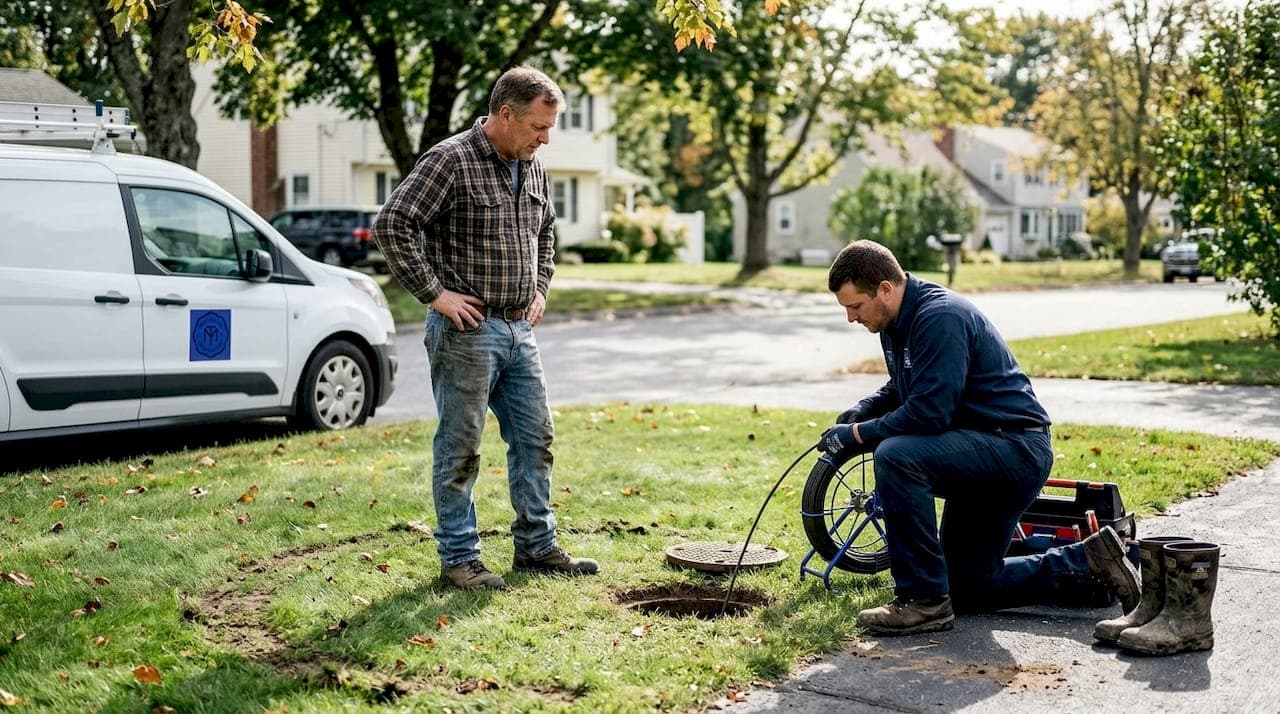
Most Maine homeowners assume that fixing a broken sewer line means tearing up the yard, cracking driveways, and living through days of noise and mess. That assumption is outdated. Cured-in-Place Pipe lining, or CIPP, lets technicians repair damaged pipes from the inside out without a single shovel in your landscaping. Maine DOT specifies UV CIPP for culverts and sewers, which means this technology meets the state's highest infrastructure standards. This guide walks you through how CIPP works, what it costs, and how to determine whether it's right for your home.
Table of Contents
- What is CIPP and how does it fix sewers?
- Why Maine prefers CIPP: Standards, safety, and environmental gains
- CIPP vs. traditional sewer repairs: Cost, speed, and disruption
- How to tell if CIPP is right for your sewer line
- Our take: What most Maine homeowners miss about CIPP
- See how trenchless sewer repair transforms Maine homes
- Frequently asked questions
Key Takeaways
| Point | Details |
|---|---|
| Minimal disruption solutions | CIPP technology repairs sewers without major digging, protecting your property’s landscape and foundation. |
| Better for Maine’s environment | UV-cured CIPP lining greatly reduces emissions and health risks compared to older methods. |
| Savings over traditional repairs | Homeowners can see major cost savings and faster results by choosing CIPP over excavation or pipe replacement. |
| Suitability matters | A proper camera inspection is essential to confirm if CIPP is the best solution for your sewer line problem. |
What is CIPP and how does it fix sewers?
CIPP stands for Cured-in-Place Pipe, a repair method where a resin-saturated liner is inserted into a damaged pipe and then hardened in place, forming a smooth, jointless new pipe wall inside the old one. No digging required. In Maine, UV-cured epoxy liners are the preferred choice because they cure faster, produce minimal odors, and deliver exceptional bond strength. CIPP offers non-invasive, long-lasting repair ideal for root-intruded, cracked, or leaking pipes running under homes and landscaping.
Here is how a typical CIPP installation unfolds:
- Camera inspection: A CCTV camera travels through the pipe to identify cracks, root intrusion, pipe deformation, or joint failures.
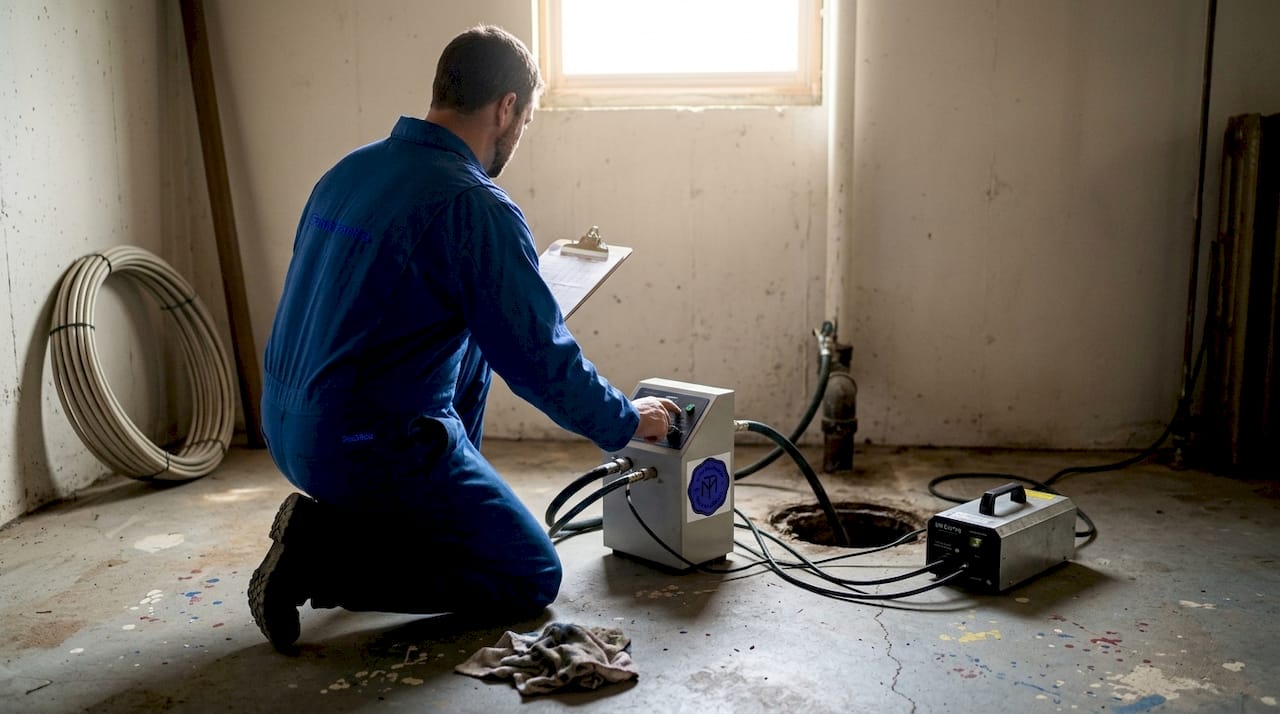
- Hydro jetting: High-pressure water clears debris, grease, and loose material so the liner bonds cleanly to the pipe wall.
- Liner insertion: A felt or fiberglass liner saturated with epoxy resin is pulled or inverted into position inside the damaged pipe.
- UV curing: A UV light train passes through the liner, hardening the resin within minutes into a rigid, corrosion-resistant sleeve.
- Final inspection: A second camera pass confirms the liner is fully sealed, smooth, and structurally sound before the pipe returns to service.
The entire process typically completes within one day. You can explore Maine trenchless lining services to see what each step looks like in practice, or browse before and after results from real Maine projects.
"UV CIPP liners cure faster and eliminate styrene-related odor concerns, making them the preferred standard for Maine infrastructure repairs."
Pro Tip: Never skip the camera inspection before scheduling a CIPP repair. A CCTV run confirms whether your pipe is a good candidate or whether a different method is needed.
Why Maine prefers CIPP: Standards, safety, and environmental gains
Maine's requirements for sewer and culvert rehabilitation go beyond generic national guidelines. The Maine DOT mandates UV-cured CIPP liners and non-styrene resins as the primary standard, with Glass Reinforced Pipe (GRP) accepted as an alternate. Traditional styrene-based resins are not permitted for new projects because they carry volatile organic compound (VOC) risks during installation and can discharge to treatment plants at concentrations above safe limits.
The environmental case for CIPP is backed by solid numbers. CIPP reduces CO2 emissions by approximately 59% compared to open-cut excavation methods, and UV-cured liners produce no significant VOC off-gassing during installation. That matters in Maine, where protecting waterways, wetlands, and soil quality is a legal and community priority.
| Feature | UV CIPP (Maine standard) | Styrene-based CIPP | Open-cut excavation |
|---|---|---|---|
| VOC/odor risk | Minimal | Moderate to high | Low but disruptive |
| CO2 footprint | 59% lower than open-cut | Moderate | Baseline (highest) |
| Maine DOT approved | Yes | No | Case by case |
| Landscape disruption | None | None | Severe |
| Cure time | Minutes (UV light) | Hours | N/A |
Beyond the environmental numbers, UV CIPP protects your family. Styrene off-gassing during traditional liner installation can cause temporary headaches and eye irritation. Non-styrene, UV-cured liners eliminate that concern entirely. For families in Maine, especially those with children or pets, that detail matters.
For seasonal guidance on keeping your sewer healthy year-round, read our Maine sewer maintenance tips. And if you want to understand the long-term protection built into our work, our warranty details cover repairs up to 50 years.
Pro Tip: Before signing any repair contract, ask your contractor whether the liner resin is non-styrene and UV-cured. If they can't confirm it, that's a warning sign.
CIPP vs. traditional sewer repairs: Cost, speed, and disruption
Knowing CIPP meets Maine standards is useful, but you also need to know how it performs against alternatives when your wallet and schedule are on the line. Here is a direct comparison.
| Factor | CIPP lining | Open-cut excavation | Pipe bursting |
|---|---|---|---|
| Avg. project duration | 1 day | 3 to 7 days | 1 to 2 days |
| Landscape disruption | None | Extensive | Moderate |
| Potential cost savings | Up to $400,000 | Baseline cost | Moderate savings |
| Pipe size flexibility | Most standard sizes | All sizes | Limited to similar diameter |
| Suitable for collapsed pipes | No | Yes | Yes |
| Longevity | 50+ years | 30 to 50 years | 30 to 50 years |
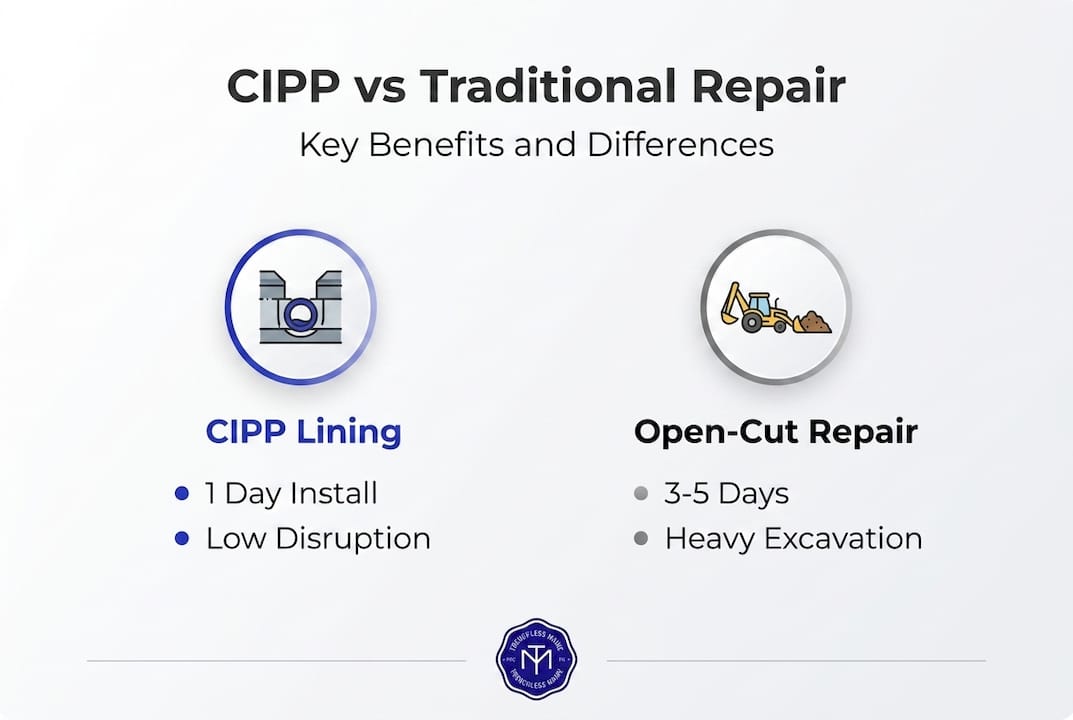
CIPP wins on speed, disruption, and cost for structurally viable pipes, while dig-and-replace remains the appropriate choice for fully collapsed lines or situations requiring upsizing.
When CIPP is your best option:
- Root intrusion, minor cracks, or joint leaks in otherwise intact pipes
- Lines running under driveways, landscaping, or concrete slabs
- Properties where excavation would damage mature trees, gardens, or hardscaping
- Projects where returning to normal use within 24 hours is a priority
When another method may be necessary:
- Pipes that have fully collapsed with no structural integrity remaining
- Lines that need to be upsized for increased flow capacity
- Severely misaligned pipe sections that a liner cannot conform to
For a detailed breakdown of expenses, see our cost comparison: CIPP vs excavation. If you're unsure whether your pipe is a good repair candidate, our guide on when repair makes sense covers older Maine pipe materials specifically. You can also review drainage issue signs to know when it's time to call a professional.
How to tell if CIPP is right for your sewer line
Not every damaged pipe qualifies for CIPP lining. The good news is that a straightforward assessment process tells you quickly whether your home is a fit.
Step-by-step assessment:
- Schedule a sewer camera inspection. A CCTV run is non-negotiable. It reveals the pipe's condition, material, and whether any obstructions or deformations exist.
- Identify the pipe material. Older Maine homes often have clay or Orangeburg pipe, both of which are prone to cracking, root intrusion, and joint separation. CIPP is well-suited for these materials as long as the pipe retains basic structural shape.
- Confirm pipe condition. The pipe must have enough wall integrity to hold a liner. Severe deformation or full collapse rules out CIPP.
- Review access points. CIPP requires a cleanout or access point at each end of the repair section. If your home lacks cleanouts, they can usually be added during the same service visit.
- Discuss alternatives if needed. If CIPP is not suitable, pipe bursting or spot repair may apply. Your technician should present options clearly.
CIPP eligibility checklist:
- Pipe is cracked, leaking, or has root intrusion but is not fully collapsed
- Pipe diameter falls within standard CIPP liner sizes
- No severe misalignment or major pipe deformation is present
- Access points are available or can be installed
- Pipe material is clay, cast iron, PVC, or Orangeburg in viable condition
Browse our success stories to see how homes across Maine with older clay and Orangeburg lines were rehabilitated without excavation.
Our take: What most Maine homeowners miss about CIPP
After working on hundreds of Maine sewer projects, we notice a consistent pattern: homeowners who skip the camera inspection upfront are the ones who end up paying more and getting surprised. They hear "trenchless" and assume it solves every problem, then feel let down when their fully collapsed pipe still requires excavation. That's not a failure of CIPP. That's a failure of expectations set without proper diagnosis.
Another thing most people miss is the difference between liner technologies. Not every provider uses UV-cured, non-styrene liners. Some still install older styrene-based systems, which are cheaper but produce more odor and don't meet current Maine DOT standards. You should always ask specifically which liner system a contractor plans to use.
Warranty transparency is equally important. A quality CIPP repair should come with a written warranty of 25 to 50 years. If a contractor hesitates to put that in writing, walk away.
Read more real-world perspectives on our expert sewer repair insights page.
Pro Tip: Ask any contractor for local project photos and references before signing. A reputable CIPP provider in Maine will have documented results from homes in your region, not just generic before-and-after images.
See how trenchless sewer repair transforms Maine homes
If this guide has made one thing clear, it's that sewer repair doesn't have to disrupt your life, destroy your yard, or drain your savings. Our team at Trenchless Maine brings over 50 years of combined expertise to every project, using no-dig repair technology that meets Maine's highest standards.
Explore our before-and-after gallery to see real Maine homes restored without excavation. When you're ready for a professional assessment, get a free quote and one of our technicians will walk you through your options with no pressure and no obligation. Most repairs complete within 24 hours, and all work is backed by our industry-leading warranty.
Frequently asked questions
Is CIPP lining suitable for old clay or Orangeburg pipes in Maine?
CIPP can often rehabilitate older clay or Orangeburg pipes if they're not fully collapsed, but a camera inspection first is required to confirm suitability before any work begins.
How long does CIPP sewer repair typically last?
CIPP solutions can last 50 years or more, particularly with UV-cured liners that meet Maine DOT's current performance standards.
Are odors or chemical fumes an issue with CIPP?
Modern UV-cured, non-styrene liners produce minimal odors and emissions, making them far safer for occupied homes than older styrene-based systems.
How does CIPP compare in cost and disruption to traditional dig-and-replace methods?
CIPP typically costs less overall, avoids extensive excavation, and can save homeowners up to $400,000 on larger projects compared to full open-cut replacement.