

Maine sewer regulations are defined as the combined set of state, municipal, and local rules governing how sewer systems are connected, repaired, permitted, and maintained on private and commercial property. Understanding Maine sewer regulations means knowing which agency has authority over your property, what permits you need before any work begins, and what happens if you skip that process. The Maine Department of Environmental Protection, Local Plumbing Inspectors (LPIs), and municipal sewer districts each play a distinct role. Getting this wrong costs money, delays home sales, and can void contractor warranties. Getting it right protects your property value and keeps you on the right side of the law.
What do Maine sewer regulations require from homeowners?
Maine sewer regulations cover three broad categories: sewer connections to public mains, subsurface wastewater disposal (septic systems), and interior plumbing that ties into either system. Each category has its own permitting authority and inspection process. Knowing which category applies to your project is the first step toward compliance.
The Maine Department of Environmental Protection oversees subsurface wastewater rules under its Subsurface Wastewater Program. Local Plumbing Inspectors enforce the Maine Plumbing Code for interior work and sewer lateral connections. Municipal sewer districts control access to public sewer mains and set their own connection standards on top of state minimums. You may need approvals from more than one of these bodies for a single project.
The stakes are real. Unpermitted sewer work risks fines, voided warranties, and legal complications when you sell your home. Buyers' attorneys routinely flag unpermitted sewer work during title searches. Addressing compliance before work starts is always cheaper than fixing it afterward.
What permits are required for sewer work in Maine?
Permit requirements depend on the type of work and your location. Here is what most Maine homeowners and developers encounter:
- Sewer connection permit: Required when connecting a new structure or adding a new lateral to a public sewer main. Issued by the municipal sewer district.
- Plumbing permit: Required for interior fixture additions, drain line modifications, and sewer lateral work. Issued by the Local Plumbing Inspector. Fees vary by fixture count.
- Septic system permit: Required for new septic installations or major repairs. Septic permits cost $250–$1,500 in Maine, with site evaluations running $400–$1,200 depending on lot complexity.
- Repair permit: Required for most sewer pipe repairs, including trenchless methods like CIPP lining. Most Maine towns require permits and inspections even for pipe relining, so verify local requirements before scheduling any contractor.
The permit process follows a standard sequence: application submission, plan review, work authorization, rough-in inspection, and final sign-off by the LPI or sewer district. Skipping any stage can trigger stop-work orders.
Starting work without permits can lead to fines, voided warranties, and serious problems during home sales. That triple risk is why permit compliance is non-negotiable, not optional.
Pro Tip: Contact your local sewer district and LPI before hiring any contractor. Confirm in writing which permits apply to your specific project. Contractor advice alone is not always complete or accurate.
Municipal sewer vs. septic: what are the key regulatory differences?
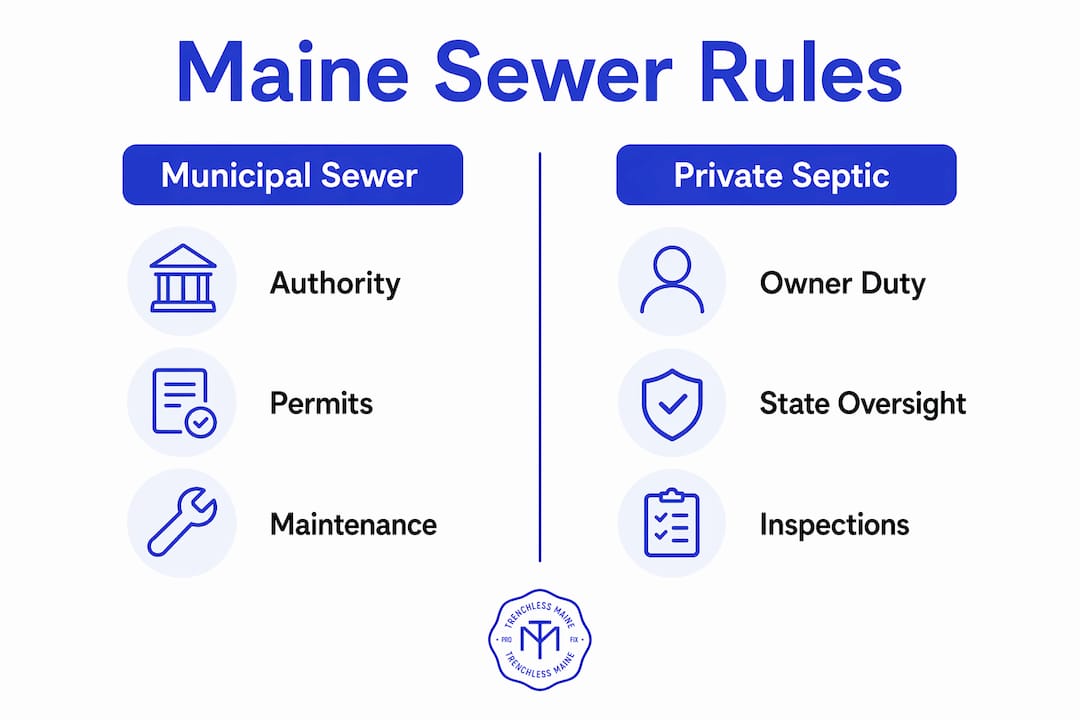
Your property's wastewater system determines which rules apply to you. The table below outlines the core regulatory differences between municipal sewer connections and private septic systems in Maine.
| Factor | Municipal sewer | Private septic |
|---|---|---|
| Regulatory authority | Municipal sewer district + LPI | Maine DEP Subsurface Wastewater Program + LPI |
| Permit issuer | Sewer district and/or LPI | Maine DEP and LPI |
| Typical permit cost | Varies by municipality | $250–$1,500 for septic; $400–$1,200 for site evaluation |
| Maintenance responsibility | Homeowner owns the lateral; district owns the main | Homeowner owns the entire system |
| Connection restrictions | State law caps lot size requirements at 5,000 sq ft and frontage at 1,250 sq ft | Lot size and soil conditions govern system design |
Maine law limits what municipal ordinances can demand from property owners seeking public sewer access. State law caps lot size requirements at 5,000 square feet and street frontage requirements at 1,250 square feet for public sewer connections. That cap prevents municipalities from using excessive lot standards to block reasonable connection requests.
Homeowners bear full responsibility for private septic systems and sewer laterals. That responsibility does not transfer to tenants or municipalities. If your lateral fails, the repair cost and permit process fall on you.
Understanding whether your property connects to a public sewer main or relies on a private septic system changes every regulatory decision you make. Check your property records or contact your municipality if you are unsure. For a detailed breakdown, the septic vs. sewer comparison from Trenchlessmaine covers the key planning and cost differences.
How does the Maine Plumbing Code affect sewer work?
The Maine Plumbing Code sets minimum technical standards for all plumbing and sewer work statewide. The code applies statewide and is enforced through inspections by licensed Local Plumbing Inspectors. No municipality can adopt standards weaker than the state code, though they can add requirements on top of it.
Here is what the code means in practice for sewer-related projects:
- Interior plumbing: Any modification to drain lines, vent stacks, or fixture connections requires a plumbing permit and LPI inspection.
- Sewer lateral work: Repairs or replacements of the pipe running from your home to the public main or septic tank require permits and inspection, regardless of the method used.
- Subsurface wastewater: Chapter 241 of Maine's rules governs septic design, installation, and repair separately from interior plumbing. Both sets of rules can apply to the same project.
- Licensed professionals: Maine law permits limited owner-occupant plumbing work, but permits and code compliance remain mandatory. Public sewer lateral connections require licensed professionals.
A common misconception is that trenchless repairs like pipe relining are exempt from permits because no excavation occurs. They are not exempt. The method of repair does not change the permit requirement. The permit covers the work itself, not the technique.
Pro Tip: Ask your LPI about inspection stages before work starts. Knowing when rough-in and final inspections are scheduled lets you coordinate with your contractor and avoid costly re-inspections.
How do you manage sewer repairs and maintenance compliantly in Maine?
Compliant sewer maintenance follows a clear sequence. Skipping steps creates legal exposure and can turn a routine repair into an expensive problem.
-
Inspect before you repair. Schedule a camera inspection to document the condition of your sewer lateral before any work begins. This gives you an accurate scope of work and supports your permit application. Trenchlessmaine's camera inspection service provides a clear video record of pipe condition.
-
Pull permits before work starts. Contact your LPI and sewer district to confirm which permits apply. Submit applications early. Timing repairs as planned maintenance rather than emergencies gives you time to navigate the permit process without pressure.
-
Hire a NASSCO-certified contractor. NASSCO certification demonstrates a contractor's adherence to technical standards and local regulations. Certified contractors are more likely to pull the correct permits and complete inspections properly. This protects your warranty and your legal standing.
-
Schedule required inspections. Do not cover or backfill any work before the LPI signs off. Covered work that has not been inspected is treated as unpermitted work, even if you pulled a permit.
-
Document everything. Keep copies of your permit, inspection reports, and contractor certifications. This documentation protects you during home sales and supports warranty claims. Sewer lateral connections to public mains must be repaired by licensed professionals to meet compliance standards.
Preventive maintenance reduces the likelihood of emergency repairs. Slow drains, gurgling sounds, and wet patches in your yard are early warning signs. Addressing them early through non-invasive repair methods keeps costs down and keeps you in control of the permit timeline.
Pro Tip: Schedule a camera inspection every 5–7 years even if you have no visible symptoms. Early detection of root intrusion or pipe deformation lets you plan repairs on your schedule, not an emergency timeline.
Key Takeaways
Complying with Maine sewer regulations requires permits, licensed contractors, and documented inspections at every stage of sewer connection, repair, or maintenance work.
| Point | Details |
|---|---|
| Permits are always required | Sewer repairs, connections, and relining all require permits before work begins, regardless of method. |
| Know your system type | Municipal sewer and private septic systems have different regulatory authorities and permit processes. |
| Hire NASSCO-certified contractors | Certified professionals follow local codes and pull correct permits, protecting your warranty and legal standing. |
| Plan repairs early | Scheduling maintenance before emergencies gives you time to complete the permit process without delays. |
| Document every step | Keep permits, inspection reports, and contractor credentials on file to protect yourself during home sales. |
What I've learned from watching homeowners get this wrong
The most common mistake I see is homeowners treating sewer repair as a purely private matter. They hire a contractor, the work gets done, and nobody pulls a permit. Everything looks fine until the house goes on the market and the buyer's inspector flags the unpermitted work. At that point, you are either paying to redo the job with proper permits or negotiating a price reduction. Neither outcome is good.
The second mistake is assuming that because a contractor said permits were not needed, permits were not needed. Contractors sometimes skip permits to move faster or keep bids competitive. That is their risk tolerance, not yours. Always verify permit requirements directly with your LPI or sewer district. Put the confirmation in writing.
What I find most useful is thinking about sewer work the way you think about a roof replacement. You would not skip a building permit on a new roof. Sewer work carries the same legal weight and the same resale implications. The role of compliance in sewer repair is not bureaucratic overhead. It is the paper trail that proves your home's infrastructure is sound.
The good news is that trenchless repair methods have made compliant repairs faster and less disruptive than they used to be. CIPP lining and hydro jetting can often be completed within a single day. There is no longer a strong practical argument for skipping permits to save time.
— John
Trenchlessmaine: compliant sewer repair across Maine
Trenchlessmaine specializes in trenchless sewer repair and pipe lining solutions that meet Maine's regulatory requirements without tearing up your yard or your schedule.

Every project includes licensed contractors, permit coordination, and post-repair documentation. Services include CIPP pipe lining, hydro jetting for drain clearing, camera inspections, and fast drain clearing for urgent blockages. Most repairs are completed within 24 hours, and warranties extend up to 50 years. Trenchlessmaine covers most of Maine's cities and towns. Check whether your property falls within the service area and request a free quote to get started with a fully compliant repair plan.
FAQ
Do I need a permit for sewer pipe relining in Maine?
Yes. Most Maine towns require permits and inspections for sewer pipe relining, even though no excavation is involved. Verify requirements with your local sewer district or LPI before scheduling work.
Who enforces Maine plumbing and sewer regulations?
The Maine Department of Environmental Protection oversees septic systems, Local Plumbing Inspectors enforce the Maine Plumbing Code, and municipal sewer districts regulate public sewer connections. All three may have jurisdiction over a single project.
What happens if I do sewer work without a permit in Maine?
Unpermitted sewer work can result in fines, voided contractor warranties, and complications during home sales. Buyers' attorneys routinely identify unpermitted work during title searches, which can delay or kill a sale.
Can I do my own sewer work in Maine?
Maine law allows limited owner-occupant plumbing work, but permits and code compliance are still required. Public sewer lateral connections must be performed by licensed professionals to meet state standards.
How much does a sewer permit cost in Maine?
Permit costs vary by project type and municipality. Septic permits range from $250 to $1,500, and site evaluations cost $400 to $1,200. Plumbing permit fees are typically calculated by fixture count and differ across towns.