
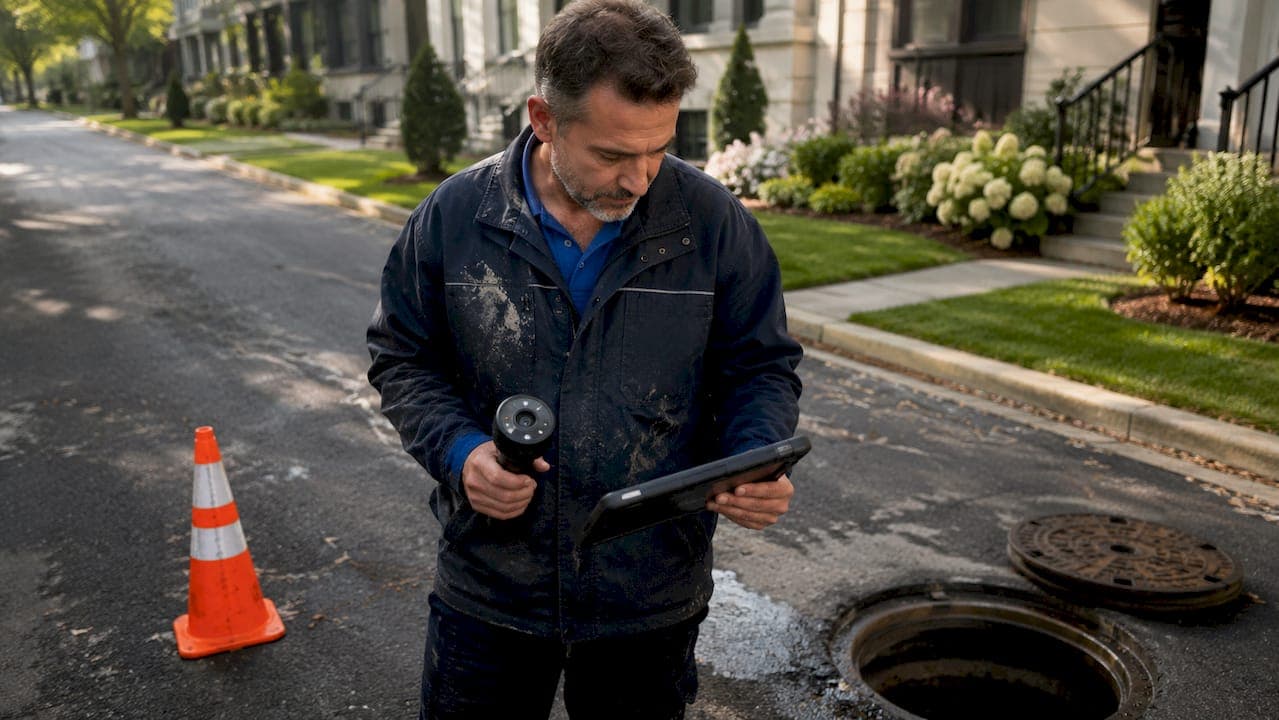
Pipe condition assessment is the process of evaluating the structural integrity and performance of pipelines to identify risks before failure occurs. For property owners and managers, understanding the importance of pipe condition assessment means the difference between a planned repair and an emergency that disrupts your property, your tenants, and your budget. Corrosion management alone costs $1.372 billion annually in oil and gas infrastructure. That figure reflects a broader truth: pipe failures are expensive, and most of them are preventable with the right data in hand.
Why is pipe condition assessment important for your property?
Pipe integrity evaluation gives you a clear picture of what is actually happening inside your sewer and water lines. Without that picture, you are making repair and replacement decisions based on guesswork. Proactive assessment transforms management from reactive panic to predictable maintenance, avoiding disastrous failures. That shift matters enormously when you are responsible for a building, a rental property, or a commercial facility in Maine.
The financial stakes are real. Failures incur extensive economic, environmental, and reputational costs, extending well beyond the direct repair bill to public safety and ecological damage. A sewer backup in a multi-unit building, for example, can mean displaced tenants, health code violations, and emergency excavation costs that run into the tens of thousands of dollars. A scheduled camera inspection, by contrast, costs a fraction of that and gives you the data to act before the crisis hits.

Regulatory bodies and industry standards increasingly require documented pipeline health records for commercial and municipal properties. Staying ahead of those requirements protects you from penalties and positions you as a responsible property steward.
What condition assessment techniques are used to inspect pipes?
The industry term for the field is pipeline integrity management, and it draws on several well-established methods. Understanding how these techniques work helps you ask the right questions when hiring a professional.
The most common approaches include:
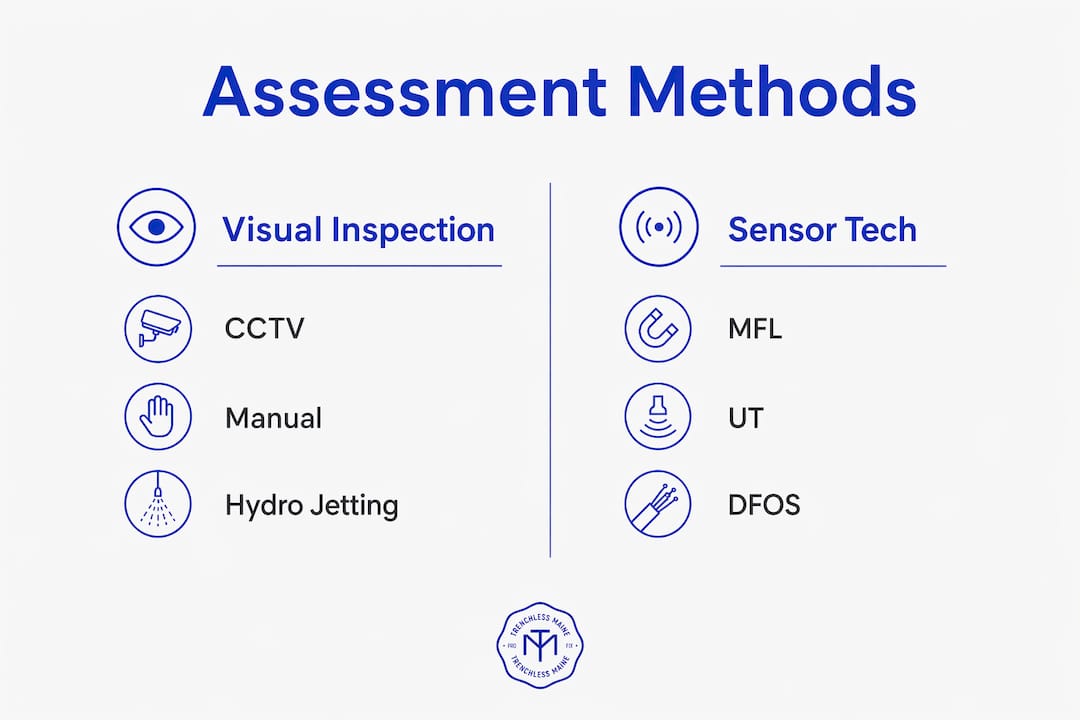
- CCTV camera inspection: A motorized camera travels through the pipe and records video of the interior. This is the baseline method for residential and commercial sewer laterals and gives a direct visual record of cracks, root intrusion, pipe deformation, and joint separation.
- In-line inspection (ILI): Used primarily in larger diameter pipelines, ILI tools travel through the pipe and collect data on wall thickness and geometry without excavation.
- Non-destructive testing (NDT): Methods like acoustic leak detection and electromagnetic surveys confirm deterioration mechanisms without damaging the pipe. Combining NDT with visual inspections is the gold standard for condition accuracy before any repair decision is made.
- Magnetic flux leakage (MFL) and ultrasonic testing (UT): These sensor-based tools detect metal loss and wall thinning in steel and cast iron pipes with high precision.
- Distributed fiber optic sensing (DFOS): An emerging method that monitors strain and temperature changes along the pipe length continuously.
Advanced machine learning models integrated with MFL, UT, and DFOS sensor data achieve up to 99.9% accuracy in defect classification. That level of accuracy means fewer false alarms and more targeted repairs.
A two-tiered assessment strategy is the most cost-efficient approach for larger properties or utility networks. The first tier uses GIS data and operational records to screen the entire system and identify high-risk segments. The second tier applies high-fidelity inspection tools only to those priority segments. This avoids the cost of inspecting every pipe with expensive equipment when most of the network is likely sound.
Pro Tip: Ask your inspection provider whether they use a tiered screening process. A provider who inspects every pipe with the same tool regardless of risk is likely overcharging you or missing the bigger picture.
For a practical overview of pipe inspection methods suited to Maine homes, Trenchlessmaine has published a detailed breakdown of non-invasive options available to residential and commercial property owners.
How much money can condition assessment actually save you?
The financial case for regular pipe condition checks is not theoretical. Targeted pipeline interventions based on assessment data can save utilities over $35 million compared to full replacements by fixing only the localized defect areas. Localized repairs typically cost $300,000 to $400,000 versus the full replacement cost of the same segment. The return on investment for condition assessment spending commonly ranges from 10x to 20x.
For a property owner, the math scales down but the principle holds. Here is how pipe integrity evaluation pays for itself:
- Avoiding emergency repair premiums. Emergency sewer repairs cost significantly more than scheduled work. A camera inspection that catches a developing crack lets you schedule a CIPP lining repair at a planned rate rather than paying emergency call-out fees.
- Eliminating unnecessary full replacements. Without condition data, contractors may recommend full pipe replacement when only a short section needs attention. Assessment data gives you the evidence to push back or confirm the recommendation.
- Extending asset life. Non-invasive pipe repair methods like CIPP lining can add decades to a pipe's service life when applied at the right time, based on condition data rather than guesswork.
- Supporting accurate budgeting. When you know the condition of your pipes, you can plan capital expenditures over a 5-year or 10-year horizon instead of being surprised by failures.
- Protecting property value. Documented pipe inspection records are an asset during property sales and lease negotiations, demonstrating responsible maintenance to buyers and tenants.
The impact of pipe maintenance decisions compounds over time. A property with a documented inspection history and proactive repair record carries measurably lower risk than one with no records at all.
Why pipe age alone does not tell you what you need to know
Age is often mistakenly used as the primary criterion for replacement urgency. Pipe age is a poor sole indicator of replacement urgency because pipes installed the same year can vary dramatically in condition depending on their environment and use history.
Consider two cast iron sewer laterals installed in the same year on the same street. One runs through stable, neutral soil with consistent flow. The other runs through acidic soil with frequent pressure fluctuations and root intrusion from nearby trees. By year 30, these two pipes may be in completely different states. Replacing both because they are "old" wastes capital. Replacing neither because they are "not old enough" risks failure in the deteriorated one.
| Factor | Age-based approach | Condition-based approach |
|---|---|---|
| Replacement trigger | Years since installation | Actual structural integrity data |
| Capital allocation | Uniform, often inefficient | Targeted to highest-risk segments |
| Failure risk | Higher, due to missed localized issues | Lower, due to data-driven prioritization |
| Cost outcome | Frequent over-replacement or missed failures | Repairs matched to real need |
Localized environmental factors like soil corrosivity and pressure fluctuations cause pipe failure more than age alone. Over 90% of a pipeline network may be sound while only specific segments need intervention. That insight should change how you think about your next inspection conversation.
Pro Tip: When a contractor recommends full pipe replacement, ask for the condition data that supports that recommendation. If they cannot provide wall thickness readings, camera footage, or NDT results, get a second opinion.
How do you integrate condition assessment into ongoing maintenance?
The goal is to move from reactive repairs to a predictable, data-driven maintenance program. Pipeline integrity management shifts from periodic inspections to continuous, data-driven condition awareness supported by digital monitoring and AI analysis. For property owners, this means building assessment into your regular maintenance calendar rather than waiting for a symptom to appear.
A practical risk-based maintenance program for your property includes:
- Scheduled baseline inspections. Conduct a full CCTV camera inspection of your sewer laterals every 3–5 years, or after any significant ground disturbance like excavation or tree removal near the line.
- Risk-based prioritization. Rank your pipes by a combination of condition score and service criticality. A sewer line serving a commercial kitchen carries higher risk than one serving a storage building.
- Continuous monitoring where warranted. For larger properties or high-value infrastructure, sensor-based monitoring provides real-time alerts on flow changes, pressure drops, and potential blockages.
- Documented maintenance records. Keep a log of every inspection, cleaning, and repair. This record supports insurance claims, regulatory compliance, and property transactions.
- Proactive cleaning cycles. Hydro jetting on a scheduled basis prevents buildup that accelerates pipe wall deterioration, extending the interval between major repairs.
Applying machine learning to historical inspection data can predict corrosion growth and optimize future inspection schedules. For most residential property owners, this level of analysis is handled by your service provider. What you control is whether you give them the data to work with by scheduling regular condition checks. Learning how to maintain sewer lines proactively is the single most effective step you can take to avoid costly emergency repairs.
Key Takeaways
Regular pipe condition assessment is the most cost-effective way to prevent emergency sewer failures, extend pipe life, and make informed repair decisions based on real structural data.
| Point | Details |
|---|---|
| Assessment beats age as a guide | Pipe condition data, not installation year, drives accurate repair and replacement decisions. |
| Targeted repairs save significant money | Fixing localized defects costs a fraction of full replacement and avoids unnecessary capital spending. |
| NDT and camera inspection are the baseline | Combining visual CCTV inspection with non-destructive testing gives the most accurate condition picture. |
| Risk-based scheduling is most efficient | Prioritize inspections by condition score and service criticality, not by a uniform calendar. |
| Proactive maintenance prevents emergencies | Scheduled inspections and cleaning cycles stop small defects from becoming costly failures. |
What I have learned from watching property owners skip this step
The property owners who call in a panic are almost always the ones who skipped the scheduled inspection two years earlier. I have seen this pattern repeat enough times to say it plainly: the cost of ignoring pipeline health is not just financial. It is the disruption, the stress, and the loss of control that comes with an emergency you could have seen coming.
What surprises most property owners is how much useful information a single camera inspection produces. You do not just learn whether the pipe is failing. You learn where the root intrusion is concentrated, how far the joint separation has progressed, and whether the pipe geometry has shifted. That information changes the entire repair conversation from "replace it all" to "fix this specific section."
The technology has also moved faster than most property owners realize. Machine learning models now predict corrosion growth from historical inspection data, which means your inspection provider can tell you not just what the pipe looks like today but when it is likely to need attention next. That kind of forward visibility is what separates a reactive maintenance budget from a planned one.
My honest advice: treat your first condition assessment as an investment in knowing what you own. Schedule it before you see symptoms, not after. The pipe lining benefits you gain from catching issues early far outweigh the cost of the inspection itself.
— John
Trenchlessmaine's pipe inspection and maintenance services
Knowing the condition of your pipes is only useful if you act on it. Trenchlessmaine specializes in non-invasive pipe inspection and repair across Maine, with over 50 years of combined expertise in sewer lateral assessment, CIPP lining, and targeted pipe maintenance.
When your condition assessment reveals buildup, blockages, or early-stage deterioration, hydro jetting in Maine clears the line thoroughly without excavation, restoring flow and slowing further wall degradation. For urgent blockages, Trenchlessmaine's drain clearing services provide fast response across most of Maine's cities. Contact Trenchlessmaine to schedule a camera inspection and get a clear picture of your pipe's current condition before a small problem becomes a costly emergency.
FAQ
What is pipe condition assessment?
Pipe condition assessment is the process of evaluating a pipe's structural integrity, wall thickness, and performance using inspection tools like CCTV cameras, non-destructive testing, and sensor-based methods to identify defects before failure occurs.
How often should property owners inspect their sewer pipes?
A full CCTV camera inspection every 3–5 years is the standard recommendation for residential and commercial sewer laterals, with more frequent checks after ground disturbance or if the property has older cast iron or clay pipes.
Why is pipe age a poor indicator of when to replace a pipe?
Pipes installed the same year can vary greatly in condition based on soil type, pressure history, and root intrusion. Condition data from an actual inspection provides far more accurate replacement guidance than installation date alone.
What is the return on investment for condition assessment?
Return on investment for condition assessment spending commonly ranges from 10x to 20x, driven by avoiding unnecessary full replacements and reducing emergency repair costs through early defect detection.
What is the difference between NDT and CCTV pipe inspection?
CCTV inspection provides visual footage of the pipe interior, while non-destructive testing methods like magnetic flux leakage and ultrasonic testing measure wall thickness and detect metal loss without visual access. Combining both methods gives the most complete picture of pipe health.