
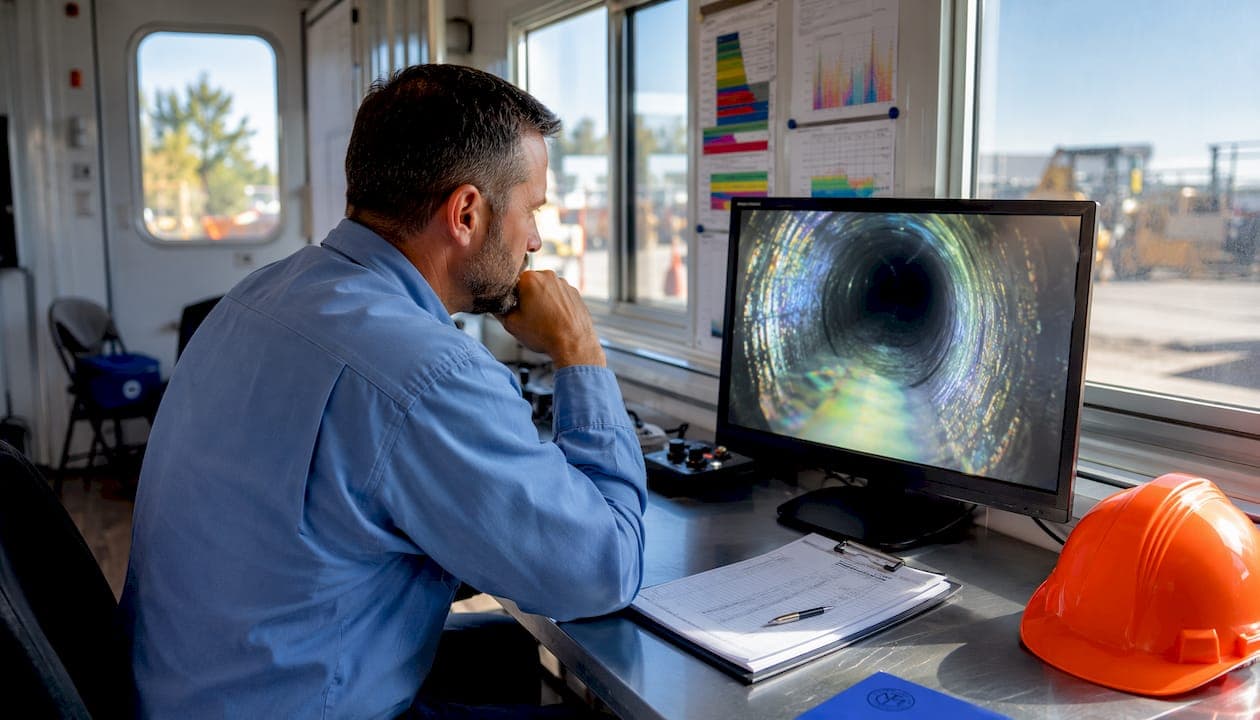
Slip lining is a trenchless rehabilitation method that inserts a new, smaller "carrier" pipe inside a deteriorating "host" pipe, then grouts the annular space between them to restore structural integrity and transfer loads. In use since the 1940s, it applies to gravity sewers, water mains, gas lines, stormwater culverts, and force mains. It is the right call when the host pipe is structurally sound enough to support insertion forces and the alignment is mostly straight. It is the wrong call when the host has collapsed, carries sharp mitered bends, or has service laterals too shallow to reconnect after lining.
When slip lining fits your project:
- Host pipe retains structural integrity (no collapse, no severe offset joints)
- Alignment is predominantly straight with gentle curves only
- Gravity sewers, water mains, or culverts where some diameter reduction is acceptable
- Manhole spacing or access points allow liner insertion without excessive joint count
When to choose a different method:
- Host pipe has collapsed or has severe deformation that blocks liner passage
- Sharp bends or mitered fittings prevent continuous insertion
- Service laterals are too numerous or too shallow to excavate and reconnect economically
- Diameter reduction would drop hydraulic capacity below design requirements
A CCTV inspection is non-negotiable before committing to slip lining. It confirms host pipe condition, identifies obstructions, and determines whether HDPE/PE100 continuous fusion or segmental jointing is the right approach. CIPP (cured-in-place pipe) is the primary alternative when bends or diameter loss are concerns.
Table of Contents
- How slip lining works: continuous vs. segmental methods
- Step-by-step slip lining installation process
- What materials are used in slip lining, and what equipment does it need?
- What are the real benefits of slip lining, and where does it fall short?
- How engineers decide if a pipe is a slip lining candidate
- Slip lining vs. CIPP, pipe bursting, and open-cut replacement
- What to expect after installation: lifespan, grouting, and maintenance
- A U.S. contractor perspective: what good slip lining looks like in practice
- Environmental impact and regulatory considerations
- Common failure modes and long-term performance considerations
- Key Takeaways
- What experienced crews watch for that most project plans miss
- Trenchlessmaine can assess your pipe and recommend the right approach
- Useful sources for deeper technical reading
How slip lining works: continuous vs. segmental methods
Slip lining comes in two mechanical forms, and the choice between them drives nearly every downstream decision on materials, equipment, and schedule.
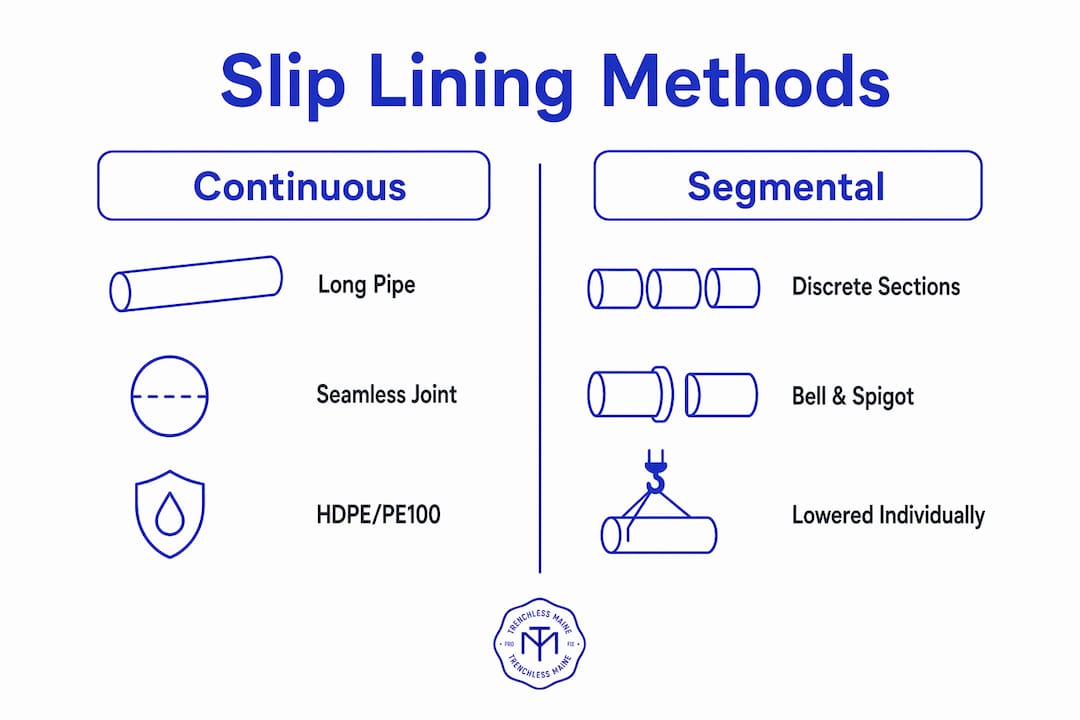
Continuous slip lining uses a long string of pipe, typically HDPE or PE100, butt-fused into a single seamless run on the surface before insertion. The fused string is then pulled or pushed through the host pipe from an insertion pit to a receiving pit. Because there are no joints inside the host pipe, leak risk is minimal and the liner behaves as a monolithic structural element. This method handles diameters roughly from 4 inches up to 63 inches and installation lengths up to around 1,000 feet per run.
Segmental slip lining uses discrete bell-and-spigot or mechanically jointed sections, lowered one at a time into the insertion pit and pushed forward as each piece is added. Materials include FRP (fiberglass-reinforced plastic), PVC, and spirally welded steel. Segmental methods accommodate a wider range of diameters, making them the standard approach for large culverts and trunk sewers. Both methods can negotiate gentle curves, but neither handles sharp bends well.
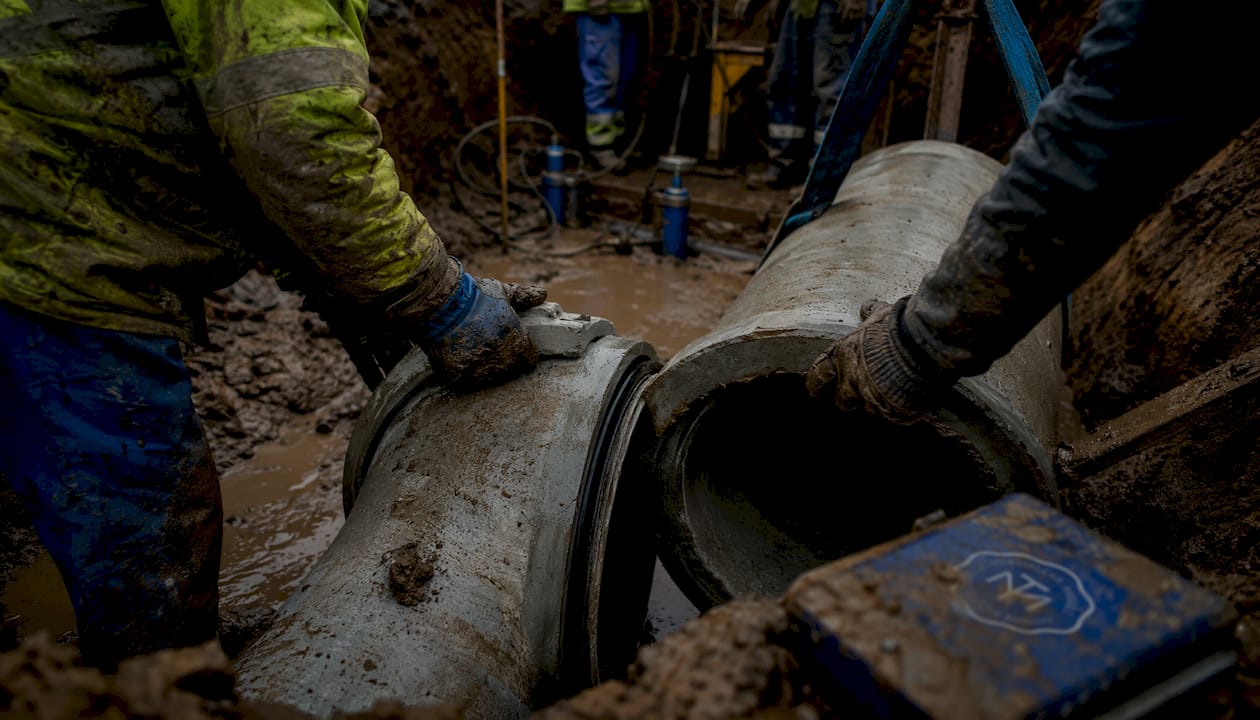
Once the liner is in place, the annular space between the carrier and host pipe is grouted. That grout layer does three things: it locks the liner against movement, transfers external loads from the surrounding soil through the host pipe to the liner, and eliminates the void that would otherwise allow groundwater infiltration or soil migration. Without proper grouting, the liner can shift under load and joint stresses accumulate at terminal connections.
One hydraulic nuance worth understanding: reducing the internal diameter does not automatically reduce flow capacity. HDPE/PE100's smooth interior lowers Manning's roughness coefficient compared to a deteriorated concrete or clay host pipe, and in many real projects that friction reduction more than compensates for the smaller cross-section.
Step-by-step slip lining installation process
The standard seven-step procedure applies to both gravity and pressure pipelines, with minor field variations depending on depth, soil, and liner material.
-
CCTV inspection. Remote closed-circuit television cameras document host pipe condition, map offset joints, locate obstructions, and confirm manhole spacing. This footage drives liner sizing and joint length decisions. Run it again after installation to verify liner seating and grout placement.
-
Clean and clear the line. High-pressure hydro jetting removes debris, root intrusion, and sediment buildup. The host pipe interior must be clear enough for the liner to pass without snagging. Any protrusions or offset joints that exceed the liner's tolerance need mechanical cutting or spot repair before insertion begins.
-
Join liner segments. For continuous HDPE/PE100 runs, butt fusion joins individual lengths into a single string on the surface. For segmental methods, mechanical couplings or bell-and-spigot joints are prepared in sequence. Joint length selection here is critical: shorter segments navigate curves better; longer segments reduce joint count on straight runs.
-
Excavate access and receiving pits. Pit size and configuration vary considerably based on pipe depth, soil stability, liner diameter, and whether existing manholes can serve as access points. Deeper runs in unstable soils require shoring and dewatering, which can become the single largest cost item on the project. Estimate pit cost early.
-
Insert the liner. The fused or segmental liner is pushed, pulled by winch, or a combination of both through the host pipe. Long runs often use staged pushes, with intermediate access points to manage insertion forces and reduce the risk of liner buckling. Maintain steady tension or push force; sudden load spikes signal a snag that needs investigation before continuing.
-
Reconnect service laterals. In sanitary sewer applications, service laterals must be re-established after lining. This typically requires spot excavation at each lateral location, followed by saddle connections, side-fusion fittings, or robotic cutting from inside the liner. Lateral reconnection is often the most labor-intensive phase of the project and should be fully scoped during design.
-
Terminal connections and annular grouting. Liner ends are sealed at manholes or headwalls using non-shrink grout compacted into the annular space for a distance of roughly half to one liner diameter. The full annular void is then filled with a non-shrink elastomeric grout. Allow the liner to relax for approximately 24 hours before making final terminal fusion connections.
Pro Tip: Never skip the post-installation CCTV pass. It confirms liner seating, identifies any grout voids, and documents the as-built condition for warranty and regulatory records. The 24-hour relaxation period before final connections is equally non-negotiable: the liner needs to reach its stress-relieved geometry, or joint stresses will accumulate and risk misalignment at the terminals.
What materials are used in slip lining, and what equipment does it need?
Liner materials
| Material | Typical sizes | Jointing method | Best for | Key limitation |
|---|---|---|---|---|
| HDPE / PE100 | 4 in – 63 in | Butt fusion (continuous) | Gravity sewers, water mains, force mains | Requires surface fusion space |
| PVC | 4 inches to roughly 63 inches | Bell-and-spigot (segmental) | Shorter gravity sewer runs | Lower flexibility, fewer large-diameter options |
| FRP (fiberglass-reinforced plastic) | — | Bell-and-spigot or mechanical (segmental) | Large culverts, trunk sewers, corrosive environments | Brittle under point loads; careful handling required |
| Welded steel | 24 in and up | Field welding (segmental or continuous) | Large-diameter pressure mains | Heavy; requires corrosion protection |
PE100/HDPE is the dominant choice for continuous slip lining because butt fusion produces a joint as strong as the pipe wall itself, and the material's flexibility allows it to negotiate gentle curves that would crack a rigid liner. Its smooth bore also delivers the Manning's n benefit described above.
One sizing reality to plan for: legacy pipes rarely match modern nominal sizes exactly. A 12-inch vitrified clay pipe may have an actual internal diameter of 11.5 inches, leaving less radial clearance than the drawings suggest. Measure actual internal diameter from CCTV footage before specifying liner OD.
Equipment checklist
- CCTV inspection camera (pre- and post-installation)
- Hydro-jetting unit for host pipe cleaning
- Butt fusion machine (for HDPE/PE100 continuous runs)
- Mechanical coupling tools (for segmental PVC or FRP)
- Winch or hydraulic pushing rig
- Grout pump and mixing equipment
- Excavation equipment for access pits (plus shoring for deep or unstable sites)
- Robotic lateral cutter (if reinstatement is done internally)
What are the real benefits of slip lining, and where does it fall short?
Benefits
- Trenchless execution. The only excavation is at entry and exit pits. Roads stay open, landscaping stays intact, and community disruption is a fraction of what open-cut replacement generates. For urban or high-traffic corridors, that alone justifies the method.
- Cost savings vs. dig-and-replace. Preventative slip lining rehabilitates pipes before catastrophic failure, avoiding emergency excavation costs that multiply when a main fails under a road or building.
- Extended service life. A correctly installed HDPE liner typically adds several decades of service life. Pipe-within-a-pipe construction protects the liner from external soil loads while the host pipe provides the structural envelope.
- Hydraulic performance can improve. This is the result most people don't expect. In a documented Milwaukee project, flow capacity rose from 575 MGD to 650 MGD after lining, despite the reduced internal diameter, because the liner's smooth surface cut friction losses significantly. For pipes with heavy tuberculation or deteriorated interiors, the roughness reduction often outweighs the cross-section loss.
- Broad application range. The method works on gravity sewers, water mains, force mains, gas lines, stormwater culverts, and industrial piping from 1 inch up to very large diameters with no apparent upper limit.
Limitations
- Diameter reduction is unavoidable. Every slip-lined pipe loses some internal cross-section. If the host pipe is already undersized or the system is running near capacity, that reduction may be unacceptable regardless of the roughness improvement.
- Straight-run dependency. Sharp bends, mitered fittings, and severe offset joints can prevent liner insertion or damage the liner during pushing. Host pipe must have sufficient structural integrity and acceptable alignment throughout the run.
- Lateral reconnection adds cost and time. Every service lateral requires individual attention after lining. On a residential sewer with connections every 50 feet, reconnection work can dominate the project schedule.
- Access pit variability. Deeper or unstable soils drive up pit cost and complexity. On some projects, pit cost alone erodes the cost advantage over open-cut methods.
For a broader look at cost-effective pipe lining options, comparing slip lining against CIPP and pipe bursting on a per-foot basis helps clarify which method delivers the best value for a specific pipe condition and budget.
How engineers decide if a pipe is a slip lining candidate
Not every deteriorated pipe qualifies. The feasibility assessment comes down to a structured set of checks, and skipping any one of them risks a failed insertion or a project that costs more than replacement.
Structural integrity of the host pipe. The host pipe must withstand insertion forces without further collapse or deformation. Engineers treat it as a structural component during the push or pull phase. If CCTV shows severe cracking, joint separation, or partial collapse, the host pipe cannot safely carry those forces and the project should shift to pipe bursting or open-cut replacement.
Alignment and curvature. Gentle curves are manageable, especially with shorter joint lengths. Sharp bends are not. Review as-built drawings and CCTV footage together; drawings often show design alignment, not actual installed alignment, which can differ significantly in older systems.
Radial clearance. A practical target of approximately 10 mm of radial clearance between the liner OD and host pipe ID is the working minimum. When that clearance cannot be met, teams model the hydraulic impact and consider whether custom joint fabrication or an alternative method is more appropriate.
Lateral and service reconnection feasibility. Map every lateral before design. If laterals are too numerous, too shallow, or located under structures that prevent excavation, reconnection cost can make slip lining impractical.
Access point availability. Manhole spacing, existing access structures, and surface conditions all affect where insertion and receiving pits can be placed. Longer insertion runs reduce pit count but increase insertion forces.
Non-negotiable site surveys:
- CCTV inspection with recorded footage and condition log
- As-built drawings cross-referenced against CCTV findings
- Manhole spacing and interior dimensions confirmed
- Soil and groundwater conditions assessed for pit design
- Lateral locations and depths surveyed
Slip lining vs. CIPP, pipe bursting, and open-cut replacement
Slip lining is one of several trenchless and conventional options. Choosing the right method depends on pipe condition, alignment, diameter requirements, and budget.
| Method | Best for | Main limitation |
|---|---|---|
| Slip lining | Structurally sound host pipes, straight runs, gravity sewers and water mains | Reduces internal diameter; cannot negotiate sharp bends |
| CIPP (cured-in-place pipe) | Pipes with bends, laterals that can be reinstated robotically, minimal ID loss required | Higher material cost; requires curing time; not suitable for collapsed pipes |
| Pipe bursting | Pipes needing full replacement or upsizing; collapsed or severely deteriorated hosts | Requires consistent soil conditions; risk of surface heave in shallow runs |
| Open-cut replacement | Collapsed pipes, failed structure, upsizing needed, or where trenchless access is impossible | Maximum disruption, cost, and schedule impact |
CIPP is the closest alternative to slip lining and the most common reason a project shifts away from slip lining. It conforms to bends, produces minimal diameter loss, and allows robotic lateral reinstatement without excavation. The tradeoff is higher material and curing cost per foot. For a detailed comparison of these sewer pipe replacement alternatives, reviewing method-specific cost and condition requirements side by side is the most reliable way to make the call.
Pipe bursting is the right choice when the host pipe is too deteriorated to support insertion forces or when the project requires upsizing. It fractures the host pipe outward while simultaneously pulling in a new pipe of equal or larger diameter. Open-cut replacement remains the fallback when no trenchless method is feasible.
What to expect after installation: lifespan, grouting, and maintenance
Post-installation obligations are straightforward but must be planned into the project schedule from the start.
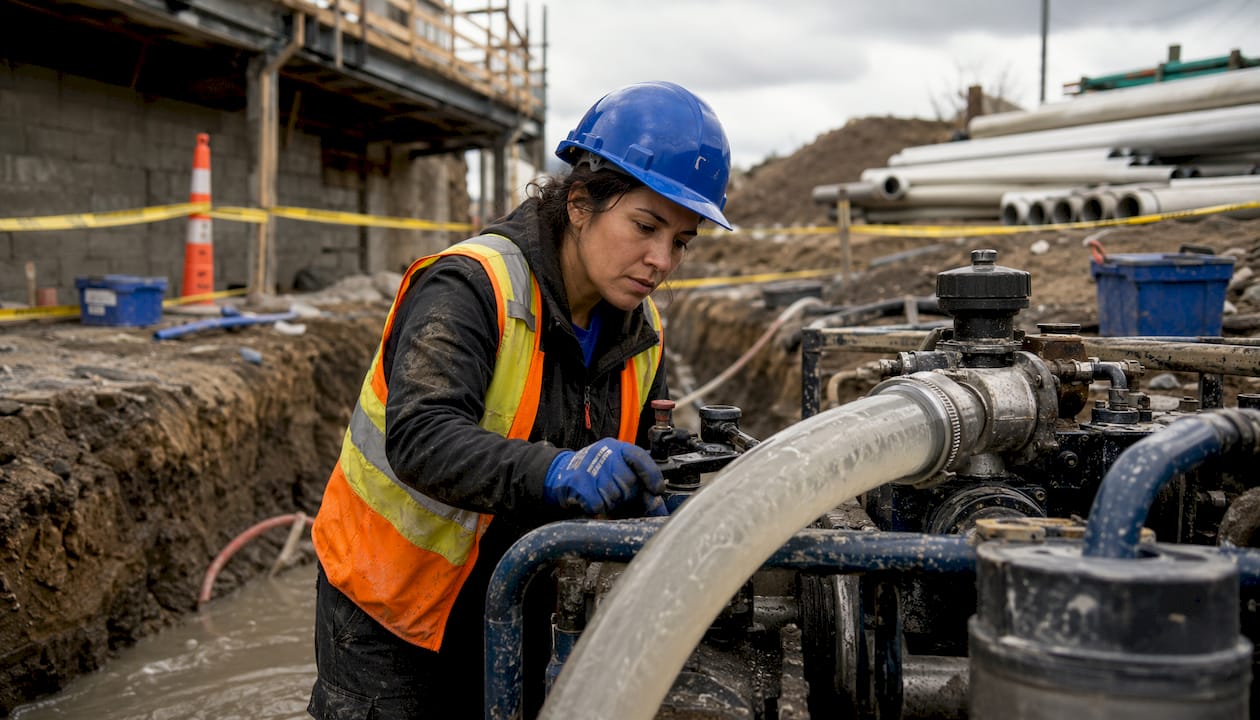
Annular grouting verification. After grouting, a follow-up CCTV pass confirms that the grout has filled the annular void without voids or blowouts. Grout quality checks should verify mix consistency and confirm that the liner has not shifted during placement. Any voids left unfilled create pathways for groundwater infiltration and can allow soil migration over time.
Design life expectations. A correctly installed HDPE liner in a gravity sewer or water main is designed to perform for several decades. Actual service life depends on operating pressure, soil chemistry, installation quality, and whether the host pipe continues to provide the structural envelope it was designed to. Warranties vary by contractor and material supplier; confirm the specific terms in writing before contract execution.
Ongoing maintenance checklist:
- Scheduled CCTV inspections at intervals defined by the asset management plan (typically every 5–10 years for municipal systems)
- Service lateral checks after any significant ground movement or heavy loading event above the pipe corridor
- Grout condition review if surface settlement is observed near the pipe alignment
- Joint integrity checks at terminal connections after the first full seasonal cycle
One practical note on pipe relining for cracked or misaligned pipes: even after successful slip lining, the original host pipe's condition continues to matter. If the host pipe degrades further and loses its load-bearing function, the liner must carry external loads it was not designed for. Periodic inspection catches this before it becomes a structural problem.
A U.S. contractor perspective: what good slip lining looks like in practice
A representative municipal project in the northeastern United States illustrates what a well-executed slip lining job delivers. A gravity sewer main running approximately 800 feet between manholes, originally 18-inch vitrified clay pipe installed in the 1960s, showed heavy joint infiltration and moderate offset joints on CCTV. The host pipe retained structural integrity throughout. Crews fused a continuous HDPE liner to a 15-inch OD, inserted it by winch over two days, reconnected six service laterals by spot excavation, and grouted the annular space. Post-installation CCTV confirmed full liner seating and no grout voids. Flow testing showed no capacity reduction despite the diameter step-down, consistent with the roughness improvement documented in similar projects.
Questions to ask any slip lining contractor before signing a contract:
- What HDPE/PE100 fusion equipment do you use, and can you show certification records for your fusion operators?
- Will you provide pre- and post-installation CCTV footage with a written condition log?
- What is your grout specification, and how do you verify annular fill?
- How do you handle lateral reconnections: excavation, robotic cutting, or both?
- What warranty do you offer on the liner installation, and what does it cover?
- Have you completed projects of similar diameter, depth, and soil conditions in this region?
Trenchlessmaine brings over 50 years of combined expertise to trenchless pipe rehabilitation across Maine, with project capabilities covering CCTV inspection, HDPE liner installation, lateral reconnections, and warranties up to 50 years. For Maine homeowners and municipalities evaluating slip lining, trenchless sewer repair in Maine is a practical starting point to confirm service area coverage and request an assessment.
Environmental impact and regulatory considerations
Slip lining's trenchless nature carries real environmental advantages over open-cut methods. Minimal excavation means less soil disturbance, reduced spoil disposal, and a smaller carbon footprint from earthmoving equipment. In environmentally sensitive corridors, such as wetlands, stream crossings, or areas with protected vegetation, the ability to rehabilitate a pipe from two small pits rather than a continuous trench can be the deciding factor in regulatory approval.
From a regulatory standpoint, slip lining projects in the United States typically require permits from the local municipality, state environmental agency, and in some cases the EPA, particularly when the pipe carries sanitary sewage or crosses a waterway. Projects near wetlands may trigger Army Corps of Engineers Section 404 review. Confirm permit requirements with your local authority having jurisdiction (AHJ) before mobilizing.
Material selection also carries environmental implications. HDPE is chemically inert and does not leach plasticizers into the surrounding soil or groundwater, which matters for water main rehabilitation in particular. FRP and PVC have similar inertness profiles. Grout selection should account for groundwater chemistry; some aggressive groundwater environments require sulfate-resistant or polymer-modified grout mixes.
Common failure modes and long-term performance considerations
Understanding where slip-lined pipes fail helps you design against those failure modes from the start.
Inadequate annular grouting is the most common post-installation problem. Voids in the grout allow the liner to shift under traffic or soil loads, concentrating stress at terminal connections and eventually causing joint failure or liner deformation. The fix is thorough grouting with a verified mix and a post-grout CCTV pass before the project is signed off.
Joint failure at terminal connections often traces back to skipping or shortening the relaxation period. When the liner is still under residual insertion stress at the time of terminal fusion, the joint geometry is off and the connection is weaker than the pipe wall. The 24-hour relaxation period exists precisely to prevent this.
Liner snagging during insertion happens when CCTV misses a protrusion or offset joint that is within tolerance on paper but catches the liner under load. Staged pushes with force monitoring catch snags before they damage the liner or the host pipe.
Service lateral infiltration after reconnection is a persistent issue when saddle connections are not properly sealed or when the excavation backfill settles and shifts the lateral connection. Pressure testing each lateral reconnection before backfilling is the standard quality check.
Long-term host pipe degradation is a slower failure mode. If the host pipe continues to deteriorate after lining and eventually loses structural continuity, the liner must carry external loads it was not sized for. Periodic CCTV monitoring of the host pipe condition, where accessible at manholes, catches this before it reaches a critical threshold.
Key Takeaways
Slip lining is the most cost-effective trenchless rehabilitation method for structurally sound, mostly straight pipes, but its diameter reduction and lateral reconnection requirements make pre-project CCTV and engineering assessment non-negotiable.
| Point | Details |
|---|---|
| Definition and scope | Carrier pipe inserted into host pipe, annular space grouted; works on sewers, water mains, gas lines, culverts. |
| Hydraulic performance | Flow capacity can increase despite smaller diameter when liner roughness (Manning's n) is lower than the deteriorated host. |
| Candidate criteria | Host pipe must be structurally sound, alignment mostly straight, and radial clearance approximately 10 mm minimum. |
| Key failure risk | Inadequate grouting and skipping the 24-hour relaxation period are the two most common causes of post-installation problems. |
| Trenchlessmaine | Trenchlessmaine delivers CCTV inspection, HDPE liner installation, lateral reconnections, and warranties up to 50 years across Maine. |
What experienced crews watch for that most project plans miss
The engineering drawings rarely capture the operational details that determine whether a slip lining project finishes on time and on budget.
Snagging on offset joints is the most common insertion delay, and it almost always happens on a joint that looked marginal on CCTV but was approved anyway. The practical rule: if a joint offset is within tolerance but close to the limit, treat it as a problem joint and plan a mechanical cutting pass before insertion. The cost of that extra step is trivial compared to a stalled liner halfway through a 600-foot run.
Pit size is consistently underestimated. The insertion pit needs to accommodate the fusion rig, the liner string staging area, and the winch or push equipment simultaneously. A pit that is 18 inches too short forces the crew to cut and re-fuse the liner string in the field, adding hours and a joint at the worst possible location. Pre-fabricate special joint lengths before mobilization and confirm pit dimensions against the actual equipment footprint, not a generic drawing.
Lateral reconnection scope almost always grows once the crew is on site. Drawings show lateral locations; they rarely show actual depth, pipe condition, or what is directly above the lateral at the surface. Budget a contingency for at least 20% more lateral work than the design shows, and confirm reconnection method with the engineer before mobilizing.
Finally, schedule the grout cure window into the program as a hard constraint, not a float activity. Grouting on a Friday afternoon and expecting to make terminal connections Monday morning works on paper. In practice, cold weather, wet soils, or a slightly off grout mix can extend cure time. Build the relaxation and cure window into the critical path from day one.
Trenchlessmaine can assess your pipe and recommend the right approach
If you are evaluating slip lining for a residential, commercial, or municipal pipe in Maine, the first step is a camera inspection to confirm whether your host pipe qualifies.
Trenchlessmaine provides the full sequence: hydro jetting to clean and clear the host pipe, CCTV inspection to document condition and confirm feasibility, HDPE liner installation with proper annular grouting, and service lateral reconnections. Projects are backed by warranties up to 50 years, and most assessments can be scheduled quickly across Maine's major service areas. The team's 50-plus years of combined experience means you get a method recommendation grounded in what actually works in Maine's soil and climate conditions, not a one-size-fits-all proposal.
To get started, request a site assessment with your pipe location, approximate diameter, and any existing inspection footage you have. The more documentation you bring to that first conversation, the faster a realistic scope and estimate can be put together.
Useful sources for deeper technical reading
- Handbook of PE Pipe, Chapter 11: Pipeline Rehabilitation by Sliplining — Plastic Pipe Institute (PPI); the most detailed U.S. technical reference for HDPE slip lining procedure, design, and connections.
- NRC Canada Technical Update on Sliplining (IRC CTU-56) — National Research Council Canada; covers inspection protocols, feasibility criteria, and municipal preventative maintenance value.
- PE100 Association: Slip Lining Process with PE100 Pipe — Technical publication covering PE100 material behavior, radial clearance guidance, and host pipe structural requirements.
- Sliplining Considerations: From Curves to Coefficients (Trenchless Technology) — Practitioner-focused article covering hydraulic performance, Manning's n implications, and documented project outcomes including the Milwaukee flow capacity case.
- City of Portland BES: Sliplining — Municipal agency overview of slip lining as a sewer construction method; useful for understanding how public utilities evaluate and apply the technique.
- Wikipedia: Sliplining — Neutral primer covering continuous vs. segmental methods, materials, and grouting requirements; good starting point for readers new to the topic.
- PPI Municipal Advisory Board: Slip Lining Construction — Step-by-step construction guidance from the Plastic Pipe Institute, aligned with the seven-step standard procedure.