

Trenchless lining warranties are legally binding guarantees that cover defects in materials and workmanship for a defined period after your pipe repair is complete. Understanding how warranties work for trenchless lining protects your property investment and prevents costly surprises years down the road. Coverage periods range from 5 to 50 years depending on the repair method, liner materials, and contract terms. The standard industry method, cured-in-place pipe lining (CIPP), carries some of the longest warranty periods available in sewer repair. Knowing what your warranty covers, what voids it, and how to file a claim puts you in control before a problem ever surfaces.
How warranties work for trenchless lining: types and coverage
Trenchless lining warranties fall into three main categories, and each one covers a different aspect of your repair. Knowing which type applies to your job determines exactly what protection you have.
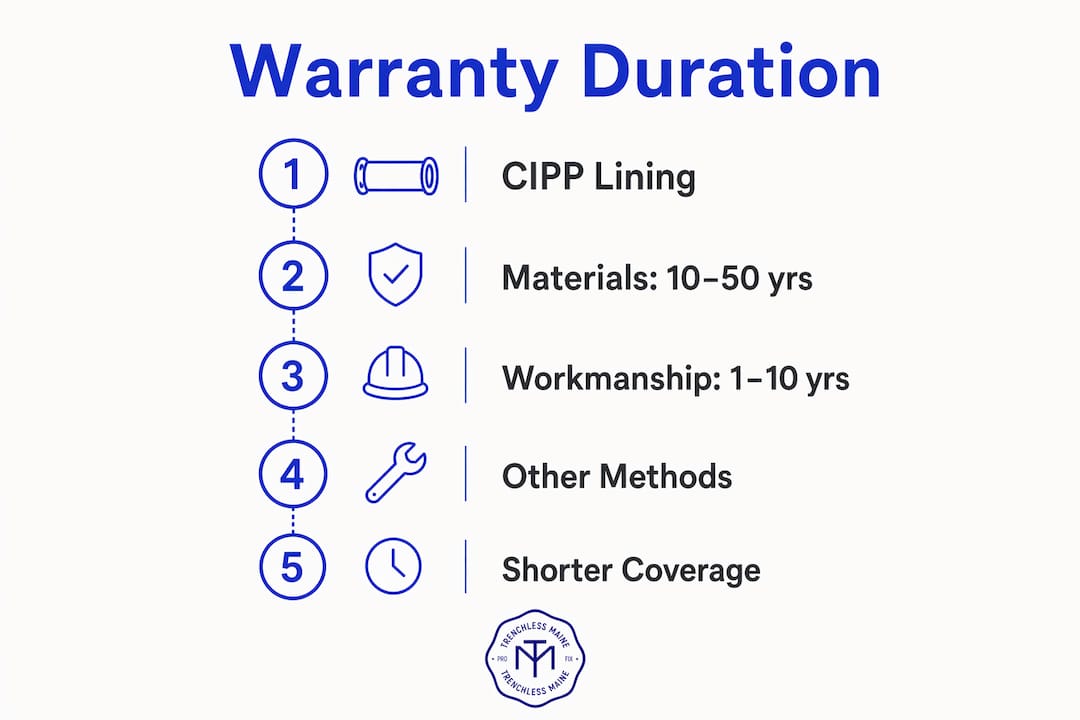
Workmanship warranties cover errors made during installation, such as improper liner placement, inadequate curing, or failed joints. These typically run 1 to 10 years and are the contractor's promise that the job was done correctly. If a liner delaminates or a joint fails within that window due to installer error, the contractor repairs it at no cost to you.
Materials warranties cover the resin, liner fabric, and composite materials used in the repair. These run significantly longer, often 10 to 50 years, because the materials themselves are engineered for decades of service. CIPP liners designed under ASTM standards carry a design life of approximately 50 years when properly installed, and materials warranties reflect that durability.
System performance warranties are less common in residential work but appear in commercial and municipal contracts. They guarantee that the repaired pipe will maintain specified flow rates and watertightness for a defined period. If the pipe fails those performance benchmarks, the contractor is obligated to remediate.
Common exclusions across all three types include:
- Root intrusion occurring after the repair is complete
- Damage from natural disasters, ground movement, or third-party excavation
- Pre-existing conditions that were present before the lining was installed
- Misuse of the pipe system, such as flushing prohibited materials
Pro Tip: Ask your contractor to provide a written list of exclusions before signing. Verbal assurances about coverage mean nothing if the written contract says otherwise.
How long do trenchless lining warranties last?
Warranty length depends heavily on the repair method and the materials used. The table below shows typical ranges by method.
| Repair method | Typical warranty range |
|---|---|
| CIPP pipe lining | 10 to 50 years on materials; 1 to 10 years on workmanship |
| Pipe bursting | 10 to 20 years |
| Epoxy coating | 5 to 25 years |
| Spot repair lining | 5 to 10 years |
CIPP pipe lining consistently earns the longest coverage because the cured resin composite becomes structurally independent of the host pipe. Epoxy coatings bond to the existing pipe wall instead of forming a new pipe within a pipe, so they carry shorter terms. Pipe bursting replaces the old pipe entirely with new HDPE pipe, and warranty terms reflect the durability of that new material.
Warranty coverage starts on a contractually defined completion date, which is typically tied to the final inspection or permit sign-off. That date matters because it establishes your baseline. Municipal permit inspections and CCTV camera records taken at project completion document the pipe's condition at the start of the warranty period, giving both you and the contractor a clear reference point for any future claim.
Maintenance requirements also affect how long your warranty remains valid. Most contracts specify that you must follow prescribed cleaning schedules and use only approved methods. Skipping annual inspections or using unauthorized cleaning equipment can shorten your effective coverage even if the calendar date has not expired.
Pro Tip: Request a copy of the post-installation camera inspection report and store it with your warranty documents. That footage is your strongest evidence if a claim dispute arises years later.
What are common warranty exclusions you need to know?
Exclusions are where most warranty disputes originate. Written definitions of defects and covered pipe segments reduce disputes by setting expectations before any problem occurs. Without that clarity, contractors and property owners often disagree about whether a specific failure falls inside or outside the warranty scope.
The exclusions that catch property owners off guard most often include:
- Root intrusion post-repair. If tree roots penetrate the liner after installation, that damage is typically not covered. The warranty covers the liner's integrity, not the surrounding soil environment.
- Prohibited cleaning methods. Warranties can be voided by using mechanical cutting tools, augers, or cable machines inside a lined pipe. Hydro-jetting is the approved cleaning method for most lined systems because it uses water pressure rather than abrasive mechanical contact.
- Ground movement and external damage. Soil settlement, frost heave (a real concern in Maine winters), and damage from nearby excavation are excluded because they originate outside the repaired pipe section.
- Pre-existing lateral damage. If your sewer lateral had a pre-existing crack or offset that was documented before lining, any failure at that location may not qualify as a warranty defect.
- Sections not covered by the contract. Warranties apply only to the specific pipe sections listed in your contract. Connecting pipes, cleanouts, and service connections outside the defined scope are not covered.
Understanding these exclusions before work begins lets you ask the right questions and negotiate clearer terms. If your contractor cannot define exactly which pipe sections are covered, that is a red flag worth addressing in writing before the job starts.
How does the warranty claims process work?
Filing a warranty claim for trenchless lining follows a defined sequence. Moving through each step correctly protects your right to a remedy.
- Identify the defect. Symptoms like recurring backups, slow drainage, or wet spots above the pipe route suggest a potential liner failure. A CCTV camera inspection confirms whether the liner has cracked, delaminated, or separated at a joint.
- Submit written notice. Contact your contractor in writing as soon as you identify a potential defect. Most warranty contracts specify a notice period, and missing that window can forfeit your claim. Email with read receipt or certified mail creates a documented record.
- Contractor investigation. The contractor conducts their own CCTV inspection per NASSCO PACP standards to assess the defect. NASSCO (National Association of Sewer Service Companies) grading provides an objective, industry-recognized evaluation of pipe condition.
- Cause determination. The contractor analyzes whether the defect resulted from a covered cause (installation error, material failure) or an excluded cause (root intrusion, external damage). This step is where disputes most commonly arise, which is why your baseline inspection record is critical.
- Warranty repair execution. If the defect falls under coverage, the contractor repairs or relined the affected section at no charge to you. The scope of the remedy, full relining versus spot repair, depends on the contract language.
- Documentation update. After the repair, a new camera inspection establishes an updated baseline. Request a copy of this report and attach it to your warranty file.
Can trenchless lining warranties transfer to a new owner?
Warranty transferability varies by contractor and contract type, and the conditions attached to transfer can significantly affect your property's resale value. A pipe lining warranty checklist helps you confirm transfer terms before listing your property.
Key points on transferability:
- Service plan enrollment is often required. A lifetime warranty requires continuous enrollment in a service partnership plan. If the new owner does not enroll, the lifetime coverage converts to a 20-year limited non-transferable warranty.
- Transfer must be initiated at sale. Most contracts require the original owner to notify the contractor at the time of property transfer. Waiting until after closing can void the transfer option entirely.
- Non-transferable warranties lose value at resale. If your warranty cannot transfer, the new owner receives no coverage benefit, which may affect how buyers perceive the repair's long-term value.
- Confirm terms in writing before listing. Contact your contractor before putting your property on the market to get written confirmation of transfer conditions, fees, and deadlines.
A transferable warranty is a genuine selling point. Buyers in Maine who understand that the sewer lateral is lined and warranted for decades have one less major infrastructure concern to price into their offer.
Key takeaways
Trenchless lining warranties protect your repair investment through defined coverage on materials and workmanship, but their value depends entirely on understanding the terms, maintaining the system correctly, and filing claims through the proper process.
| Point | Details |
|---|---|
| Coverage types matter | Workmanship, materials, and performance warranties each cover different failure causes and durations. |
| Duration varies by method | CIPP lining carries up to 50-year material warranties; epoxy coatings typically run 5 to 25 years. |
| Exclusions are specific | Root intrusion, prohibited cleaning tools, and external damage are commonly excluded from coverage. |
| Claims require documentation | Written notice, CCTV inspection, and baseline records are all required to support a valid claim. |
| Transferability has conditions | Lifetime warranties often require service plan enrollment to transfer; confirm terms before any property sale. |
What I've learned after years of trenchless warranty work
The single biggest mistake I see property owners make is treating the warranty document as a formality rather than a contract they need to read carefully. Most disputes I've encountered do not involve timing. They involve disagreements about which pipe section is covered or whether a specific failure mode qualifies as a defect. Those disputes almost always trace back to vague written language that nobody questioned at signing.
My honest advice: before any trenchless lining job begins, ask the contractor to mark the covered pipe sections on a diagram and define "defect" in writing. That one step eliminates the majority of claim disputes I've seen. The warranty coverage details should map directly to the scope of work, with no ambiguity about where coverage starts and stops.
Maintenance is the other area where property owners unknowingly void their own coverage. Sending a plumber with a cable machine into a lined pipe to clear a blockage is a common mistake. Hydro-jetting is the correct method for lined systems, and using anything else gives the contractor legitimate grounds to deny a future claim. Keep records of every cleaning and inspection performed on the lined section. That paper trail is your protection if the contractor ever questions whether you maintained the system properly.
Finally, do not wait to confirm transferability when you sell. I've seen transactions complicated by warranty terms that nobody checked until the week of closing. Confirm the transfer conditions the moment you list the property.
— John
Trenchless Maine: warranty-backed sewer repair across Maine

Trenchlessmaine backs its no-dig sewer repair work with industry-leading warranties, giving Maine homeowners, property managers, and business owners documented protection on every lining job. From pre-job camera inspection through post-repair documentation, Trenchlessmaine provides the written warranty terms, covered pipe diagrams, and maintenance guidance you need to keep your coverage valid for decades. The team's combined expertise spans over 50 years, and the full range of services includes CIPP lining, hydro jetting, and camera inspection across most of Maine's cities. Contact Trenchlessmaine today for a free consultation and a clear explanation of the warranty terms that will protect your repair investment.
FAQ
What does a trenchless lining warranty typically cover?
A trenchless lining warranty covers defects in installation workmanship and liner materials for a defined period. Coverage does not extend to root intrusion after repair, external damage, or failures caused by prohibited maintenance practices.
How long is a CIPP pipe lining warranty?
CIPP pipe lining warranties on materials often span 10 to 50 years, with workmanship coverage typically running 1 to 10 years. The exact term depends on the contractor's contract and the liner materials specified.
What voids a trenchless lining warranty?
Using mechanical cutting tools or augers inside a lined pipe is one of the most common ways to void coverage. Skipping required maintenance inspections or failing to notify the contractor of a defect within the specified notice period can also forfeit your claim rights.
Can I transfer my trenchless lining warranty when I sell my home?
Transferability depends on your contract terms. Some lifetime warranties convert to a 20-year limited warranty if the new owner does not enroll in a required service plan. Confirm transfer conditions with your contractor before listing the property.
How do I start a warranty claim for a trenchless repair?
Submit written notice to your contractor as soon as you identify a potential defect, then schedule a CCTV camera inspection to document the issue. The contractor will investigate using NASSCO standards and determine whether the failure falls under covered warranty terms.