
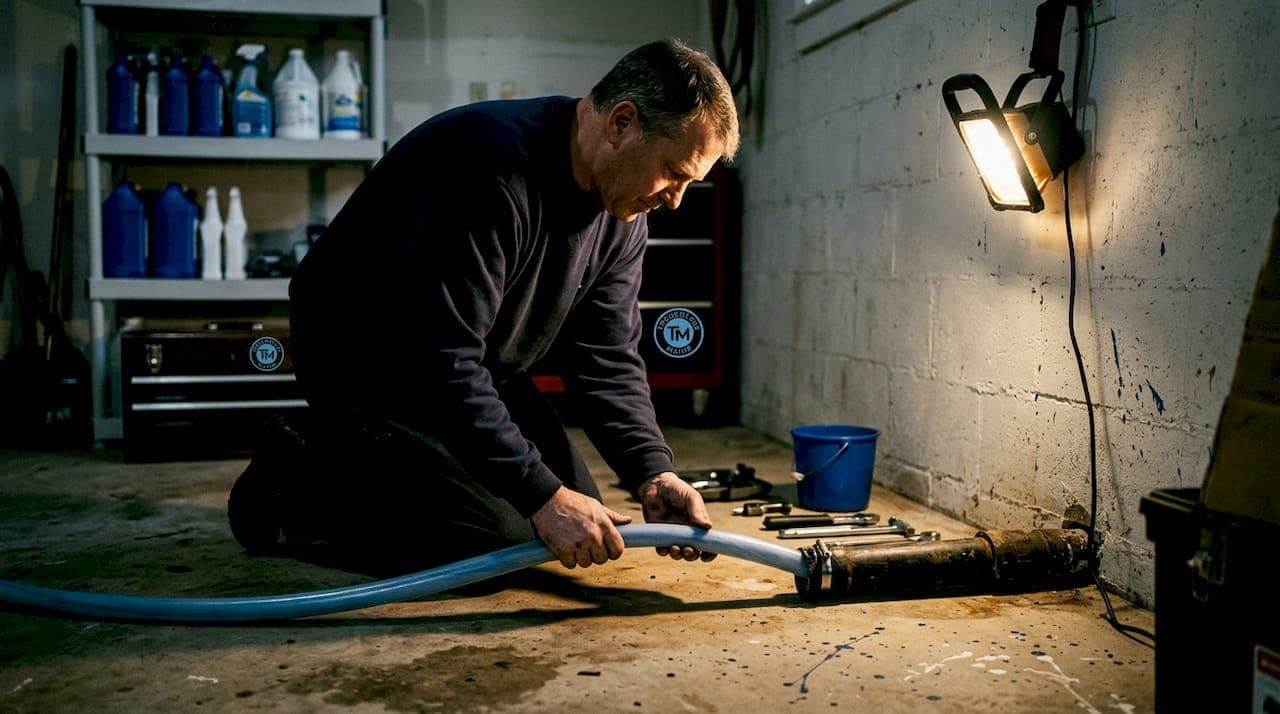
Most homeowners assume that fixing a damaged drain pipe means tearing up their yard, pulling out the driveway, and spending weeks in construction chaos. That assumption is wrong, and it costs people money every year. Drain relining is a trenchless repair method that fixes cracked, corroded, or root-damaged pipes from the inside out, with no major excavation required. If you're dealing with slow drains, sewage odors, or recurring blockages, this guide explains exactly what drain relining is, how the process works, what it costs, and when it makes sense for your property.
Table of Contents
- Key takeaways
- What is drain relining and how the process works
- Benefits of drain relining over traditional replacement
- Limitations and when relining won't work
- Drain relining vs replacement: what the numbers show
- When to consider drain relining and how to get started
- My take on why drain relining is underused and underappreciated
- How Trenchlessmaine can help with your drain repair
- FAQ
Key takeaways
| Point | Details |
|---|---|
| No digging required | Drain relining repairs pipes from the inside, preserving your yard, driveway, and landscaping. |
| Long service life | Properly installed relined pipes last 30 to 60 years, outpacing many traditional pipe materials. |
| Significant cost savings | Relining typically costs 30–60% less than open-cut pipe replacement. |
| Inspection comes first | A professional camera inspection is required before relining to confirm your pipe qualifies. |
| Not suitable for all pipes | Severely collapsed or missing pipe sections cannot be relined and may require traditional replacement. |
What is drain relining and how the process works
Drain relining is a trenchless repair technique that rehabilitates a damaged pipe by creating a brand-new pipe surface inside the existing one. Instead of digging up the ground to remove and replace the old pipe, technicians insert a flexible liner coated in epoxy resin directly into the damaged pipe through an existing access point. Once the liner is in position, it cures and hardens, forming a smooth, seamless new pipe wall inside the old one.
This approach falls under the broader category of Cured-In-Place Pipe lining, commonly called CIPP. CIPP repairs damaged drains internally without excavation by using resin-saturated liners that restore the pipe's structural integrity.
Here is how the drain relining process works from start to finish:
- Camera inspection. A technician sends a small camera through the pipe to assess the extent and type of damage. This step confirms whether relining is appropriate or if replacement is needed.
- Pipe cleaning. Before the liner goes in, the pipe must be thoroughly cleaned. Hydro jetting is the most effective method, using high-pressure water to remove grease, scale, debris, and root intrusion from the pipe walls.
- Liner preparation. A felt or fiberglass liner is saturated with a two-part epoxy or polyester resin. The liner is custom-cut to match the length and diameter of the damaged pipe section.
- Liner insertion. The resin-saturated liner is pulled or inverted into place through a cleanout, inspection opening, or, in some cases, a small access pit. Access points enable liner insertion and curing operations without the need for full trench digging.
- Curing. The liner is inflated against the inner wall of the pipe using air pressure or water pressure, then cured using hot water, steam, or UV light, depending on the resin system used. Curing typically takes two to four hours.
- Final inspection. Once cured, a camera passes through again to verify the liner has bonded correctly and the pipe interior is clean and smooth.
The drain relining materials used, specifically the epoxy resins, are formulated to handle residential wastewater chemicals and pressures. Epoxy resins in relining are specifically engineered for corrosion resistance, extending pipe longevity well beyond what older clay, cast iron, or Orangeburg pipes can offer.
Pro Tip: Ask your contractor whether UV-cured or hot-water-cured lining is being used. UV curing is faster and increasingly preferred for residential jobs because it gives technicians more control over the cure time.
Benefits of drain relining over traditional replacement
When you stack up the benefits of drain relining against conventional open-cut pipe replacement, the differences are significant. This is not just about avoiding a messy yard. It's about cost, time, durability, and peace of mind.
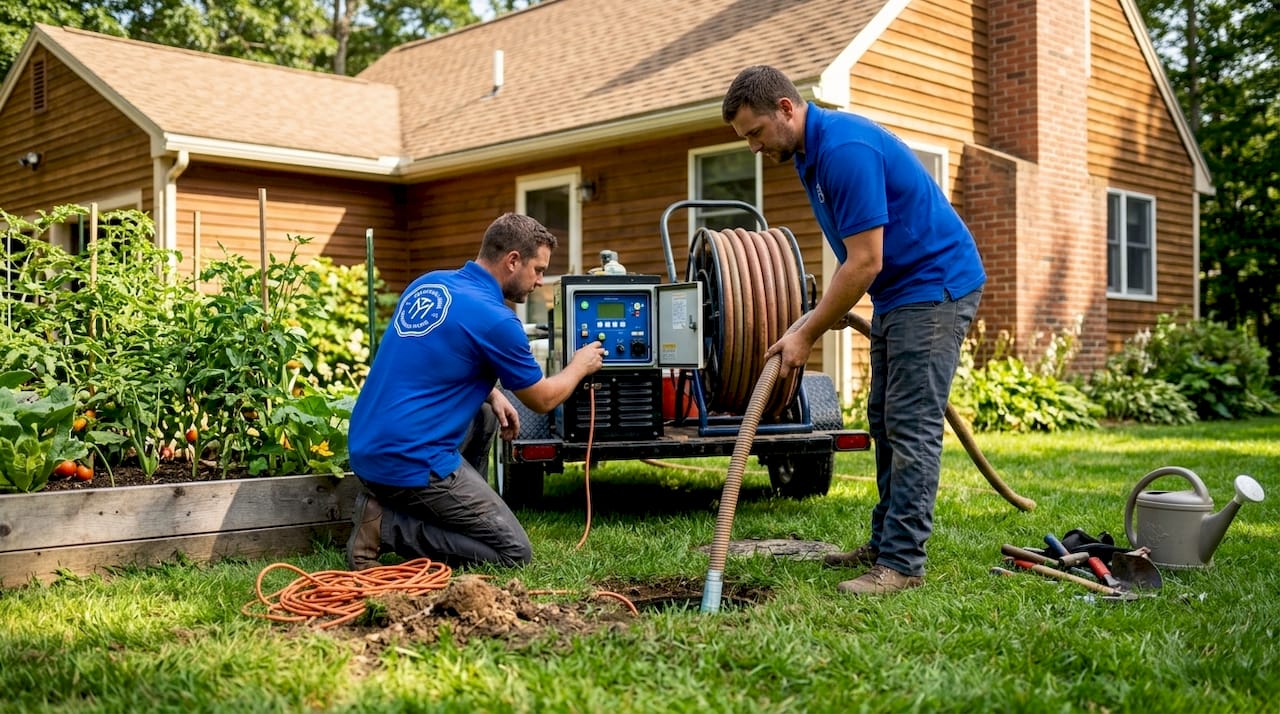
- Minimal property disruption. Because there's no trench, your lawn, garden beds, driveway, and landscaping stay intact. For property managers overseeing multi-unit buildings, this means tenants are not displaced and operations continue.
- Cost and time savings. Relining requires 50–80% less time to complete than open-trench replacement. Many residential jobs finish within a single day.
- Long-lasting performance. Resin liners resist corrosion and household wastewater, and a quality installation can last 30 to 60 years. That's a long-term fix, not a patch.
- Permanent defense against root intrusion. Relining seals cracks and joints permanently, cutting off the entry points that tree roots exploit. Mechanical root clearing alone doesn't solve the underlying problem. Roots grow back. A sealed liner does not give them a way in.
- Improved flow capacity. Relined pipes maintain or improve flow capacity because the smooth, jointless interior surface prevents debris and grease from accumulating the way they do in older corroded pipes.
- Environmentally responsible. Trenchless relining reduces excavation waste and avoids soil disruption, which matters for properties near wetlands, mature trees, or environmentally sensitive areas common across Maine.
The combination of these factors makes drain relining one of the most practical long-term investments you can make in your property's infrastructure.
Limitations and when relining won't work
Drain relining is not a universal fix. Understanding its limitations helps you make the right call, and a trustworthy contractor will tell you upfront when relining is not the right option.
- Severely collapsed pipes are not candidates. Relining requires a mostly continuous pipe path for liner insertion. If a section has completely caved in or is missing entirely, there is nothing for the liner to form against.
- Slight diameter reduction occurs. Adding a liner inside an existing pipe reduces the internal diameter by a small amount, typically a few millimeters. In most residential pipes this is negligible, but in narrower pipes it may be worth discussing with your technician.
- Not all pipe materials qualify. Pipes with severe joint displacement, major bellying (sections that have dropped and hold standing water), or extensive structural deformation may not be suitable for relining without additional preparation or partial replacement.
- Inspection and cleaning are non-negotiable. Without a thorough camera inspection and professional cleaning first, a relining job can fail prematurely. Liner adhesion depends on a clean, clear pipe wall.
- Some damage scenarios favor replacement. If a large stretch of pipe has failed in multiple locations, or the pipe is so degraded that lining would only mask deeper problems, traditional open-cut replacement may be the more honest recommendation.
The key takeaway here is that professional assessment matters. Never skip the sewer camera inspection step. It's the only way to know with certainty what your pipe needs.
Drain relining vs replacement: what the numbers show
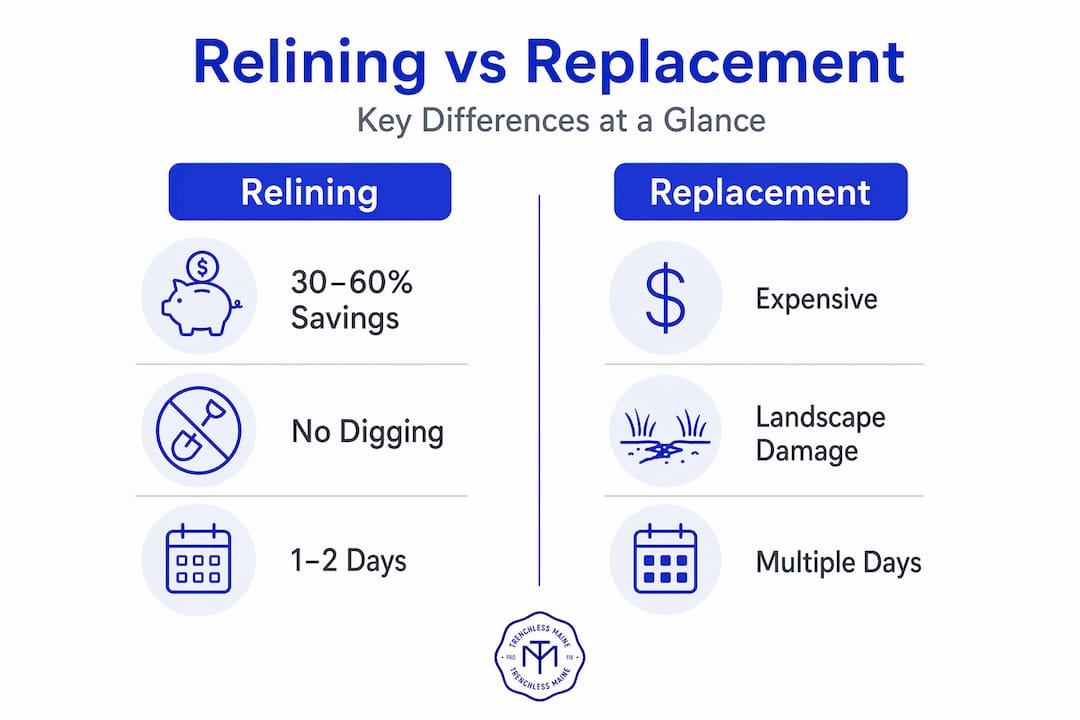
The most practical question most homeowners ask is straightforward: what does each option actually cost and how long will it last? Here's a direct comparison.
| Factor | Drain relining | Traditional pipe replacement |
|---|---|---|
| Average cost savings | 30–60% less than replacement | Baseline cost |
| Project duration | Often 1 day or less | Several days to weeks |
| Excavation required | Minimal to none | Extensive trenching |
| Landscape restoration | Not needed | Often significant |
| Lifespan | 30 to 60+ years | 25 to 50+ years depending on material |
| Root intrusion resistance | Permanent once sealed | Depends on pipe material and joints |
| Flow performance | Maintained or improved | Depends on new pipe condition |
| Environmental impact | Lower disruption and waste | Higher disruption and debris |
Cost of drain relining varies depending on pipe length, diameter, depth, and access difficulty. For most residential projects in Maine, relining a sewer lateral runs a fraction of what full excavation and replacement would cost once you factor in labor, equipment, and surface restoration.
Pro Tip: When comparing quotes, ask contractors to break out the cost of surface restoration separately. Many open-cut replacement quotes don't include the cost of replacing concrete, asphalt, or landscaping, which can add thousands of dollars to the final bill.
If you're evaluating your options, reviewing the pipe lining process in detail can help you ask sharper questions when speaking with contractors.
When to consider drain relining and how to get started
Certain warning signs point clearly toward pipe damage that drain relining can address. Catching these early saves money and protects your property from worse problems down the road.
- Slow drains throughout the house that don't respond to standard clearing
- Sewage odors in the yard or basement without an obvious cause
- Recurring drain backups, especially in lower-level fixtures
- A strip of unusually green or lush grass running across your yard, which can signal a cracked pipe acting as an effective fertilizer source
- Unexplained wet patches or soft ground over where pipes are buried
- Gurgling sounds from toilets or drains when other fixtures are in use
If you're seeing any of these signs, the first step is a professional camera inspection to pinpoint the problem. Check the warning signs you need sewer repair for a full breakdown of what to look for before the situation becomes urgent.
Once a diagnosis is confirmed, a qualified trenchless contractor can typically complete a residential relining job within 24 hours. To keep a relined pipe in peak condition, avoid flushing anything other than water, toilet paper, and human waste. Annual camera inspections every few years give you confidence that everything is performing as expected.
My take on why drain relining is underused and underappreciated
I've seen a lot of properties in Maine where homeowners spent far more than they needed to on pipe repairs simply because they weren't aware relining was an option. Contractors who specialize in excavation have little financial incentive to suggest it. That reality is uncomfortable, but it's real.
What I find most interesting is that relining often outperforms replacement in long-term durability. A new pipe buried in Maine's freeze-thaw soil is still subject to joint failure and root intrusion over time. A cured epoxy liner, seamless by design, gives roots nothing to grab onto and doesn't corrode. In my view, that's a meaningful structural advantage that doesn't get enough credit.
The biggest misconception I encounter is that relining is a temporary fix, a way to delay the inevitable. It's not. When done correctly on a qualifying pipe, it's a permanent repair. The key phrase is "qualifying pipe," which is exactly why professional assessment is not optional. I've seen relining jobs performed on pipes that should have been replaced, and the outcome is predictably poor. Match the method to the condition and you'll rarely go wrong.
— John
How Trenchlessmaine can help with your drain repair
If you're dealing with slow drains, recurring backups, or root intrusion in your Maine property, Trenchlessmaine specializes in exactly the kind of non-invasive repair this article covers.
Trenchlessmaine's team brings over 50 years of combined experience in trenchless pipe lining and sewer repair across Maine. Services include CIPP pipe lining, hydro jetting, and full sewer camera inspections, all designed to diagnose and fix your pipe issues with minimal disruption to your property. Most residential projects are completed within 24 hours and are backed by industry-leading warranties. Explore the repair technology overview to understand exactly what methods Trenchlessmaine uses and why they work. Ready to find out if relining is right for your pipes? Reach out for an assessment and get a clear answer before the problem gets bigger.
FAQ
What is drain relining in simple terms?
Drain relining is a repair method where a resin-coated liner is inserted into a damaged pipe and cured to form a new pipe inside the old one, requiring no major excavation.
How long does a relined drain last?
A professionally relined drain typically lasts 30 to 60 years, depending on the materials used and the quality of the installation.
Is drain relining as effective as pipe replacement?
Yes, and in many cases it's more durable. Relined pipes are seamless and root-resistant, which gives them a structural advantage over jointed replacement pipes in aggressive soil conditions.
Can any pipe be relined?
No. Pipes that are severely collapsed, missing sections, or have major structural deformation are not suitable candidates. A professional camera inspection is required to determine eligibility before any relining work begins.
How much does drain relining cost compared to replacement?
Drain relining typically costs 30 to 60% less than traditional open-cut pipe replacement, with most residential jobs completed in a single day and no additional surface restoration costs.