
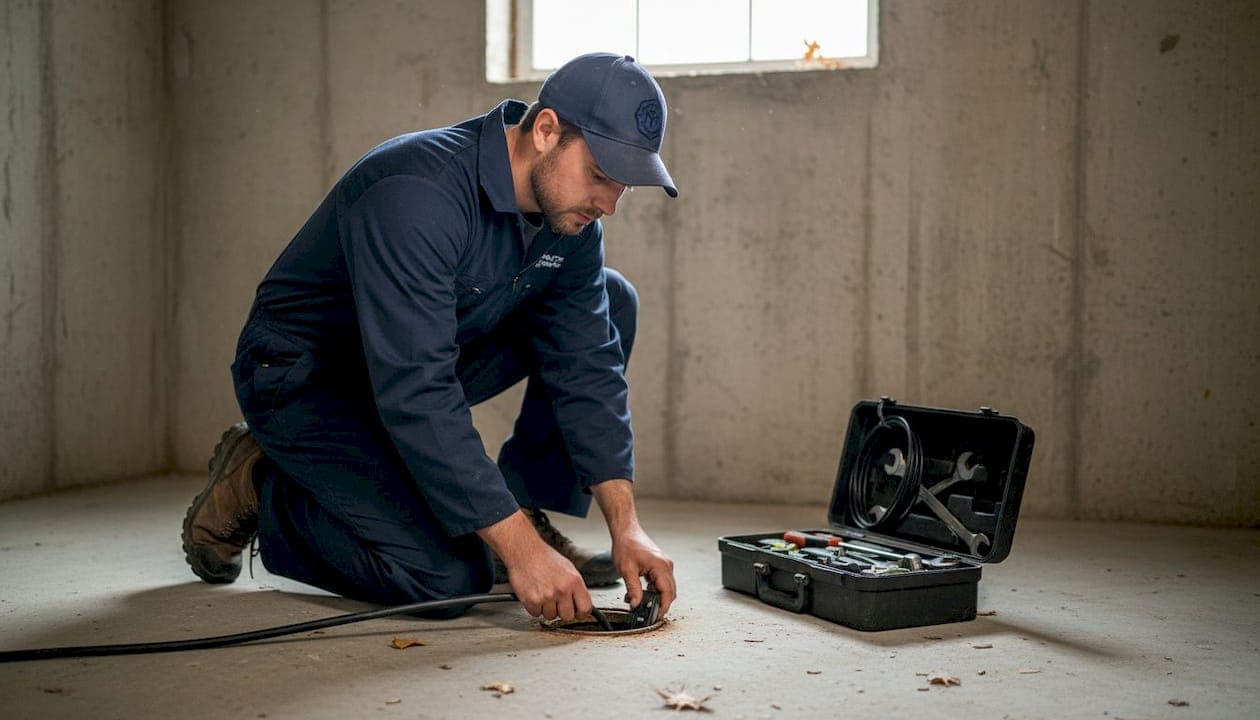
Most Maine homeowners assume that fixing a damaged sewer main means tearing up their yard, breaking through driveways, and dealing with weeks of messy, expensive work. That assumption is wrong, and it's costing people money. Mainline sewer relining is a proven, trenchless method that repairs your pipe from the inside out, leaving your landscaping, concrete, and hardscapes completely intact. This guide explains exactly what relining is, how it works step by step, where it excels, and where it falls short, so you can make a confident, informed decision before agreeing to any repair work.
Table of Contents
- What is mainline sewer relining?
- How the mainline sewer relining process works
- Key benefits and possible limitations
- Relining versus pipe bursting: Which is right for you?
- A fresh perspective: What most homeowners miss about relining
- Explore trenchless sewer relining solutions in Maine
- Frequently asked questions
Key Takeaways
| Point | Details |
|---|---|
| Non-invasive solution | Mainline sewer relining repairs pipes without destroying your yard or driveway. |
| Meets rigorous standards | Professional relining follows ASTM and NASSCO guidelines for lasting results. |
| Not for collapsed pipes | If pipes are badly deformed, pipe bursting or traditional methods are required. |
| Side-by-side comparison | Relining is best for intact but damaged pipes, while bursting is for total replacements. |
What is mainline sewer relining?
Mainline sewer relining is a no-dig sewer technology that repairs your home's main sewer line without digging a trench across your property. Instead of removing the old, damaged pipe, technicians create a brand-new pipe inside the existing one. The result is a fully functional, watertight sewer line installed with minimal disruption to your home, yard, or daily routine.
The technical term for this process is cured-in-place pipe (CIPP) lining. A flexible liner, saturated with a special epoxy resin, is inserted into the damaged pipe and then cured, either using hot water, steam, or ultraviolet light, until it hardens into a rigid, seamless new pipe wall. Once cured, the liner bonds tightly to the interior of the host pipe and effectively becomes a new, independent pipe structure.
This approach is especially valuable in Maine, where mature trees, frozen ground, established landscaping, and complex hardscapes make excavation particularly disruptive and expensive. Consider a homeowner in Portland with a century-old maple tree near the sewer lateral, or a property in Bangor with a paved driveway running over the sewer line. In both cases, excavation would cause significant collateral damage. Relining sidesteps all of that entirely.
Here's what mainline sewer relining typically addresses:
- Root intrusion from trees and shrubs growing into pipe joints
- Cracks and fractures caused by ground movement, frost heave, or age
- Corrosion and deterioration in older cast iron or clay pipes
- Joint separation where pipe sections have slightly shifted but not collapsed
- Minor infiltration where groundwater seeps into the sewer line
One key advantage is that relining compares favorably to excavation costs when you factor in landscaping restoration, driveway repair, and labor time. Because no open trench is needed, project timelines are dramatically shorter.
Industry standards govern how relining work is performed to ensure durability and structural integrity. CIPP lining standards such as ASTM F1216 for inversion lining, ASTM F1743 for pull-in-place lining, and NASSCO guidelines specify the exact wall thickness required, ranging from 3mm to 20mm, based on pipe diameter, soil conditions, traffic loads above ground, and groundwater pressure. These aren't just recommendations. They are engineered specifications that determine how long your relined pipe will perform.
"A properly installed CIPP liner, built to ASTM and NASSCO specifications, functions as a fully structural pipe with no reliance on the integrity of the surrounding host pipe."
With the basics in mind, let's dig deeper into the relining process, from start to finish.
How the mainline sewer relining process works
Now that you understand what relining is, let's walk through the process homeowners can expect. A professional relining job follows a clear sequence of steps, and understanding each one helps you ask better questions, set realistic expectations, and recognize quality workmanship.
1. Sewer camera inspection
Before any repair begins, a technician inserts a high-definition camera into your sewer line through an existing cleanout or access point. This live video inspection reveals the exact location and nature of the damage, whether it's a crack at 30 feet, root intrusion at 60 feet, or joint separation near the street. No guesswork. No unnecessary digging.
2. Pipe cleaning with hydro jetting
Once the damage is mapped, the pipe is thoroughly cleaned using high-pressure water jetting. This process clears out root intrusion, grease buildup, sediment, and debris, preparing a clean surface for the liner to bond properly. Skipping this step is a common cause of liner failure, so reputable contractors always clean before lining.
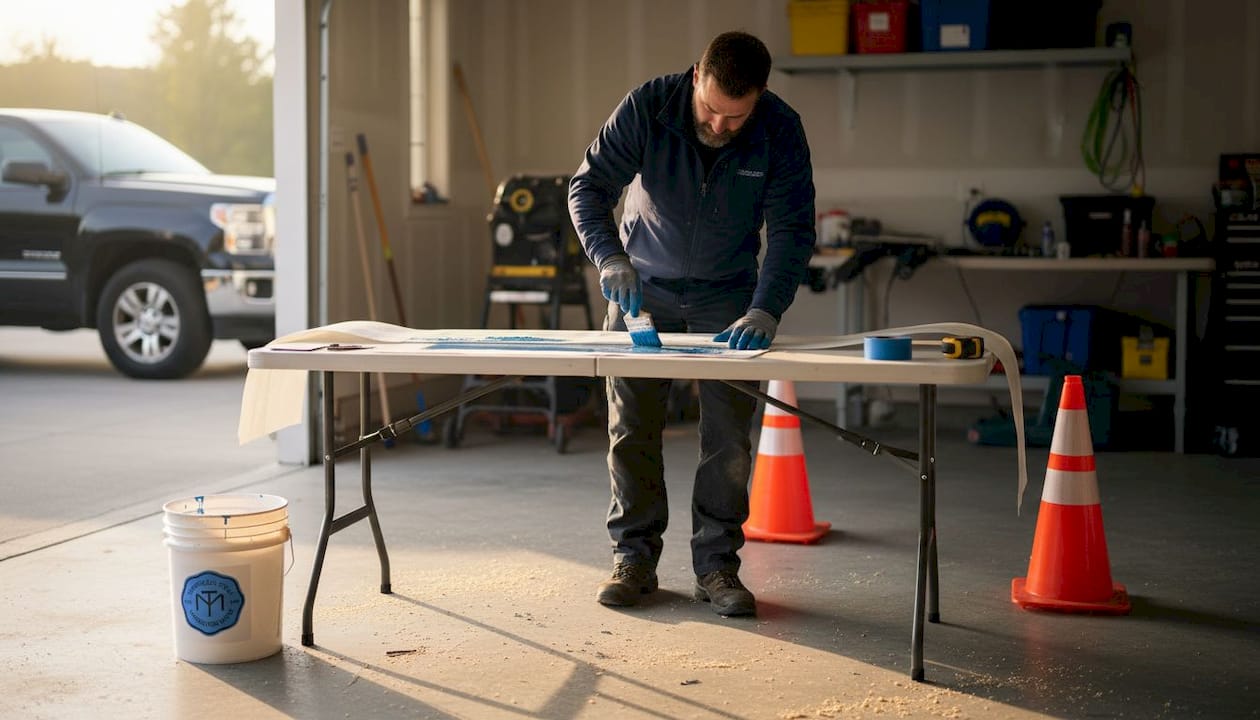
3. Measuring and preparing the liner
The liner is custom cut to the exact length of the damaged pipe section. It's then saturated with epoxy or polyester resin and inspected before insertion. The wall thickness is calculated according to current NASSCO and ASTM standards, factoring in soil conditions, pipe depth, and surface loads. This precision is what separates professional relining from a temporary patch job.
4. Liner insertion
There are two main methods for getting the liner into the pipe. With inversion lining (ASTM F1216), the liner is inverted, or turned inside out, using water or air pressure and pushed into place. With pull-in-place lining (ASTM F1743), the liner is pulled through the pipe with a cable and then inflated from inside. Both are proven techniques. Your contractor will select the best option based on pipe access, diameter, and condition.
5. Curing
The liner is inflated and held in position while the resin cures and hardens. Curing can be done with hot water, steam, or UV light, depending on the resin type and liner design. UV curing is increasingly popular because it's faster and produces very consistent results. Curing typically takes between one and four hours.
6. Final camera inspection
Once curing is complete, the technician runs the camera through one final time to confirm the liner has bonded correctly, there are no wrinkles or voids, and any laterals, the branch pipes connecting to your main line, have been properly reinstated.
Most trenchless services in Maine can complete a standard residential mainline relining job within a single day. You can view before-and-after documentation from real projects in the mainline repair results gallery.
Pro Tip: Before you commit to any relining contractor, ask them directly whether their process follows ASTM F1216 or F1743 standards, and whether they use NASSCO-trained inspection staff. Any reputable provider will answer confidently and in detail.
Key benefits and possible limitations
Understanding the process helps, but knowing where relining shines, and where it doesn't, is just as important before making your decision.
Benefits of mainline sewer relining:
- No excavation required. Your lawn, garden, driveway, and foundation remain untouched.
- Fast turnaround. Most residential projects are completed within 24 hours.
- Long service life. Relined pipes are engineered to last 50 years or more with minimal maintenance.
- Seamless pipe interior. No joints or seams mean no future root intrusion points.
- Cost savings. Without excavation and site restoration costs, relining is often significantly more affordable.
- Environmentally responsible. No soil disruption, no heavy equipment, and less waste material.
Statistic callout: Most relined sewer pipes have a designed service life of 50+ years, making relining a long-term investment, not a temporary fix.
Possible limitations to consider:
- Not effective for pipes that have lost their round shape or collapsed significantly.
- Slightly reduces the inside diameter of the pipe, though usually by only a few millimeters.
- Requires at least one accessible entry point to insert the liner.
- May not be ideal when the existing pipe needs to be upsized for increased flow capacity.
Here's a quick side-by-side comparison to help you assess your own situation:
| Condition | Relining suitable? | Alternative |
|---|---|---|
| Cracks or fractures, pipe shape intact | Yes | Not needed |
| Root intrusion, minor joint gaps | Yes | Hydro jetting alone if early-stage |
| Pipe deformation less than 40% | Yes (marginal cases) | Evaluate with camera inspection |
| Pipe collapsed or deformed over 40% | No | Pipe bursting or excavation |
| Severe offset or grade failure | No | Excavation or pipe bursting |
| Need to upsize pipe diameter | No | Pipe bursting |
The critical threshold is pipe deformation. Pipes deformed more than 40% cannot hold a liner in place during insertion or curing, so relining is not a safe option in those cases. This is exactly why a thorough camera inspection matters so much before any repair decision is made. For tree root intrusion solutions specifically, relining is often the most permanent fix available, since the new seamless liner eliminates all the entry points roots previously exploited.
Relining versus pipe bursting: Which is right for you?
Still unsure which method fits your situation? Here's how relining stacks up against the main alternative.
Both relining and pipe bursting are trenchless methods, meaning neither requires a large open trench across your property. But they work very differently and suit different conditions. Understanding the distinction could save you thousands of dollars and help you choose the right repair the first time.
Relining rehabilitates the existing pipe by creating a new pipe wall on the inside. The original host pipe stays in the ground and serves as a form for the new liner. This is ideal when the pipe is damaged but still retains its general shape.
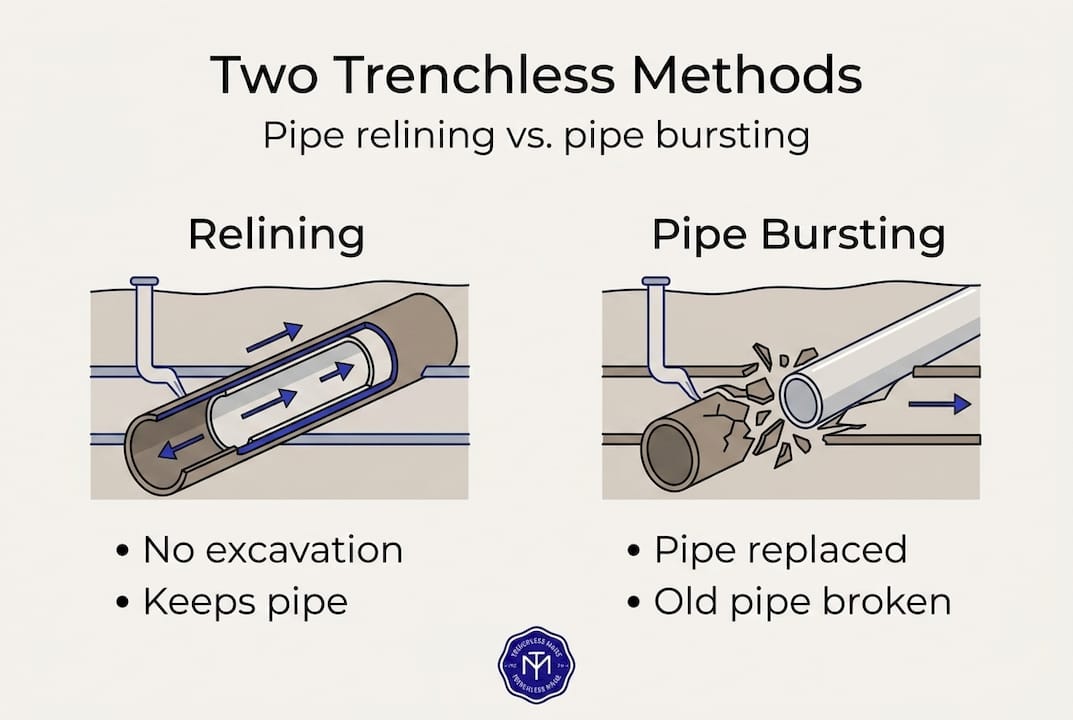
Pipe bursting replaces the existing pipe entirely. A bursting head is pulled through the old pipe, fracturing it outward into the surrounding soil, while simultaneously pulling a new pipe into position. This is the right choice when the pipe is too deteriorated or deformed to support a liner, or when you need to increase the pipe's diameter to handle higher flow demands.
Here's a practical comparison:
| Situation | Best method | Why |
|---|---|---|
| Cracked or corroded pipe, shape intact | Relining | No replacement needed, fast and cost-effective |
| Collapsed pipe or deformation over 40% | Pipe bursting | Liner cannot be inserted safely |
| Need larger pipe for upgraded capacity | Pipe bursting | Relining slightly reduces interior diameter |
| Pipe under concrete slab or mature landscaping | Relining preferred | Minimal surface impact |
| Severely deteriorated clay or cast iron | Either, based on inspection | Camera diagnosis determines best path |
| Severe offset at joints or grade failure | Pipe bursting or excavation | Structural issues liner cannot address |
Lining rehabilitates while bursting replaces, and each method has a clear set of ideal use cases. The right choice always begins with an accurate camera inspection and a contractor who is willing to explain both options honestly.
Pro Tip: For older Maine homes with established landscaping or mature trees near the sewer line, relining is almost always the preferred starting point. Pipe bursting, while still trenchless, involves more ground disturbance because the old pipe is fractured outward. If your pipes are intact enough for relining, that's the gentler path. You can also review a detailed cost breakdown comparison to understand the financial difference between each method.
A fresh perspective: What most homeowners miss about relining
Putting it all together, let's look at what most people get wrong about mainline relining, and what you can do differently.
After working on sewer repairs across Maine, one pattern stands out clearly. Homeowners often call us after already agreeing to excavation, sometimes after paying a deposit, simply because they never knew relining was an option. They searched for "sewer repair," got a quote that assumed digging, and moved forward without a second opinion.
The uncomfortable reality is that not every contractor offers relining. Some still default to excavation because it's what they know, or because their equipment investment is in traditional digging. That doesn't make them dishonest. But it does mean you need to ask specifically whether relining is an option before any work begins.
A camera inspection is your single most important first step. Without it, no one, including us, can tell you whether relining is viable. Spending a few hundred dollars on a proper diagnosis can save you tens of thousands in unnecessary excavation and site restoration costs. Follow our seasonal sewer maintenance tips to stay ahead of issues before they become emergencies. Getting a qualified second opinion is not an insult to the first contractor. It's smart homeownership.
Explore trenchless sewer relining solutions in Maine
Ready to see if mainline relining is right for your Maine home? Here's your next step.
Trenchless Maine specializes in no-dig sewer solutions for homeowners across the state, from Portland to Bangor and beyond. Our team brings over 50 years of combined expertise to every camera inspection, cleaning, and relining project we handle.
Most homeowners can schedule a camera inspection and receive a detailed estimate quickly, with many relining projects completed within a single day. Whether you're dealing with root intrusion, cracked pipes, or slow drains, we'll give you an honest diagnosis and the clearest path forward. Get a free sewer relining quote today, or explore all trenchless services to see the full range of solutions available for your home.
Frequently asked questions
How long does mainline sewer relining last?
Most relined sewer pipes last at least 50 years because the cured epoxy liner is engineered as a fully structural, seamless pipe wall. With routine maintenance, many installations will exceed that estimate comfortably.
Can relining fix a completely collapsed or broken pipe?
No. Pipes that have collapsed beyond 40% deformation, or that have severe offsets or grade failures, are not suitable candidates for relining because the liner requires a stable host pipe to cure properly. Pipe bursting or excavation would be the appropriate repair in those cases.
Are there special standards that contractors must follow for relining?
Yes. Reputable contractors follow ASTM F1216 and F1743 standards along with NASSCO guidelines to ensure the liner wall thickness is correctly engineered for the specific pipe conditions, soil loads, and groundwater environment at your property.
What is the difference between relining and pipe bursting?
Relining installs a new pipe wall inside the existing host pipe, while pipe bursting replaces the old pipe entirely by fracturing it outward and pulling a new pipe into position. Both are trenchless methods, but relining is better for intact damaged pipes, while bursting suits severely deteriorated or undersized pipes.