
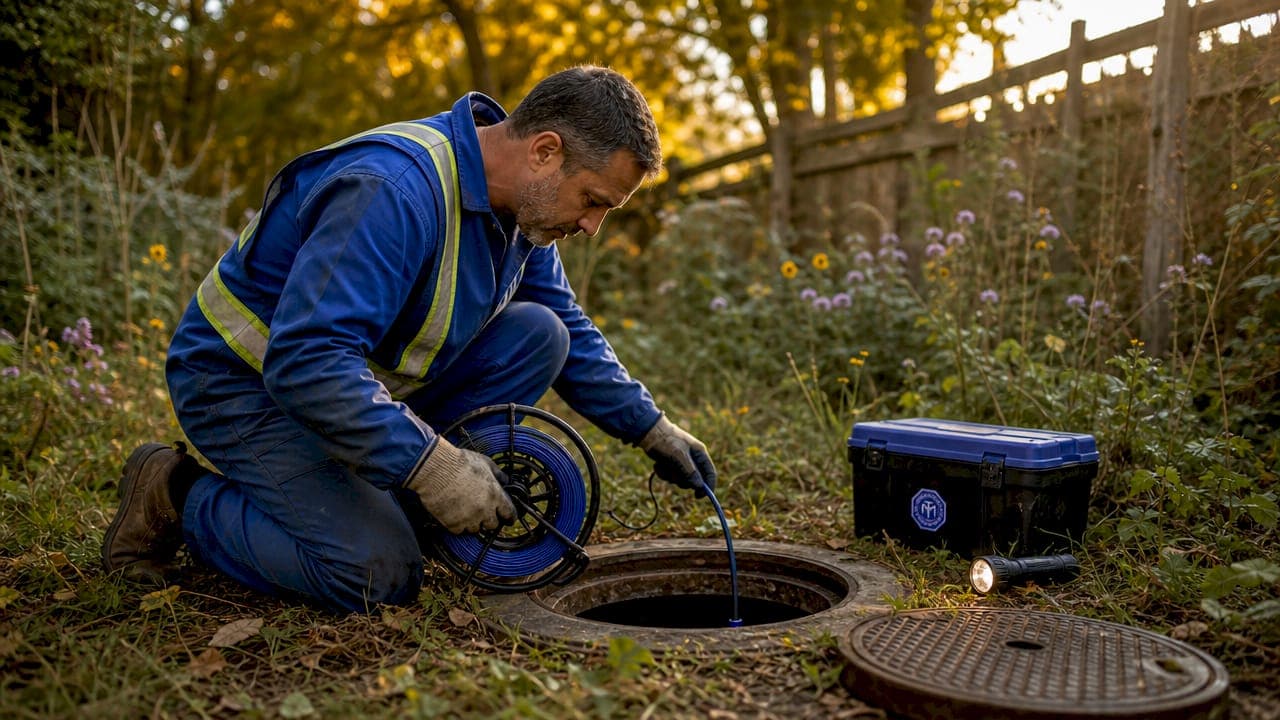
Sewer line failure is defined as the progressive loss of structural integrity or flow capacity in a buried pipe, caused by root intrusion, soil instability, aging materials, or environmental stress acting alone or in combination. Understanding what causes sewer line failure is the difference between a $500 camera inspection and a $15,000 emergency excavation. The most common culprits are tree root intrusion, freeze-thaw soil movement, corroded or deteriorated pipe materials, and human factors like grease buildup and improper flushing. Recognizing the warning signs early, including recurring clogs, slow drains, and soggy yard patches, gives you a real chance to act before a partial blockage becomes a full collapse.
What causes sewer line failure in most homes?
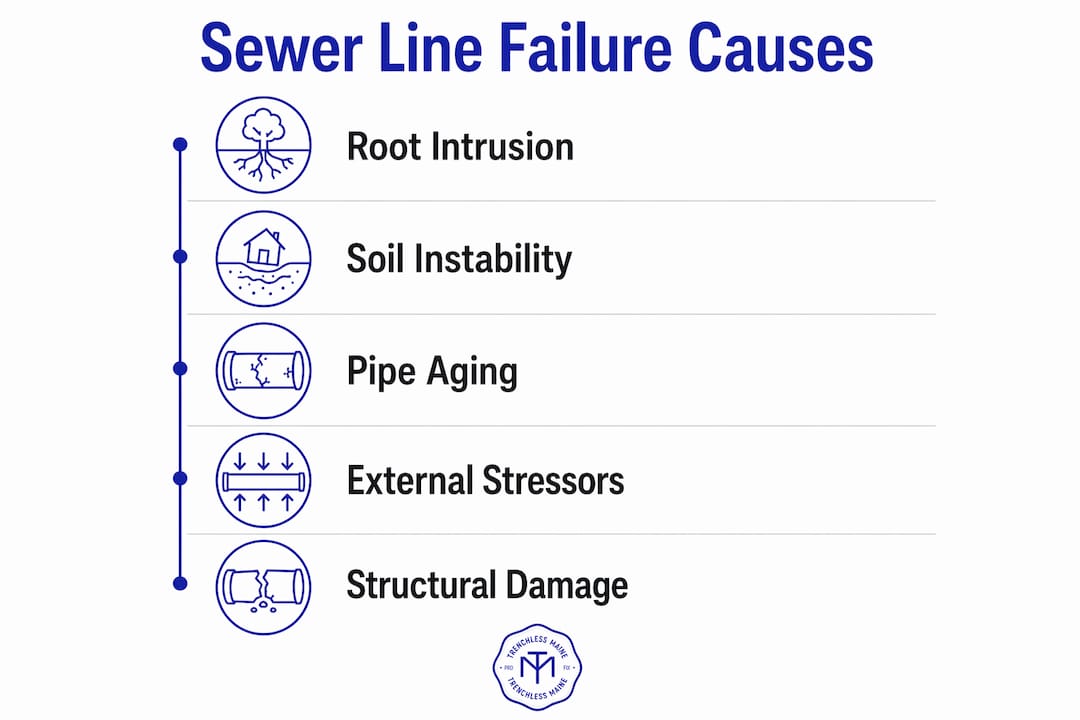
Sewer line failure is almost always cumulative, meaning no single event destroys a pipe overnight. Mechanical stress, soil support loss, material aging, and environmental pressure build on each other over years until the pipe can no longer function. This is why two identical pipes installed on the same street can fail decades apart. One sits in stable sandy loam; the other runs beneath a clay-heavy yard with a silver maple 10 feet away.
The four primary causes are root intrusion, soil and bedding failure, pipe material degradation, and external stressors like traffic loads and chemical corrosion. Each one is serious on its own. Together, they accelerate failure dramatically. A homeowner who understands this interplay can make smarter decisions about inspection timing, repair methods, and long-term maintenance.
How do tree roots cause sewer line failure?
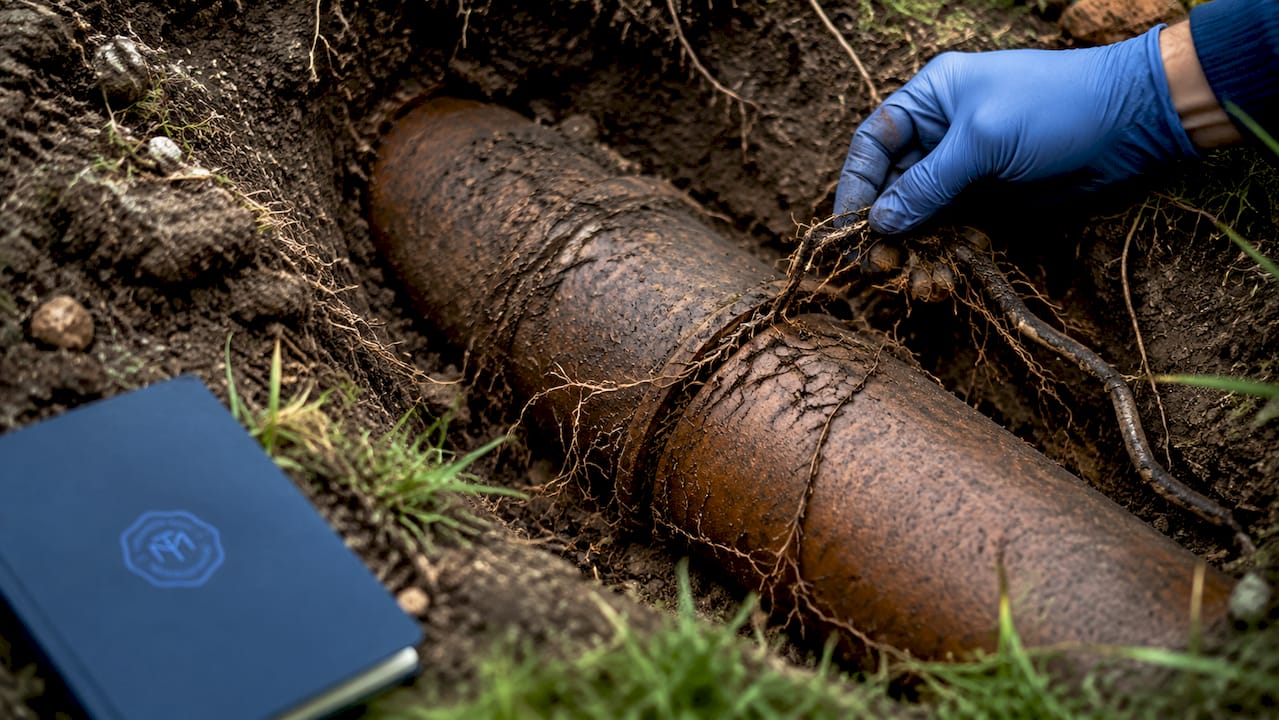
Tree roots are the single most reported cause of residential sewer line damage across the United States. Roots follow moisture gradients underground and enter pipes through the smallest available openings, including hairline cracks, deteriorated joints, and loose rubber gaskets. Once inside, they don't stop growing.
The damage mechanism works in two stages. First, fine feeder roots thread through a joint and absorb the moisture inside the pipe. Second, as those roots thicken, they exert radial pressure that widens the crack or separates the joint further. Clay and Orangeburg pipes are especially vulnerable because their joints are less flexible and their walls are more brittle than modern PVC. You can learn more about root damage in Maine pipes and how it progresses in residential systems.
The industry uses a grading system to classify root damage severity:
- Grade 1 and 2: Fine roots or minor intrusion with no significant flow restriction. Cleaning and monitoring are sufficient.
- Grade 3: Moderate root mass causing partial blockage. Hydro jetting and follow-up inspection are recommended.
- Grade 4: Root intrusion exceeding 25% bore reduction, indicating active structural compromise and urgent repair need.
- Grade 5: More than 50% bore reduction or active collapse. Full replacement is typically required at this stage.
Pro Tip: If you notice a strip of unusually green, lush grass running across your yard above the sewer line, that growth is being fed by a slow leak. It's one of the clearest visual signs of root intrusion or joint separation worth investigating immediately.
Why do soil conditions and external pressures lead to sewer pipe failure?
Soil is not a passive material surrounding your pipe. It is an active structural component, and when it shifts, shrinks, saturates, or freezes, your pipe moves with it. Homeowners consistently underestimate soil-related damage compared to more visible causes like root intrusion or flushing habits.
Here is how the four main soil-related mechanisms cause damage:
-
Freeze-thaw cycling. Water expands approximately 9% when it freezes, and soil containing moisture heaves upward with each freeze cycle. In Maine, where ground frost can reach several feet deep, pipes buried in freeze zones experience repeated upward and lateral stress that separates joints and shifts pipe alignment over time.
-
Clay soil shrink-swell. Expansive clay soils absorb water and swell during wet seasons, then contract and crack during dry periods. A pipe running through clay-heavy ground experiences constant lateral squeezing and release, which loosens joints and deforms older pipe materials.
-
Soil saturation and settlement. When soil becomes waterlogged, it loses its load-bearing capacity. Pipes that were properly supported at installation begin to sag as the bedding material shifts beneath them. A sagged pipe, sometimes called a belly, traps solids and accelerates blockage formation.
-
Traffic vibration and particle migration. Continuous low-frequency vibration from heavy vehicles or nearby rail lines causes soil particles to migrate gradually away from the pipe, leaving voids in the bedding. Over decades, this produces the same result as poor installation: an unsupported pipe that cracks under its own weight.
Pro Tip: If your home sits near a road that sees heavy truck traffic, or if you've had utility work done nearby in the last five years, schedule a camera inspection even if you have no symptoms. Vibration damage is invisible until it isn't.
How does aging pipe material contribute to sewer line failure?
Every pipe material has a service life, and many homes in Maine are sitting on pipes that have already exceeded theirs. The type of material determines not just how long a pipe lasts, but how it fails.
| Pipe material | Typical service life | Primary failure mode |
|---|---|---|
| Clay tile | 50 to 60 years | Joint separation, root intrusion, cracking |
| Orangeburg | 30 to 50 years | Delamination, collapse, bore deformation |
| Cast iron | 75 to 100 years | Internal corrosion, tuberculation, joint failure |
| PVC | 100 or more years | Joint failure from improper installation |
Older cast iron and Orangeburg pipes exhibit corrosion and structural deterioration that reduces their resistance to external loads over time. Cast iron corrodes from the inside out through a process called tuberculation, where iron oxide deposits build up on the pipe wall, narrowing the bore and weakening the structure. Orangeburg, a fiber-based pipe used widely from the 1940s through the 1970s, absorbs moisture and deforms into an oval shape before eventually collapsing entirely.
Hydrogen sulfide gas produced by anaerobic bacteria in sewers causes microbially induced corrosion, or MIC, which attacks both concrete and clay pipe walls from the inside. This chemical process is a documented primary cause of aging sewer pipe degradation and is particularly aggressive in low-flow or partially blocked lines where gases accumulate. If your home has clay or concrete pipes installed before 1980, MIC is a realistic threat worth assessing.
What other environmental and human factors accelerate sewer line failures?
Beyond roots and soil, several environmental and human-driven factors push pipes toward failure faster than their material age alone would suggest.
- Grease and wipe accumulation. Grease and so-called flushable wipes build up inside pipes over time, creating blockages that add internal pressure and stress the pipe wall. Grease cools and hardens on the pipe interior, narrowing the bore and creating a surface where solids catch and compound. This is one of the most preventable causes of premature sewer line stress.
- Heavy vehicle loads above the pipe. Heavy vehicle traffic over concrete pipes significantly stresses them, especially when bedding is inadequate. Dynamic wheel loads create impact forces that exceed the static design load of older pipes, initiating cracks that propagate with each subsequent pass.
- Hydrogen sulfide corrosion. As noted above, MIC from hydrogen sulfide is not just a material aging issue. It accelerates in pipes that experience frequent low-flow conditions, making it relevant to vacation properties, seasonal homes, and pipes serving low-occupancy buildings.
- Nearby construction and utility work. Excavation within 10 to 20 feet of a sewer lateral can disturb bedding, sever root systems that were stabilizing soil, and introduce vibration that loosens joints. If a neighbor has had major work done recently, your pipe may have been affected without any visible sign at your property.
- Population growth and system overload. Sewer systems designed for an earlier era suffer under modern usage loads. Increased flow volumes from densification and infill development push older pipes beyond their original design capacity, accelerating wear at joints and low points.
How can homeowners detect and prevent sewer line failure effectively?
Early detection is the most cost-effective tool you have. A camera inspection that catches a Grade 3 root intrusion costs a fraction of the emergency repair that follows a Grade 5 collapse. Knowing what to look for, and when to call a professional, is the practical core of sewer line maintenance.
- Watch for recurring clogs and slow drains. A single slow drain is usually a localized blockage. Multiple slow drains or a toilet that gurgles when you run the sink points to a problem in the main sewer lateral, not just a branch line.
- Check your yard after rain. Soft, soggy patches above the sewer line that don't dry out normally indicate a leak or pipe failure underground. A strip of unusually green grass in an otherwise dry yard is another reliable indicator.
- Notice sewage odors inside or outside. A functioning sewer line is sealed. If you smell sewage in your basement, crawl space, or yard, the pipe has a breach somewhere along its run.
- Schedule a professional camera inspection. Camera inspections are the only reliable way to distinguish a blockage from structural failure. Misdiagnosis leads to repeated cleaning that never addresses the underlying damage, costing more over time than a single accurate diagnosis upfront.
- Adopt preventive habits. Never pour cooking grease down the drain. Dispose of wipes, paper towels, and hygiene products in the trash. Plant large trees away from sewer lines, or choose species with non-aggressive root systems.
Pro Tip: Schedule a camera inspection every 5 to 7 years if your home is more than 30 years old, or sooner if you have mature trees within 20 feet of the sewer line. Catching root intrusion at Grade 2 instead of Grade 4 can save thousands of dollars in repair costs.
Key takeaways
Sewer line failure results from the combined effect of root intrusion, soil instability, aging pipe materials, and environmental stressors, and catching any one of these early prevents the others from compounding.
| Point | Details |
|---|---|
| Root intrusion is graded 1 to 5 | Grade 4 and 5 defects require urgent repair or full replacement to prevent collapse. |
| Soil conditions drive hidden damage | Freeze-thaw cycles, clay shrink-swell, and vibration damage pipe supports without visible symptoms. |
| Pipe material determines failure mode | Orangeburg deforms and collapses; cast iron corrodes internally; clay joints separate under root pressure. |
| Human factors accelerate deterioration | Grease, wipes, and nearby construction add stress that shortens pipe lifespan significantly. |
| Camera inspection is the diagnostic standard | Only video inspection reliably separates a blockage from structural failure, preventing costly misdiagnosis. |
Why I think most homeowners fix the wrong thing first
After years of working with sewer systems across Maine, the pattern I see most often is this: a homeowner calls because of a recurring clog, a plumber snakes the line, it clears, and everyone moves on. Six months later the same clog is back. A year after that, there's a backup in the basement.
The problem was never the clog. It was a sagging pipe with a root intrusion at the joint, sitting in clay soil that had been shifting for a decade. The snake cleared the symptom and left the cause completely untouched.
What I've found is that professional diagnostics are not a luxury for serious problems. They are the starting point for any problem that has happened more than once. A camera inspection changes the entire conversation from "clear it again" to "here is exactly what is wrong and what it will take to fix it permanently."
The other misconception I run into constantly is that sewer failure is always about what you flush. Grease and wipes matter, but environmental soil conditions dictate pipe lifespan nearly as much as pipe material quality. A homeowner with perfect flushing habits and a pipe running through frost-heave-prone soil is still at real risk. Treating the whole system, soil conditions, pipe material, root proximity, and usage habits, is the only approach that actually holds.
— John
How Trenchlessmaine can fix your sewer line without digging up your yard
When a camera inspection confirms structural damage, the next question is always: how do we fix it without tearing up the driveway, the landscaping, or the foundation plantings?

Trenchlessmaine specializes in no-dig trenchless repair methods including CIPP lining, pipe bursting, and hydro jetting, all designed to restore your sewer line with minimal disruption to your property. Most projects are completed within 24 hours, and repairs are backed by warranties up to 50 years. If your pipe has root intrusion, joint separation, or corrosion damage that doesn't yet qualify as a Grade 5 collapse, trenchless repair is almost certainly the faster, more affordable path forward. Contact Trenchlessmaine to schedule a sewer scope inspection and get a clear picture of what your pipe actually needs.
FAQ
What is the most common cause of sewer line failure?
Tree root intrusion is the most frequently reported cause of residential sewer line failure, followed by aging pipe materials and soil movement from freeze-thaw cycles. These factors typically act together rather than in isolation.
How do I know if my sewer line is failing?
The clearest signs of sewer line issues include multiple slow drains, recurring clogs, sewage odors inside or outside the home, and soggy yard patches above the pipe route. A camera inspection is the only way to confirm whether the cause is structural or a simple blockage.
Can trenchless repair fix all types of sewer pipe failures?
No. Trenchless repair is not suitable for pipes with Grade 5 defects, significant sag, or complete collapse. Those conditions require excavation and full replacement. A camera inspection determines which repair method is appropriate.
How long do sewer pipes typically last?
Service life varies by material. PVC pipes can last 100 or more years, cast iron typically lasts 75 to 100 years, clay tile lasts 50 to 60 years, and Orangeburg pipes often fail within 30 to 50 years. Soil conditions and usage habits affect actual lifespan significantly.
Does flushing wipes really damage sewer lines?
Yes. Wipes and grease accumulate inside pipes, narrowing the bore and adding internal pressure that stresses the pipe wall over time. This buildup is one of the most preventable contributors to premature sewer line stress and blockage formation.