

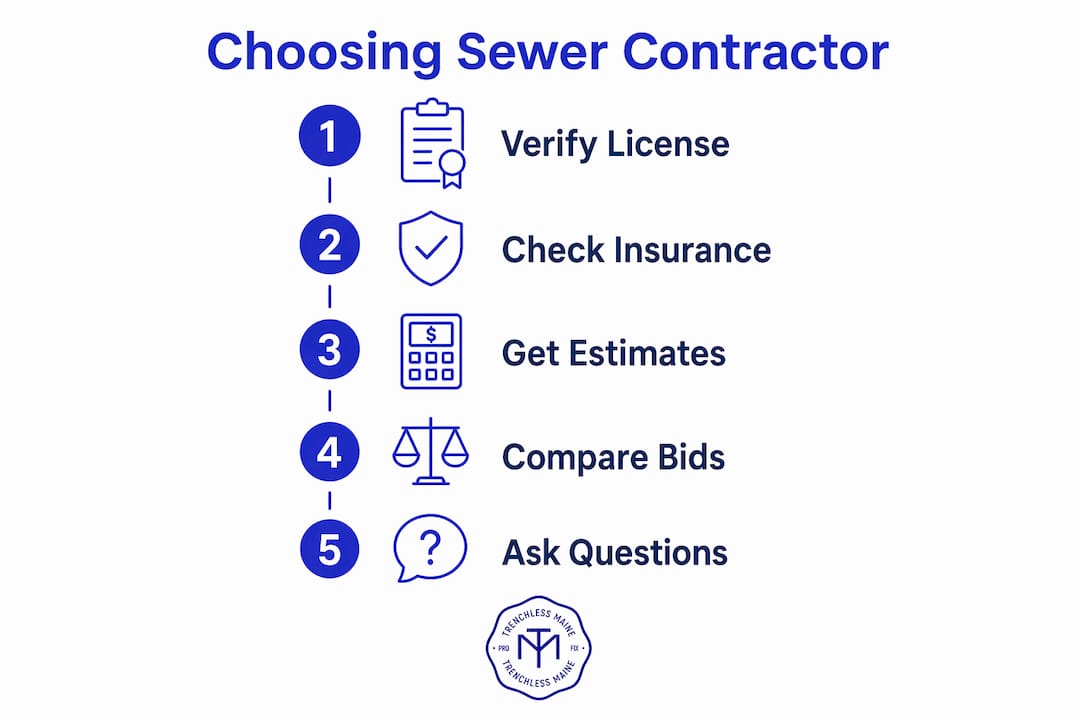
Choosing the right sewer contractor means verifying licenses, confirming insurance, and comparing written estimates before any work begins. Skip one of those steps and you risk voided permits, surprise costs, or repairs that fail inspection. The criteria for sewer contractor selection are straightforward, but most homeowners only discover them after a bad hire. This guide walks you through every checkpoint, from license class verification to the questions you should ask before signing anything.
How to choose a sewer contractor: licenses and insurance first
A qualified sewer contractor holds the correct license class for your project's scope and carries adequate insurance. These two requirements protect you from financial liability and guarantee the work meets local code.
License classes and what they mean
Licensing requirements vary by state. In Virginia, for example, Class A, B, and C licenses correspond to contracts over $120,000, up to $120,000, and up to $10,000 respectively. That structure exists in most states in some form. Hiring a contractor whose license class does not match your project scope can void your permits and strip you of consumer protection fund coverage.
Beyond the class, the license type matters. Specialized utility or underground contractors are legally required for work in public rights-of-way and main sewer connections. A general plumber is not the same credential. Using the wrong classification risks permit denial and failed inspections, which means you pay twice.
Insurance minimums you should require
- General liability insurance: Require at least $1 million in coverage for any sewer project. This protects your property if the contractor causes accidental damage.
- Workers' compensation: Required in most states. Without it, you could be liable for medical costs if a worker is injured on your property.
- Surety bond: A bond guarantees the contractor will complete the work. It is separate from insurance and signals financial stability.
- Environmental certifications: For commercial property sewer contractor vetting, updated environmental certifications and wastewater permits reduce your legal exposure on regulated sites.
Always ask for physical copies of the license and insurance certificate. Then verify both through your state's official contractor licensing portal. Reluctance to share documentation is a major red flag and a reason to walk away immediately.
Pro Tip: Search your state's contractor license lookup tool by the company name and license number together. A mismatch between the two is a sign the contractor is operating under someone else's credentials.
How to compare written estimates and spot red flags
Getting multiple estimates is the single most effective way to protect yourself from overcharges and incomplete work. At least three written, itemized estimates from separate contractors give you a real market baseline. That comparison also reveals which contractors are transparent and which are not.
What every estimate must include
- Repair scope and method: The estimate should name the specific repair approach, whether that is pipe bursting, CIPP lining, or open-cut excavation.
- Materials list: Generic terms like "pipe materials" are not enough. The estimate should specify pipe diameter, material type, and liner thickness.
- Labor costs: Broken out separately from materials so you can compare apples to apples across bids.
- Permit and inspection fees: Written documentation of permit fees prevents disputes later. Any estimate that omits permit costs is incomplete.
- Restoration plan: The estimate should describe exactly how disturbed landscaping, pavement, or hardscape will be returned to its original condition. Transparent restoration plans protect you from hidden costs after the repair is done.
- Warranty terms: Confirm what is covered, for how long, and whether it transfers if you sell the property.
Red flags to watch for in any bid
| Warning sign | What it signals |
|---|---|
| Vague scope description | Contractor may expand the job and charge more later |
| Bid significantly lower than others | Missing line items or unlicensed subcontractors |
| No permit fees listed | Contractor may skip permits entirely |
| Verbal-only quote | No legal protection if disputes arise |
| No restoration plan | You may be left with a torn-up yard |
A bid that comes in far below the others is not a deal. Obtaining multiple detailed estimates reveals how professional each contractor actually is. The lowest number often signals missing scope, not efficiency.
Pro Tip: Ask each contractor to walk you through their estimate line by line. A confident, knowledgeable contractor will do it without hesitation. One who deflects or rushes through it is telling you something important.
What role do local reputation and specialized experience play?
Local knowledge is not a soft benefit. A contractor familiar with Maine's soil conditions, frost depths, and municipal code requirements will pull permits faster, pass inspections on the first attempt, and anticipate site-specific problems before they become costly surprises.
How to research a contractor's reputation
- Check Google Reviews and the Better Business Bureau for patterns, not just star ratings. One bad review is noise. Five reviews mentioning the same problem is a pattern.
- Ask the contractor for three references from projects similar to yours in scope and location. Call them.
- Search the contractor's name on your state's licensing portal to confirm no disciplinary actions or license suspensions.
- Review their project history for familiarity with local municipal codes and soil conditions. Locally rooted contractors show better outcomes on both fronts.
Why NASSCO certification matters for trenchless work
For trenchless sewer repairs, look for technicians with NASSCO PACP certification. NASSCO stands for the National Association of Sewer Service Companies. NASSCO PACP certification confirms the technician can accurately interpret camera inspection footage and apply the correct rehabilitation method. Without it, you have no way to verify the diagnosis your contractor gives you.
"Contractors with strong local roots are more likely to provide reliable service due to their familiarity with local challenges and long-term community reputation." — Sewer Repair Authority
The difference between a general plumber and a licensed utility contractor is not just a credential on paper. Many homeowners hire general plumbers for sewer work that legally requires a utility contractor classification. That mistake leads to regulatory problems, failed inspections, and repairs that do not hold up. Check the license type before you check the price.
What questions should you ask your sewer contractor before hiring?
A thorough contractor interview takes 15 minutes and can save you thousands. Use this checklist before you sign any contract.
Credential and insurance questions
- Can you provide your license number and insurance certificate today?
- What license class do you hold, and does it cover this project's scope?
- Are you bonded, and can I see proof?
- Will you pull the required permits, and are those fees included in your estimate?
Experience and method questions
- How many projects similar to mine have you completed in the past two years?
- Are you familiar with the local municipal codes and utility infrastructure in this area?
- What repair method do you recommend, and why is it the right choice for my pipe condition?
- Do your technicians hold NASSCO PACP certification for camera inspections?
- Will you provide written camera inspection footage before and after the repair?
Project management and warranty questions
- Who will physically perform the work? Your in-house crew or subcontractors?
- If subcontractors are used, are they licensed and insured under your policy?
- What does your warranty cover, and how long does it last?
- What is your restoration plan for my yard or driveway after the work is complete?
- How do you handle unexpected problems discovered during the repair?
If a contractor hesitates on any credential question or cannot produce documentation on the spot, that is your answer. Move to the next name on your list. You can learn more about warranty coverage options before your contractor conversation so you know what reasonable terms look like.
Key takeaways
Choosing a reliable sewer contractor requires verifying license class, confirming insurance minimums, comparing at least three itemized estimates, and checking local reputation before any work begins.
| Point | Details |
|---|---|
| Verify license class | Match the contractor's license class to your project scope to avoid voided permits. |
| Require insurance minimums | Demand at least $1 million in general liability plus workers' compensation before hiring. |
| Get three written estimates | Compare itemized bids to identify missing scope, permit fees, and restoration plans. |
| Check local reputation | Review BBB ratings, call references, and confirm no disciplinary actions on state portals. |
| Ask about NASSCO certification | Certified technicians provide accurate camera inspections and reliable trenchless repair diagnoses. |
What I've learned from watching homeowners hire the wrong contractor
I've seen the same mistake repeated more times than I can count. A homeowner gets one estimate, it sounds reasonable, and they sign. Two weeks later they're dealing with a failed inspection, a yard that looks like a construction site, and a contractor who stopped returning calls.
The single biggest error is treating price as the primary filter. Price is the last thing you should evaluate. Verify the license, confirm the insurance, and check the references first. If a contractor passes all three, then you look at price. A bid that skips permit fees or restoration costs is not cheaper. It just hides the real cost until later.
I also think homeowners underestimate how much local knowledge matters. A contractor who has worked in your municipality knows which inspectors require what documentation, which soil conditions cause pipe deformation, and which repair methods the local utility will approve. That knowledge shortens your project timeline and reduces the chance of a costly do-over.
One more thing: always ask who is actually doing the work. A licensed contractor who subcontracts to an unlicensed crew is a real scenario. Get the answer in writing. If the crew performing the work is not covered under the contractor's insurance policy, you carry the risk. That is not a position you want to be in when someone is digging up your sewer lateral.
The Trenchlessmaine blog covers contractor vetting, local regulations, and repair methods in detail if you want to go deeper before your first call.
— John
How Trenchlessmaine protects your property with certified trenchless repair
When you've done the work of vetting a contractor and you want a team that meets every standard on this list, Trenchlessmaine is built for exactly that. Their certified technicians use no-dig sewer repair technology including CIPP lining, hydro jetting, and camera inspections to fix sewer problems without tearing up your yard. Work is typically completed within 24 hours, and repairs are backed by warranties up to 50 years.

Trenchlessmaine serves most of Maine's cities and brings over 50 years of combined expertise to every project. If you want to minimize repair disruption and work with a contractor who is transparent about licensing, insurance, and pricing from the first call, reach out to Trenchlessmaine for a free quote today.
FAQ
What licenses does a sewer contractor need?
A sewer contractor must hold a state-issued contractor license that matches the project scope, and may need a separate utility or underground contractor classification for work on public mains. License requirements vary by state, so verify through your state's official licensing portal.
How much insurance should a sewer contractor carry?
Contractors should carry at least $1 million in general liability insurance and active workers' compensation coverage. Commercial property managers should also require updated environmental certifications for regulated sites.
Why should I get three estimates for sewer repair?
Three itemized estimates give you a fair market price baseline and reveal which contractors are transparent about scope, permits, and restoration costs. A significantly lower bid usually means missing line items, not a better deal.
What is NASSCO PACP certification?
NASSCO PACP certification confirms a technician is trained to assess sewer pipe condition using standardized camera inspection protocols. It is the recognized credential for trenchless sewer rehabilitation and inspection work.
What are the biggest red flags when hiring a sewer contractor?
Refusing to provide license or insurance documentation, offering verbal-only quotes, omitting permit fees from estimates, and using vague scope descriptions are all signs to walk away and find a different contractor.