
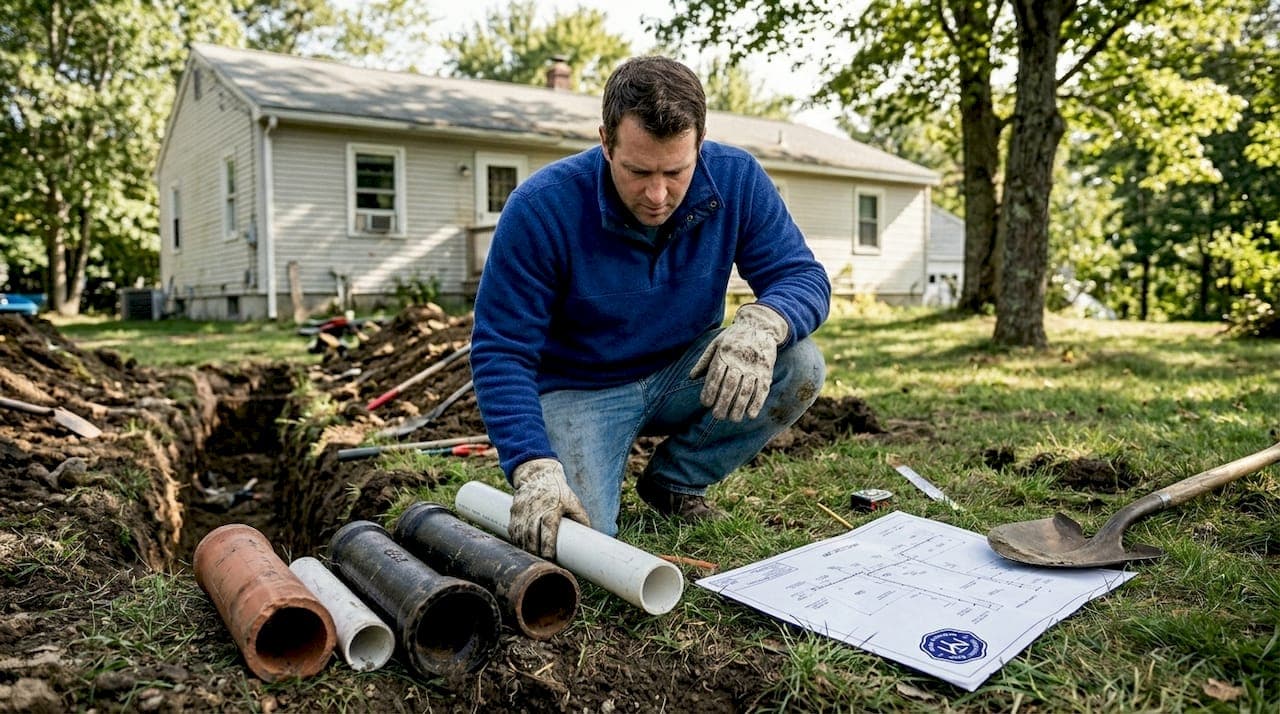
Choosing among the available sewer pipe material types is one of those decisions that looks straightforward until you start digging into the details. The wrong material for your soil conditions, system pressure, or local climate can mean premature failure, costly excavation, and repairs that disrupt your property for days. Whether you're replacing an aging line, managing a multi-unit property, or planning a new installation, understanding how each material performs under real-world conditions is the difference between a 50-year solution and a 10-year headache. This guide breaks down every major option so you can make a confident, informed call.
Table of Contents
- Key Takeaways
- What to know before selecting sewer pipe materials
- 1. Clay pipes
- 2. Cast iron pipes
- 3. Orangeburg pipes
- 4. PVC pipes
- 5. ABS pipes
- 6. HDPE pipes
- 7. Polypropylene (PP) pipes
- 8. Concrete pipes
- 9. Ductile iron pipes
- Sewer pipe materials comparison
- How to choose the right sewer pipe material
- My honest take on sewer pipe material selection
- Upgrade your sewer system without the excavation
- FAQ
Key Takeaways
| Point | Details |
|---|---|
| System type drives material choice | Gravity and pressure sewer systems have different demands that directly affect which pipe material performs best. |
| Older materials carry hidden risks | Clay, cast iron, and Orangeburg pipes fail most often at joints and connections, not through the pipe wall itself. |
| Thermoplastics dominate modern installs | PVC and ABS meet ASTM D2680 standards for gravity sewers, offering durability and reliable sealing at lower cost. |
| HDPE leads in pressure applications | Fusion-welded HDPE joints are virtually leak-proof and can last 100 or more years under soil movement stress. |
| Camera inspection comes before material choice | A professional CCTV inspection reveals actual failure points and guides the right repair or replacement material decision. |
What to know before selecting sewer pipe materials
Not every pipe material works in every situation, and material selection directly affects how long your system performs. Before you compare products or get contractor quotes, you need to understand the factors that narrow your options.
System type matters first. The two main categories are gravity sewers and pressure sewers. Gravity sewers require deep trenches to maintain a consistent downward slope, while pressure sewers use pumps to move waste and can be installed at shallower depths. Pressure systems need materials that handle sustained internal stress, while gravity systems prioritize flow characteristics and joint tightness.
Beyond system type, you should evaluate:
- Soil conditions: Expansive clay soils, rocky ground, and areas with heavy tree root activity all stress pipe joints and walls differently.
- Chemical exposure: Industrial properties and sites near agricultural runoff may have soils with elevated chemical concentrations that degrade certain materials faster.
- Ground movement: In areas with frost heave (a real concern in Maine), flexible materials handle soil shifts better than rigid ones.
- Temperature range: Some materials become brittle in extreme cold during installation, affecting long-term joint integrity.
- Existing pipe condition: If you're repairing rather than replacing, knowing what material you already have is critical.
Pro Tip: Before committing to any material, schedule a professional camera inspection of your existing line. CCTV inspection is the standard diagnostic tool for identifying root intrusion, pipe deformation, and joint failure, and it prevents you from choosing a repair material based on guesswork.
1. Clay pipes
Clay pipes are among the oldest sewer materials still found in residential systems. Homes built before the 1970s commonly have clay sewer laterals, and some of those lines are still functional today. Clay offers excellent resistance to chemical degradation because it is inert. Acids and alkalis in soil have little effect on the pipe wall itself.
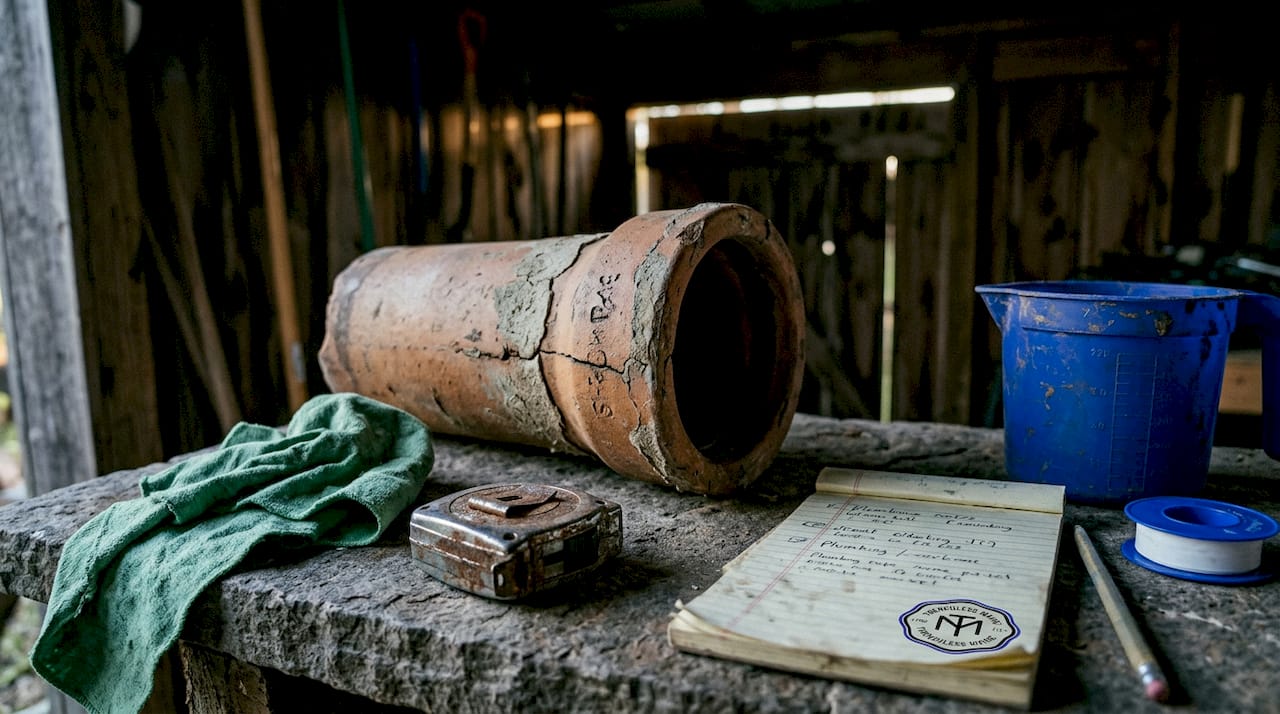
The weakness is at the joints. Bell-and-spigot clay joints were historically sealed with mortar or oakum, neither of which holds indefinitely. Older pipe materials like clay suffer most of their failures at joints and service connections, not through uniform corrosion of the wall. Tree roots exploit those joint gaps, and soil settlement can separate sections entirely. Clay is no longer specified for new residential construction in most jurisdictions.
2. Cast iron pipes
Cast iron was the premium residential sewer material from the early 1900s through the mid-20th century. It is heavy, strong, and handles above-ground and below-slab applications well. Interior cast iron still appears in multi-story buildings because of its sound-dampening properties. Water rushing through a cast iron stack is noticeably quieter than through PVC.
Below grade, cast iron corrodes from the inside out when hydrogen sulfide gas in the pipe reacts with moisture to form sulfuric acid. This process, called microbially influenced corrosion, thins the pipe wall over decades. A cast iron lateral in good structural shape may still be worth lining rather than replacing, which is where trenchless technologies add real value.
3. Orangeburg pipes
Orangeburg is the material no homeowner wants to find during a camera inspection. Manufactured from layers of pitch-impregnated wood fiber, it was used extensively for sewer laterals from the 1940s through the 1970s, largely because metal was being conserved for World War II production.
Orangeburg absorbs moisture over time, softens, and deforms from round into an oval or flat shape. That deformation restricts flow and eventually causes collapse. There is no effective way to repair or line a severely deformed Orangeburg pipe. If your home was built in that era and you have not had a camera inspection, it is worth scheduling one soon.
4. PVC pipes
PVC is the most widely used material for residential gravity sewer systems installed today. It is lightweight, corrosion-resistant, and relatively easy to work with, which keeps labor costs down. The smooth interior surface minimizes sediment buildup and supports good flow velocity.
PVC pipe for gravity sewer applications is governed by ASTM D2680, which covers both the pipe and the joining system, setting standards for stiffness and joint tightness. That certification matters because a pipe that meets spec is predictable in performance. PVC also has a relatively lower carbon footprint among plastic pipe options, particularly when produced with responsible energy sourcing.
5. ABS pipes
ABS (acrylonitrile-butadiene-styrene) is PVC's closest competitor in residential drain, waste, and vent systems. Both materials fall under ASTM D2680 standards for composite sewer piping, meaning quality and performance benchmarks are comparable.
ABS is slightly more rigid than PVC and performs better in cold-temperature installations, which is relevant in Maine where below-freezing work is sometimes unavoidable. It is also lighter and can be easier to cut and join. The trade-off is cost. ABS pipe typically runs a bit more expensive than equivalent PVC. Most contractors default to PVC for below-grade sewer work and ABS for interior drain piping, though local code and contractor preference also play a role.
Pro Tip: Never mix PVC and ABS in the same run without using an approved transition coupling. The two materials cannot be solvent-cemented to each other, and an improper joint is a future leak point.
6. HDPE pipes
High-density polyethylene is the go-to material for pressure sewer systems, and its performance record is exceptional. HDPE offers over 100 years of expected service life, resists virtually all chemicals found in municipal wastewater, and flexes under soil movement rather than cracking.
The defining advantage of HDPE is its jointing system. Pipes are joined by heat fusion, which melts and bonds the material into a seamless connection. There are no gaskets to dry out, no mortar to crack, and no mechanical fittings to loosen. That fusion-welded joint integrity makes HDPE the most leak-resistant option for high-stress applications. The trade-off is installation equipment. Fusion welding requires specialized tools and trained operators, which increases upfront cost.
7. Polypropylene (PP) pipes
Polypropylene is gaining ground in commercial and municipal sewer applications in the United States, having been standard in European infrastructure for years. PP offers superior chemical and temperature resistance compared to PVC, making it well suited for industrial drainage or systems that handle elevated temperatures from commercial kitchen or laundry waste.
Multi-layer PP pipes add structural wall stiffness without sacrificing chemical resistance. For most residential gravity sewer laterals, PP is more pipe than you need. But if you're managing a property with unusual discharge characteristics, it is worth discussing with your engineer.
8. Concrete pipes
Concrete pipe dominates large-diameter municipal trunk sewers rather than residential laterals. It is inexpensive per linear foot at large sizes, locally sourced in most regions, and capable of handling enormous flow volumes. The drawback is susceptibility to sulfide corrosion on the interior crown of the pipe. Microbial activity produces hydrogen sulfide gas that attacks the cement matrix, gradually thinning the pipe wall from the inside.
Concrete is rarely specified for residential sewer work today, but property managers overseeing larger commercial sites connected to municipal concrete infrastructure should be aware of its maintenance needs.
9. Ductile iron pipes
Ductile iron is cast iron's stronger, more flexible descendant. It handles high pressure and external loads better than any other metal pipe option, making it the standard for water transmission mains and force mains in municipal systems. It can also be found at pressure sewer pump discharge points.
For residential use, ductile iron is overkill on most projects, and the cost reflects that. You're more likely to encounter it at the connection between a private pressure sewer system and a municipal force main than in a standard residential sewer lateral.
Sewer pipe materials comparison
| Material | Expected Lifespan | Best Application | Root Intrusion Risk | Relative Cost |
|---|---|---|---|---|
| Clay | 50-100 years (if joints intact) | Gravity sewer, older homes | High at joints | Low |
| Cast iron | 50-75 years | Interior/above-grade drain | Low | Moderate |
| Orangeburg | Failed in most cases | No longer recommended | High | N/A |
| PVC | 50-100 years | Gravity sewer residential | Low | Low |
| ABS | 50-100 years | Interior drain, cold climates | Low | Low to moderate |
| HDPE | 100+ years | Pressure sewer, high-stress | Very low | Moderate to high |
| Polypropylene | 50-100 years | Commercial, industrial drain | Very low | Moderate to high |
| Concrete | 50-75 years | Municipal trunk sewers | Moderate at joints | Low at large scale |
| Ductile iron | 50-100 years | Force mains, pressure systems | Very low | High |
How to choose the right sewer pipe material
Once you understand the material options, the decision comes down to your specific conditions. Here is a practical sequence to follow:
- Get a camera inspection first. CCTV inspection identifies actual failure points, whether those are root intrusions at joints, deformed Orangeburg sections, or corroded cast iron walls. You cannot make a sound material decision without this data.
- Identify your system type. Gravity or pressure? Your local municipality can confirm this, and it determines whether you need a material rated for pressure service or flow characteristics alone.
- Assess your site conditions. Soil type, ground cover, tree proximity, and frost depth all affect which materials will hold up over the long term.
- Set a realistic budget. PVC is cost-effective for most residential gravity sewer work. HDPE adds cost but justifies it in pressure applications or sites with significant ground movement.
- Check local codes. Some municipalities specify approved materials for sewer lateral construction. Your contractor should confirm compliance before ordering materials.
- Consider trenchless options. If your existing pipe is structurally sound but damaged at joints or showing early corrosion, trenchless sewer repair methods like CIPP lining work on clay, cast iron, PVC, and concrete without full excavation.
Pro Tip: When comparing bids, make sure every contractor is quoting the same pipe material and the same ASTM specification. A lower bid using a thinner-wall schedule pipe is not an apples-to-apples comparison.
My honest take on sewer pipe material selection
I've reviewed enough sewer repair projects to spot the pattern most homeowners and property managers miss. They focus almost entirely on rated lifespan and ignore the installation environment. A pipe rated for 100 years in ideal conditions might fail in 20 if the soil chemistry is aggressive or the backfill was rushed.
The most critical factor is system-environment compatibility, not the marketing claim on the product sheet. I've seen PVC laterals fail prematurely because of improper bedding around rocky Maine soil, and I've seen 70-year-old clay lines that were still perfectly serviceable because they sat in stable, well-draining ground with no nearby trees.
What I've also learned is that material type alone tells you very little without a camera inspection. The failure in clay and cast iron systems almost always happens at the joints, not through the pipe body. If you skip the inspection and just replace like-for-like, you may be solving the wrong problem entirely.
My strong preference for most Maine residential properties is to combine a camera inspection with a trenchless lining evaluation before committing to full replacement. The cost difference can be significant, and the disruption to your yard and driveway is minimal with the right technology. Modern CIPP liners installed inside existing pipe essentially create a new pipe within the old one, and they bond to clay, cast iron, and concrete equally well.
— John
Upgrade your sewer system without the excavation
If your sewer inspection revealed damaged pipe or you're weighing material options for a repair, Trenchlessmaine offers a smarter path forward. Rather than digging up your yard, driveway, or landscaping to replace failing pipe, trenchless methods work from within the existing line.
Trenchlessmaine's no-dig repair technology applies to clay, cast iron, PVC, concrete, and more. CIPP lining installs a resin-saturated liner inside your existing pipe, curing into a jointless new pipe that resists root intrusion and corrosion. Most residential projects complete within 24 hours. For lines with severe buildup before lining, hydro jetting services clear the pipe thoroughly first. And if you haven't had a sewer scope done yet, Trenchlessmaine's camera inspection service gives you the full picture of what's happening underground before you spend a dollar on materials or labor. Reach out today to find out which solution fits your pipe and your property.
FAQ
What are the most common sewer pipe material types in homes?
The most common types found in residential properties are clay (in older homes), cast iron (mid-century construction), and PVC or ABS (post-1970s installations). Orangeburg is also found in homes built between the 1940s and 1970s and is prone to deformation and collapse.
Which pipe material is best for a gravity sewer line?
PVC is the most widely used material for residential gravity sewer lines today. It meets ASTM D2680 standards, resists corrosion, and offers a smooth interior surface that supports good flow with minimal sediment buildup.
How long do different sewer pipe materials last?
Expected lifespans vary by material: clay and PVC can last 50 to 100 years with intact joints, HDPE can exceed 100 years, and Orangeburg typically fails well short of 50 years. Actual lifespan depends heavily on soil conditions, installation quality, and maintenance.
Can I reline an old sewer pipe instead of replacing it?
Yes. Trenchless CIPP lining works on clay, cast iron, concrete, and PVC pipes, provided the existing pipe has enough structural integrity to support the liner. A camera inspection determines whether your pipe is a candidate for lining or needs full replacement.
What is the difference between PVC and ABS sewer pipes?
Both PVC and ABS are thermoplastic materials rated for gravity sewer use under ASTM D2680, but ABS is slightly more rigid and performs better in cold-temperature conditions. PVC is more widely used for below-grade sewer laterals, while ABS is common in interior drain, waste, and vent systems.