

Sewer service area coverage is defined as the geographic boundary within which a utility is responsible for maintaining and operating the public sewer system. Understanding the importance of area coverage in sewer service is not a technical nicety. It is the foundation for knowing who fixes what, when, and at whose expense. Over 24 million U.S. households lack centralized sewer service, relying on on-site systems with high failure rates. That number reveals how fragmented sewer responsibility already is across the country. For property owners and managers in Maine and beyond, knowing your exact service area boundary is the first step toward protecting your property, your budget, and your health.
Why area coverage in sewer service affects your maintenance responsibilities
The most common and costly misunderstanding in sewer management is this: property owners assume the utility handles everything. The utility's responsibility ends at the main sewer line. Everything between your home and that main line, the segment called the sewer lateral, is your responsibility.
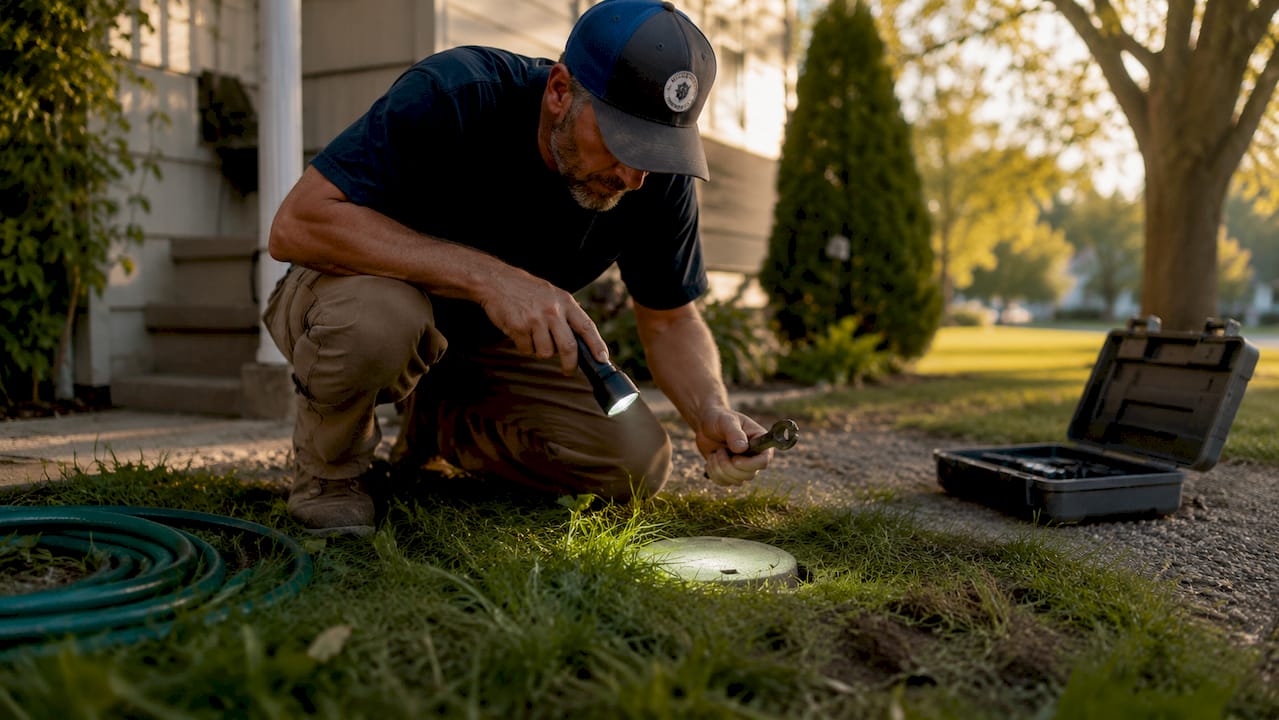
Knowing your coverage boundaries is the difference between a targeted repair call and a misdirected service request that wastes days and money. Paper maps and institutional knowledge held by older utilities are often incomplete. That gap leads property owners to call the wrong party, delay repairs, and absorb costs that could have been avoided.
The practical consequences of unclear coverage show up in three specific ways:
- Emergency response delays. When a backup occurs, unclear boundaries mean dispatchers and property owners spend time determining jurisdiction instead of fixing the problem.
- Misdirected maintenance. Without knowing where your lateral ends and the main line begins, you may pay for inspections or repairs on pipe segments that are not your responsibility.
- Repair cost disputes. Utilities and property owners frequently disagree on responsibility when boundaries are not documented. The property owner almost always loses that argument without clear records.
Pro Tip: Request a written copy of your sewer service area boundary from your local utility before any repair work begins. Keep it with your property records alongside your deed and insurance documents.
Trenchlessmaine recommends that property owners in Maine verify their connection point before scheduling any sewer lateral repair. A camera inspection of the full lateral length confirms exactly where your pipe connects to the main and removes any ambiguity about responsibility.
What mapping gaps mean for sewer coverage reliability
The national picture on sewer service area mapping is incomplete in ways that directly affect property owners. The EPA has modeled sewersheds for 13,864 treatment plants that lack state-supplied boundary data, using building footprints and parcel networks as proxies. That is a significant portion of U.S. treatment infrastructure operating on estimated, not verified, boundaries.
Modeled boundaries carry confidence limitations. They work reasonably well in dense urban areas where building footprints align predictably with sewer connections. In rural and scattered communities, the accuracy drops considerably.
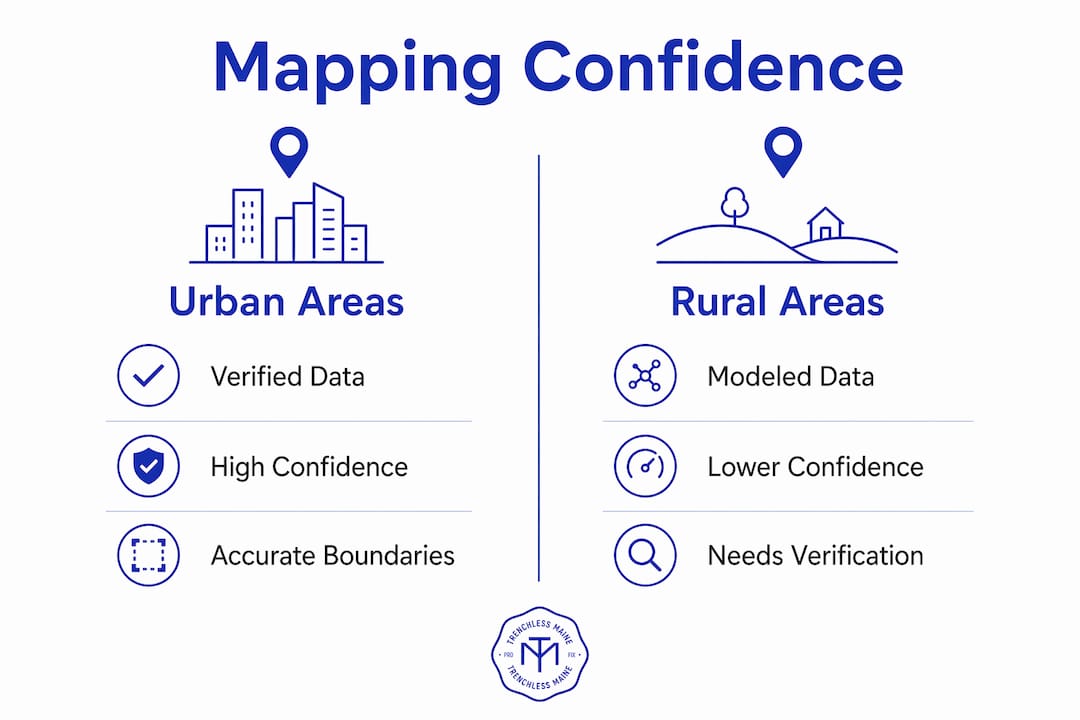
| Area type | Mapping method | Confidence level |
|---|---|---|
| Dense urban | State-supplied verified data | High |
| Suburban | Parcel network modeling | Moderate |
| Rural/scattered | Probabilistic estimation | Low |
Probabilistic sewer boundaries in rural areas should always be verified against utility field notes before any maintenance request is submitted. Submitting a repair order based on a modeled boundary in an unincorporated area risks targeting the wrong pipe segment entirely.
The public health consequences of mapping gaps extend beyond individual property disputes. Well-mapped sewer areas allow health officials to target interventions faster and more cost-effectively than individual clinical testing alone. When sewer boundaries are unclear, outbreak source tracking slows down, and communities face longer exposure windows. That is not a theoretical risk. It is a documented consequence of incomplete sewer coverage data.
On-site wastewater systems often fail to properly treat over 40% of organic compounds, leading to contamination. Properties that fall outside verified sewer service areas and rely on failing on-site systems carry a disproportionate share of that environmental burden.
How sewer service area knowledge protects you financially
Sewer backup insurance is one of the most underused protections available to property owners. Standard homeowners insurance does not cover sewer backup damage. You need a separate endorsement, and the coverage limits you choose should reflect your actual risk exposure.
Sewer backup endorsement limits typically start at $5,000. Knowing your exact service area boundary informs how much coverage makes sense for your property. A property with a long lateral running through a yard with mature trees faces higher root intrusion risk than a property with a short, recently lined lateral.
Key financial protection steps tied to sewer coverage knowledge:
- Confirm your lateral length and condition. Longer laterals in older neighborhoods carry higher failure risk and justify higher endorsement limits.
- Identify your risk zone. Properties in low-lying areas, older infrastructure corridors, or near tree-heavy lots face elevated backup risk.
- Document your pipe condition. A recent camera inspection report strengthens your position with insurers and speeds up claims processing.
- Check for basement exposure. Recurring basement water problems are often linked to sewer lateral failures. Basement properties need the highest endorsement limits available.
Pro Tip: Ask your insurer specifically whether your endorsement covers the full sewer lateral from your home to the main line. Some policies only cover damage inside the home, not the pipe itself.
Sewer backup insurance boundaries clarify that homeowners are responsible for pipes between their property and the main line. Knowing exactly where that boundary sits removes guesswork from your financial planning.
Steps to verify your sewer coverage and protect your property
Taking control of your sewer service area knowledge requires a few direct steps. None of them require engineering expertise. They do require some initiative.
-
Contact your local utility in writing. Request a copy of the sewer service area map for your property address. Ask specifically for the location of your connection point to the main line.
-
Cross-reference with your municipality's GIS portal. Many Maine municipalities publish sewer infrastructure layers online. Compare the utility's map against the public GIS data to catch discrepancies.
-
Schedule a camera inspection. A professional sewer inspection of your lateral confirms the pipe's condition and exact connection point. This is the most reliable way to verify coverage boundaries in the field.
-
Request digital asset records. Digital sewer maps that catalog every manhole, gravity main, and inspection finding turn hidden infrastructure into manageable assets. Ask your utility whether they maintain digital records and whether you can access the data relevant to your property.
-
Establish a maintenance schedule. Once you know your lateral's length, material, and age, set a routine inspection interval. Older clay or cast iron pipes in Maine's freeze-thaw climate warrant inspection every two to three years. Newer CIPP-lined pipes can go longer between checks.
-
Coordinate with your utility on emergency protocols. Know the utility's after-hours emergency number. Know which segment of pipe they will respond to and which segment falls to you. Write it down and keep it accessible.
Improved sewer infrastructure management reduces flood-related obstructions by 40–60% and increases system reliability to over 95%. That data applies to utilities, but the principle holds for individual property owners who manage their laterals proactively. Knowing your coverage area is what makes proactive management possible.
Maintaining sewer lines consistently prevents the kind of failures that turn a $300 cleaning into a $15,000 emergency excavation. Coverage knowledge is what tells you which pipe to maintain and how often.
Key Takeaways
Accurate sewer service area knowledge is the single most effective tool property owners have for preventing costly repairs, protecting their insurance position, and responding quickly to emergencies.
| Point | Details |
|---|---|
| Know your lateral boundary | The utility's responsibility ends at the main line; your lateral is your financial responsibility. |
| Verify mapped boundaries | EPA-modeled sewersheds carry confidence limitations, especially in rural areas. Always confirm with utility field records. |
| Match insurance to risk | Sewer backup endorsements start at $5,000; lateral length, pipe age, and basement exposure determine the right limit. |
| Use digital asset maps | Digital sewer maps turn invisible infrastructure into trackable, manageable assets that prevent emergency failures. |
| Schedule routine inspections | Camera inspections confirm connection points and pipe condition, removing ambiguity before emergencies occur. |
What I've learned from property owners who got this wrong
I've spoken with enough property owners after sewer emergencies to recognize a pattern. The crisis almost never starts with a catastrophic failure. It starts with a misunderstanding about who owns which pipe. A homeowner calls the utility. The utility says it's not their segment. The homeowner calls a plumber. The plumber scopes the pipe and finds a problem that has been developing for two years. By then, the repair cost has tripled what it would have been with early intervention.
The uncomfortable truth is that most property owners do not know where their sewer lateral ends. They assume the utility handles everything underground. That assumption is wrong, and it is expensive to discover at the wrong moment.
What I find most frustrating is that the information is available. Utilities have maps. Municipalities have GIS portals. Camera inspection technology is affordable and widely accessible. The gap is not technological. Governance and political will drive sewer coverage more than technology does. That applies to individual property owners too. The will to ask the right questions before a problem develops is what separates a $400 maintenance call from a $12,000 emergency.
My advice is direct: treat your sewer lateral the way you treat your roof. You would not wait for a leak to find out the condition of your shingles. Do not wait for a backup to find out the condition of your lateral or the exact boundary of your service coverage. Get the map. Get the inspection. Know what you own.
— John
Trenchlessmaine's professional sewer services for informed property owners
Property owners who understand their sewer service area boundaries are better positioned to act before problems escalate. Trenchlessmaine works with exactly those owners across Maine, providing the professional services that turn coverage knowledge into real protection.
Trenchlessmaine's hydro jetting service uses high-pressure water to clear grease, root intrusion, and debris from sewer laterals, restoring full flow without excavation. For properties with slower drains or recurring blockages, professional drain clearing resolves the problem fast, often within 24 hours. Both services work best when property owners already know their lateral boundaries and pipe conditions. Trenchlessmaine covers most of Maine's cities and brings over 50 years of combined expertise to every job. Contact Trenchlessmaine to confirm service availability at your address and schedule an assessment.
FAQ
What is a sewer service area boundary?
A sewer service area boundary defines the geographic zone where a utility is responsible for operating and maintaining the public sewer main. Property owners are responsible for the sewer lateral connecting their building to that main.
Who is responsible for the sewer lateral on my property?
The property owner is responsible for the sewer lateral from the building to the connection point at the public main. The utility takes over at the main line itself.
Why do sewer service area maps have accuracy problems?
The EPA has modeled sewersheds for thousands of treatment plants using building footprints and parcel data rather than verified field records. These models carry lower confidence in rural and scattered areas, where probabilistic estimates replace real-world measurements.
Does homeowners insurance cover sewer backup damage?
Standard homeowners insurance does not cover sewer backup damage. A separate sewer backup endorsement is required, with limits typically starting at $5,000. The right limit depends on your lateral's length, age, and your property's backup risk.
How often should I inspect my sewer lateral?
Older clay or cast iron laterals in Maine's freeze-thaw climate warrant inspection every two to three years. Newer lined pipes can go longer between checks. A camera inspection is the most reliable way to assess condition and confirm your coverage boundary.