

A sewer repair warranty is a binding commitment from a contractor or manufacturer guaranteeing that sewer repair work will perform as promised for a defined period, protecting you from unexpected costs tied to defects or failures. The role of warranties in sewer repair goes well beyond a handshake agreement. It defines who pays when something goes wrong, what conditions trigger coverage, and how long your protection lasts. For homeowners and property managers in Maine, where freeze-thaw cycles accelerate pipe stress, understanding warranty coverage for sewer repair is one of the most financially consequential decisions you will make before signing any service contract.
What types of warranties exist in sewer repair?
Sewer repair warranties fall into three distinct categories, and knowing the difference between them determines how much protection you actually have.
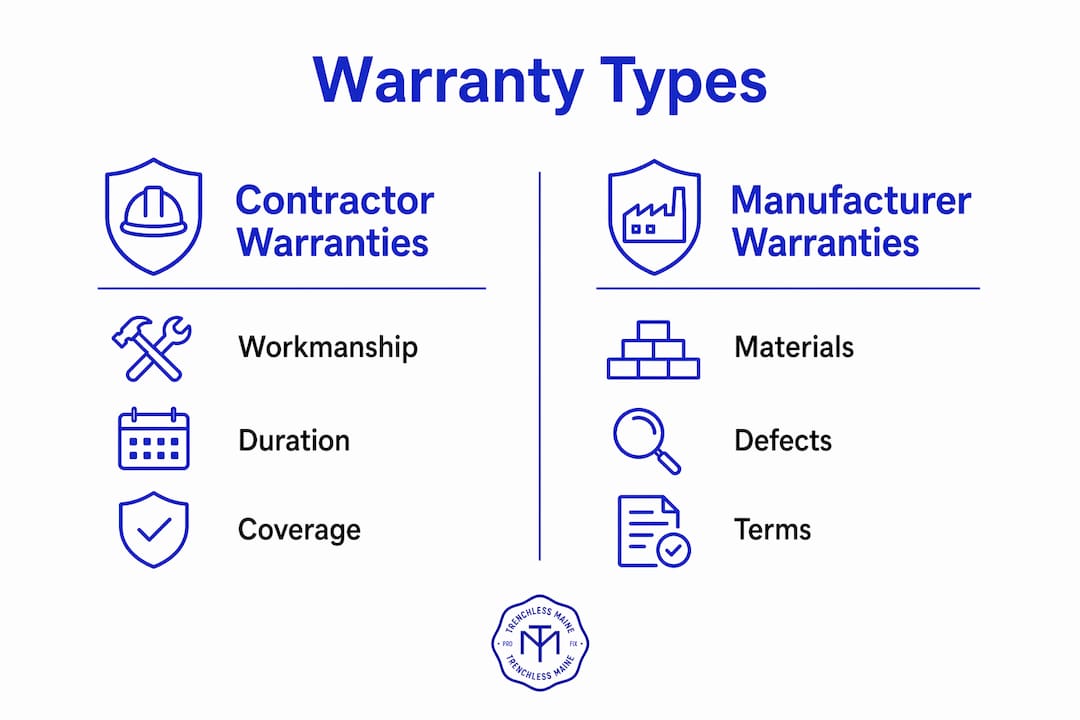
Workmanship warranties cover errors made during installation, including improper joint connections, inadequate liner curing, or poor trench backfill that causes settlement. Licensed contractors typically offer workmanship warranties ranging from 1 to 5 years, with CIPP (cured-in-place pipe) lining contractors often extending that to 10 years given the longer expected liner lifespan. A 10-year workmanship warranty on a CIPP installation reflects the technology's durability and gives you a meaningful window to identify any installation defects.
Materials warranties come directly from manufacturers, covering defects in the pipe, liner, or fittings themselves. For CIPP lining, manufacturer-backed materials guarantees often extend beyond the contractor's workmanship warranty, but they require proper installation protocols to remain valid. If the contractor deviates from the manufacturer's specified curing process, the materials warranty can be voided even if the workmanship warranty is still active.
System performance warranties are most common in municipal and commercial contexts. They guarantee that the repaired system will meet specific flow or pressure standards for a set period. Residential homeowners rarely receive these, but they are worth requesting on large-scale lateral replacements.
Beyond category, warranties are also classified as express (written, with specific terms) or implied (legally assumed based on the nature of the work). Always insist on an express written warranty. Implied warranties are harder to enforce and vary by state law.
One critical detail many homeowners miss: permits and inspection records are required for warranty enforceability. Unpermitted work removes the baseline inspection needed to verify defects during a claim. If your contractor skips the permit, your warranty may be unenforceable regardless of what the paperwork says.
Pro Tip: Before any work begins, ask your contractor to confirm in writing that all required permits will be pulled and that inspection records will be provided to you upon project completion.
What coverage limits and exclusions should homeowners know about?
Warranty coverage for sewer repair sounds reassuring until you read the exclusions. Understanding what is not covered is just as important as knowing what is.
Coverage typically includes:
- Defects in workmanship discovered within the warranty period, such as liner delamination or joint failure caused by the contractor's installation process.
- Material defects confirmed by manufacturer inspection, such as a liner with inconsistent wall thickness from the factory.
- Structural failures directly attributable to the repair method used, such as improper pipe alignment after open-cut replacement.
Common exclusions that lead to denied claims include:
- Root intrusion occurring after the repair is completed. If tree roots penetrate a newly lined pipe, most contractors classify this as a post-repair environmental condition, not a workmanship defect.
- Third-party damage, such as a utility contractor cutting through a repaired lateral during a separate project.
- Pre-existing conditions that were documented before the repair but not addressed in the scope of work.
- Seismic events or ground movement beyond normal soil settlement.
- Lack of maintenance, which is a growing reason for claim denial. Routine sewer maintenance is required to avoid claim denials, and neglect is one of the most common reasons warranty providers reject claims as of 2026.
"As of 2026, 29% of homeowners who utilized home warranty plans for sewer issues reported their claims were denied, mostly due to exclusions such as tree root intrusion and damage beyond coverage limits."
That denial rate means nearly one in three homeowners who expected coverage walked away paying out of pocket. The practical implication is clear: read every exclusion clause before signing, and schedule annual camera inspections to document your pipe's condition throughout the warranty period.
One more distinction worth understanding: home warranties cover sewer line repairs caused by normal wear and tear but exclude root intrusion, corrosion, and pre-existing issues. A contractor warranty, by contrast, covers workmanship and materials defects. These two products serve different purposes and should not be treated as interchangeable.
How do warranty claims work in sewer repairs?
Filing a warranty claim on a sewer repair is a structured process. Knowing the steps in advance prevents costly mistakes that could disqualify your claim.
- Document the defect immediately. If you notice recurring blockages, sewage odors, or wet spots in your yard near the repaired line, photograph and date the evidence. Written records of when symptoms appeared strengthen your claim.
- Provide written notice to your contractor. Most warranty agreements require formal written notification within a specific timeframe. Verbal complaints do not satisfy this requirement. Send notice by email or certified mail and keep copies.
- Request a CCTV inspection. Claims require documented CCTV evidence to determine defect cause and eligibility for repair under warranty terms, following NASSCO PACP (Pipeline Assessment and Certification Program) standards. This inspection establishes whether the defect is a workmanship failure, a materials issue, or an excluded condition.
- Review the contractor's cause determination. The contractor will assess whether the defect falls within warranty coverage. If they classify it as an exclusion, you have the right to request the inspection footage and seek an independent assessment.
- Confirm remedy scope. Covered remedies typically include repair, relining, or full replacement of the defective section. Get the proposed remedy in writing before any work begins.
- Verify permits for the warranty repair. The repair work done under warranty must also be permitted and inspected. Skipping this step can create the same enforceability problems as the original job.
Pro Tip: Keep a dedicated folder, physical or digital, with your original warranty document, permit records, inspection reports, and all contractor correspondence. This documentation is your only leverage if a claim dispute escalates.
How to evaluate and choose sewer repair warranties when hiring contractors
Not all warranties are equal, and the differences matter significantly when repair costs can reach $25,000. Use this comparison to evaluate what contractors are actually offering you.
| Warranty Feature | What to Look For | Red Flag |
|---|---|---|
| Duration | 5 to 10 years for CIPP lining; 1 to 5 years for open-cut | Less than 1 year on any repair type |
| Coverage scope | Labor and materials both covered | Labor-only warranty that excludes material costs |
| Transferability | Warranty transfers to new owner if property is sold | Non-transferable warranty reduces resale value |
| Permit requirement | Contractor confirms permits will be pulled | No mention of permits in the warranty document |
| Performance bond | Contractor carries a bond from a licensed surety | No bond, no insurance certificate provided |
Labor-only warranties exclude material costs and can mislead homeowners into thinking they have full coverage. If a liner fails due to a manufacturing defect, a labor-only warranty leaves you paying for the replacement material yourself. Always verify that both labor and materials are covered before signing.
Performance bonds from licensed sureties act as financial backstops to contractor warranties. If your contractor goes out of business before honoring a warranty claim, a performance bond means you still have recourse. Ask every contractor for their bond number and verify it with the issuing surety.
CIPP lining warranties deserve special attention. The method's longer lifespan justifies longer warranty terms, and the best contractors back their CIPP work with both a workmanship warranty and a separate manufacturer materials guarantee. Review the pipe lining warranty checklist before comparing contractor proposals to confirm you are evaluating equivalent coverage.
Pro Tip: Ask every contractor this specific question: "Does your warranty cover both labor and materials, and is it backed by a performance bond?" The answer tells you immediately how seriously they stand behind their work.
What role do warranties play in managing sewer repair costs and risks?
The financial case for strong warranty coverage is straightforward when you look at the numbers. Sewer lateral replacement costs range from $5,000 to $25,000, with some municipal rebates between $1,000 and $4,000 available depending on local 2026 ordinances. A warranty that covers a failed repair within that range is not a minor perk. It is a direct financial shield.
| Scenario | No Warranty | With Full Warranty |
|---|---|---|
| Liner delamination at year 3 | You pay $8,000 to $15,000 for relining | Contractor covers repair at no cost |
| Joint failure after open-cut repair | You pay $3,000 to $7,000 for excavation and repair | Covered under workmanship warranty |
| Contractor goes out of business | No recourse; full cost falls on you | Performance bond covers repair costs |
| Material defect in CIPP liner | You pay for replacement material | Manufacturer warranty covers materials |
Beyond direct repair costs, warranties also reduce the risk of contractor insolvency leaving you stranded. A contractor who offers a 10-year warranty backed by a performance bond has a financial incentive to do the job correctly the first time. That alignment of interests protects you in ways that price alone cannot.
Maintaining your sewer lines throughout the warranty period is not optional if you want claims approved. Schedule annual sewer camera inspections to document pipe condition and catch developing issues before they become full failures. Pair that with periodic drain clearing to prevent buildup that warranty providers could classify as neglect. The cost of routine maintenance is a fraction of the cost of a denied claim.
For a deeper look at how Maine homeowners can structure their warranty coverage, the sewer pipe warranty guide covers residential scenarios specific to this region.
Key takeaways
A sewer repair warranty is only as strong as the documentation, permits, and contractor backing it, making verification before signing the single most important step you can take.
| Point | Details |
|---|---|
| Warranty types matter | Workmanship, materials, and performance warranties serve different functions and should all be reviewed. |
| Exclusions cause most denials | Root intrusion, lack of maintenance, and pre-existing conditions account for the majority of the 29% denial rate. |
| Permits are non-negotiable | Unpermitted work voids warranty enforceability regardless of what the written warranty states. |
| Full coverage beats labor-only | Always confirm both labor and materials are covered before signing any sewer repair contract. |
| Performance bonds add security | A licensed surety bond protects you if the contractor goes out of business before honoring a claim. |
Why I think most homeowners underestimate warranty risk
I have seen homeowners spend $15,000 on a sewer lateral replacement and walk away with a one-page "guarantee" that covers labor only for 12 months. They assume the paperwork is standard. It is not.
The most common misunderstanding I encounter is treating a contractor warranty and a home warranty plan as the same thing. They are not. One covers the quality of a specific repair. The other is an insurance product covering wear and tear across your home's systems. Confusing the two leads homeowners to assume they are covered when they are not, and that assumption is expensive.
The 2026 legal precedent out of Fort Myers is worth paying attention to. A Fort Myers ruling established that municipalities retain ultimate responsibility for sewer connections even when subcontracting work. That ruling reinforces something I have believed for years: the chain of accountability in sewer repair is longer than most homeowners realize, and knowing who is responsible at each link in that chain is part of protecting yourself.
My practical advice is this: insist on a written warranty that covers both labor and materials, confirm permits are pulled before work starts, and schedule annual camera inspections to keep your documentation current. A warranty is only as useful as your ability to enforce it.
— John
Protect your investment with Trenchlessmaine's warranty-backed repairs

Trenchlessmaine backs its trenchless sewer repair and CIPP lining services with industry-leading warranties, giving Maine homeowners and property managers real protection against defects and failures. Every project includes proper permitting, documented inspections, and written warranty terms covering both labor and materials. The no-dig repair technology Trenchlessmaine uses is specifically chosen for its long service life and manufacturer-backed materials guarantees. If you want to understand exactly what your warranty covers before committing to a repair, explore the full range of sewer repair services or review the Trenchlessmaine warranty terms directly. Get a free quote and know your coverage before the first shovel hits the ground.
FAQ
What does a sewer repair warranty typically cover?
A sewer repair warranty covers defects in workmanship and materials within the stated warranty period. Coverage does not extend to root intrusion, third-party damage, or pre-existing conditions that were present before the repair.
Do I need a warranty for sewer repairs?
Yes. Sewer lateral replacement costs range from $5,000 to $25,000, and a warranty that covers a failed repair within that range provides direct financial protection against defects or contractor errors.
How long do sewer repair warranties last?
Workmanship warranties from licensed contractors typically last 1 to 5 years. CIPP lining contractors may offer 10-year warranties, and some manufacturer materials guarantees extend even further depending on the liner product used.
Can a sewer repair warranty be voided?
Yes. Unpermitted work, lack of routine maintenance, and failure to provide written notice of a defect within the required timeframe are the most common reasons warranties are voided or claims are denied.
What is the difference between a contractor warranty and a home warranty?
A contractor warranty guarantees the quality of a specific repair, covering workmanship and materials defects. A home warranty is an insurance product that covers normal wear and tear across home systems, with separate exclusions and claim processes.