
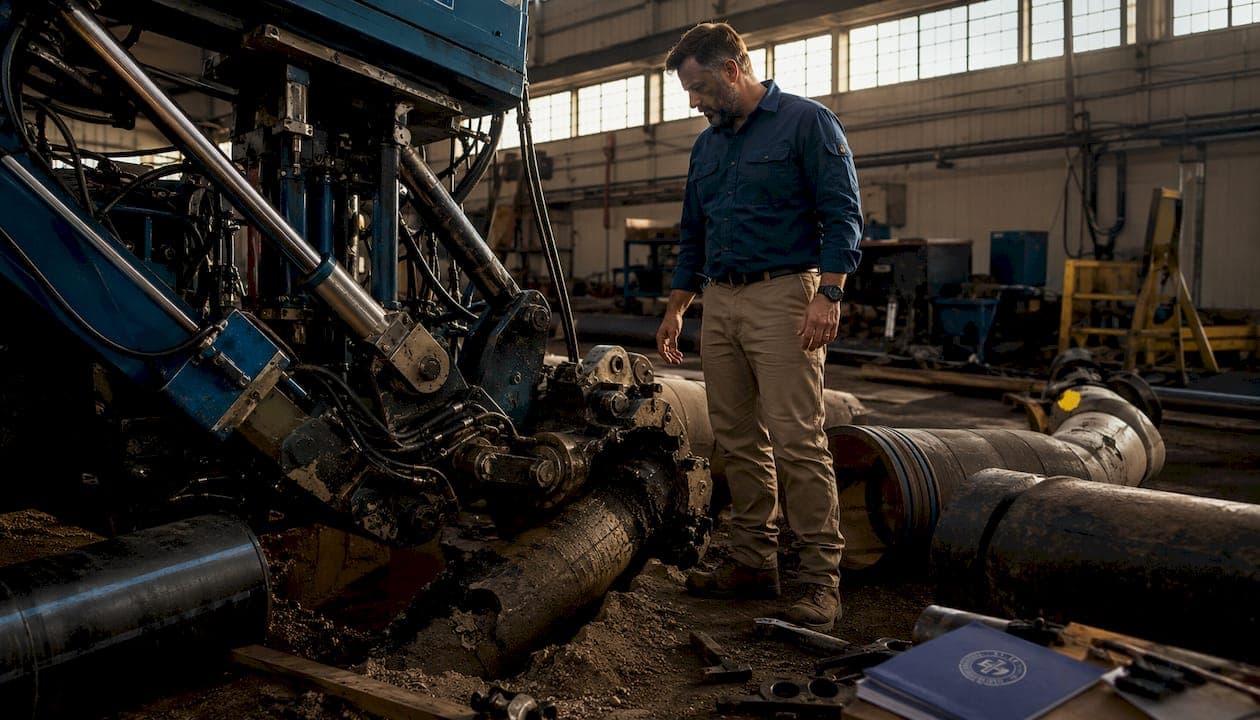
What is pipe bursting, and how does it replace underground pipes?
Pipe bursting is a trenchless replacement method in which a specialized bursting tool is pulled through a damaged underground pipe, fracturing it outward into the surrounding soil while simultaneously pulling a new pipe into the void left behind. No open trench runs the length of your yard. Instead, the old pipe is destroyed in place, and the new one takes its position along the same path. The EPA recognizes pipe bursting as a standard method for replacing sewer, water, and gas lines, and the technique has been applied to pipes from 3 to over 30 inches in diameter, with straight pulls documented up to 1,500 feet.
The new pipe pulled into place is almost always high-density polyethylene, or HDPE. It resists corrosion, handles ground movement well, and typically offers a long service life. That combination makes it the go-to material for pipe bursting projects across the country.
Key characteristics of pipe bursting at a glance:
- Trenchless, but not excavation-free: small launch and receiving pits replace the long open trench
- Full pipe replacement: the old pipe is destroyed, not just lined or patched
- Upsizing capability: the new pipe can be one or more sizes larger than the original
- Suitable pipe materials replaced: clay, cast iron, Orangeburg, asbestos cement, concrete, and truss pipe
- New pipe material: HDPE (PVC cannot be used because it cannot withstand the pulling forces)
- Recognized applications: sewer laterals, water mains, and gas distribution lines
What equipment does a pipe bursting operation actually use?
Five core pieces of equipment drive every pipe bursting job. Understanding what each one does helps you ask the right questions when a contractor walks you through a project proposal.
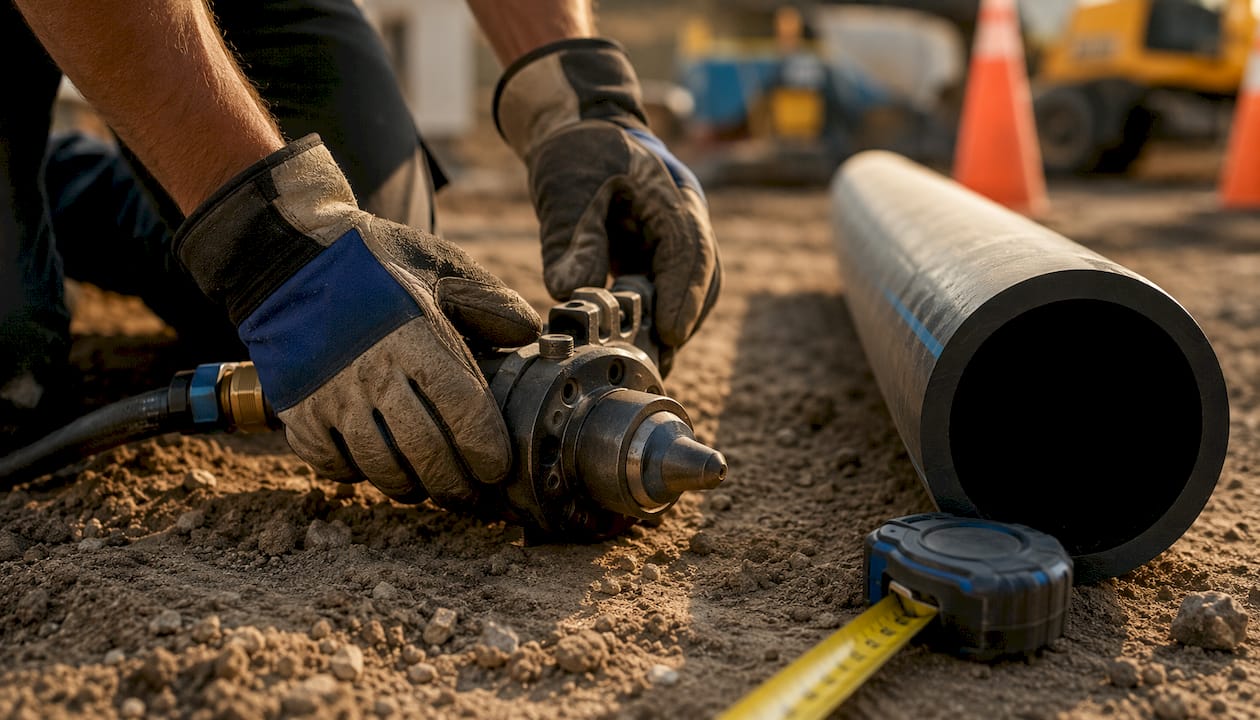
- Expander head (bursting head): the tool that physically fractures the old pipe. It comes in two types: static heads, which rely entirely on the pulling force of the winch to expand and break the pipe, and dynamic heads, which add hydraulic or pneumatic power to fragment the pipe at the point of impact. Dynamic heads are typically chosen for harder pipe materials or denser soil conditions.
- Pulling rods or chain links: heavy interlocking steel rods or chain links connect the bursting head to the pulling machine. Each link can weigh several hundred pounds, and the chain must transmit enormous tensile force without failure.
- Pulling machine (winch): set in the receiving pit, this machine generates the pulling force that drags the bursting head through the existing pipe. Hydraulic winches are standard on larger-diameter projects.
- Retaining device: anchors the pulling machine inside the receiving pit so the pulling force is directed into the pipe rather than simply moving the machine itself.
- Hydraulic power pack: supplies pressurized fluid to both the pulling machine and, when applicable, a dynamic bursting head.
Pro Tip: Ask your contractor whether a static or dynamic head is planned for your specific pipe material. Clay and Orangeburg respond well to static heads, while cast iron or reinforced concrete often demands the added impact force of a pneumatic or hydraulic dynamic head.
The new HDPE pipe is fused into a continuous string above ground before insertion. That fusion process requires a clear, flat laydown area adjacent to the launch pit, often longer than the pipe run itself. Contractors need to account for that space during site planning, especially on tight residential lots.
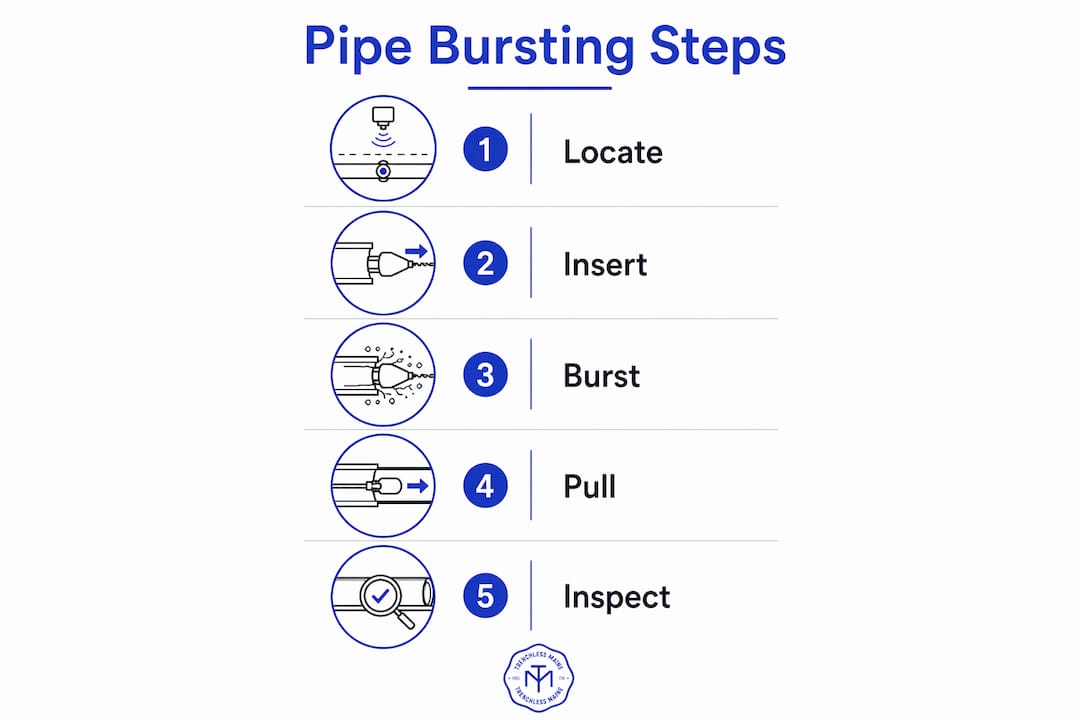
How does pipe bursting work, step by step?
The process follows a logical sequence, and knowing each stage helps you understand why the job takes as long as it does and what the crew is actually doing on your property.
-
Pre-installation camera inspection. A camera inspection is run through the existing pipe to document its condition, confirm the pipe material, check for severe offsets or collapses, and identify any nearby utilities that could be affected by ground displacement. This step is not optional; skipping it is the most common cause of mid-project failures.
-
Utility locating and engineering assessment. The crew marks all underground utilities near the pipe alignment. The EPA requires careful pre-project engineering review of soil conditions and utility proximity before any pipe bursting operation begins, because the outward ground displacement created during bursting can damage adjacent lines.
-
Excavation of launch and receiving pits. Two small pits are dug: a launch (sending) pit where the bursting tool and new pipe enter the line, and a receiving pit at the far end where the pulling machine is anchored. These pits are the only excavation on a standard job.
-
HDPE pipe fusion and staging. Individual HDPE pipe sections are heat-fused into a continuous string above ground alongside the launch pit. The fused string must be long enough to cover the full pull distance before insertion begins.
-
Tool assembly and insertion. The bursting head is attached to the pulling rods, fed into the existing pipe through the launch pit, and connected to the new HDPE pipe at its trailing end.
-
The pull. The winch in the receiving pit activates, drawing the bursting head through the old pipe. As it travels, the head fractures the old pipe radially outward, pushing fragments into the surrounding soil, while the new HDPE pipe follows directly behind, filling the space created.
-
Upsizing, when applicable. If the new pipe is a larger diameter than the original, a correspondingly larger bursting head is used. The EPA notes that upsizing to at least the next larger pipe size is generally advisable, since it builds in capacity for increased loading over time.
-
Post-installation testing. Once the new pipe is in place, the crew pressure-tests or vacuum-tests the line to confirm integrity. A follow-up camera inspection verifies the pipe seated correctly and no debris remains inside.
-
Pit backfill and site restoration. The launch and receiving pits are backfilled and compacted. Surface restoration, whether asphalt, concrete, or lawn, follows.
Where is pipe bursting used, and what pipes can it replace?
Pipe bursting works across a wide range of underground utility applications, though its fit depends on pipe material, soil type, and the condition of the existing line.
Common applications:
- Sewer laterals and mains: the most frequent use case in residential and municipal work. Collapsed, root-invaded, or severely deteriorated gravity sewer lines are prime candidates.
- Water distribution mains: aging cast iron or asbestos cement water mains can be replaced without disrupting the road surface above.
- Natural gas distribution lines: the technique was originally developed for the gas industry in the late 1970s before expanding into municipal water and sewer applications.
Pipe materials that can be replaced:
- Vitrified clay pipe
- Cast iron pipe
- Orangeburg pipe (a fiber-based material notorious for collapsing over time)
- Asbestos cement pipe
- Truss pipe
- Unreinforced and reinforced concrete pipe
Soil conditions that favor pipe bursting:
- Moderately compactable soils that can absorb the displaced pipe fragments
- Stable ground above the water table
Soil conditions that create challenges:
- Rocky soil, which can deflect or damage the bursting head
- Densely compacted backfill, which increases the force required and widens the zone of ground movement
- Saturated soils below the water table, which resist fragment displacement
- Shallow pipe depth, where upward ground heave can reach the surface
Pipe bursting is particularly valuable in urban environments because it avoids the traffic disruption, business impact, and surface damage that open trench work causes. For a homeowner in Maine with a mature landscaped yard, that difference is felt immediately: no torn-up lawn running the full length of the pipe.
Pipe bursting vs. trenching and other trenchless methods: advantages and limits
Pipe bursting sits in a specific position among pipe rehabilitation options. It is not always the right choice, but when it fits, nothing else matches what it can do.
| Factor | Open trench | Pipe bursting | CIPP lining | Sliplining |
|---|---|---|---|---|
| Surface disruption | Extensive | Minimal (pits only) | Minimal | Minimal |
| Full pipe replacement | Yes | Yes | No (liner inside old pipe) | No |
| Upsizing possible | Yes | Yes | No | No (reduces diameter) |
| Works on collapsed pipes | Yes | Yes (if accessible) | No | No |
| Suitable pipe materials | Any | Brittle/fracturable | Structurally sound host pipe | Structurally sound host pipe |
| Soil constraints | None | Rocky/dense soil limits | None | None |
| New pipe material | Any | HDPE only | Epoxy/resin liner | HDPE or PVC liner |
| Typical access needed | Full trench | Two small pits | One access point | Two access points |
The clearest advantage pipe bursting holds over CIPP lining is its ability to replace a pipe that has already collapsed or is so deformed that a liner cannot be inserted or inflated properly. CIPP lining works by curing a resin-saturated liner inside the existing pipe, which means the host pipe must still have enough structural integrity to hold the liner in place during installation. When a pipe has caved in, pipe bursting is the method that actually solves the problem. Lining would simply fail.
Compared to sliplining, pipe bursting avoids the diameter reduction that sliplining always causes. Sliplining inserts a smaller pipe inside the existing one, which permanently reduces flow capacity. Pipe bursting replaces the pipe at the same size or larger.
Against open trench replacement, pipe bursting wins on surface disruption, restoration cost, and speed, though it requires soil conditions that can absorb the fractured pipe fragments.
Limitations worth knowing:
- Rocky or very dense soil can deflect the bursting head or require excessive pulling force
- Pipes with severe bends or misaligned joints may block the bursting head's travel
- Proximity to other utilities within two to three pipe diameters creates ground displacement risk
- The laydown area for HDPE fusion is larger than what CIPP lining requires
Pro Tip: Never choose between pipe bursting and lining based on price alone. A camera inspection first tells you which method the pipe actually needs. A collapsed pipe lined with CIPP will fail; a structurally sound pipe burst unnecessarily wastes money and disrupts more soil than needed.
Expert insights and best practices for a successful pipe bursting project
A few misconceptions about pipe bursting show up repeatedly, and clearing them up before a project starts saves time, money, and frustration.
"Trenchless" does not mean "no digging at all." Many homeowners hear "trenchless" and picture a crew that never touches a shovel. In reality, pipe bursting requires excavated access pits at both ends of the run, plus a clear laydown area for HDPE pipe fusion. The pits are small compared to a full trench, but they are real excavations that need to be planned for.
Camera inspection is not a formality. Experts consistently identify pre-installation camera inspection as the single most important step in the process. The inspection confirms pipe material, reveals any severe offsets or collapses that could block the bursting head, and locates adjacent utilities that might be damaged by ground displacement. Skipping it or treating it as optional is how projects fail mid-pull.
Expert tips for a well-run pipe bursting project:
- Confirm the existing pipe material before selecting a bursting head type; cast iron and concrete require different head configurations than clay or Orangeburg
- Verify that the soil along the pipe alignment can absorb displaced fragments; request a soil assessment if the ground is rocky or heavily compacted
- Plan the HDPE laydown area during site assessment, not on the day of installation
- Check for utilities within two to three pipe diameters of the pipe being replaced, and flag any that are deteriorated or pressurized
- Specify upsizing in the project scope whenever the existing pipe is at or near its flow capacity; the EPA recommends upsizing to at least the next larger size as standard practice
- Require a post-installation camera inspection and pressure or vacuum test before accepting the work as complete
Key project parameters: Pipe bursting has been successfully applied to pipe diameters ranging from 3 inches to over 30 inches, with continuous HDPE pulls documented at up to 1,500 feet in a single run.
One more point that contractors sometimes gloss over: the ground displacement created during bursting is real and localized. Pneumatic dynamic heads in particular generate noticeable surface vibrations directly above the pipe alignment. If your project runs near a foundation, a pressurized gas line, or aging water service connections, those conditions need to be flagged and assessed before the pull starts, not discovered during it.
How much does pipe bursting cost?
Pipe bursting costs more per linear foot than CIPP lining in most cases, but it is the only option when a pipe has collapsed beyond repair. Pricing varies by region, pipe diameter, depth, soil conditions, and the length of the run.
For residential sewer lateral replacements, costs generally fall in the range of $60–$200 per linear foot, depending on local labor rates and site conditions. A typical 50-foot residential lateral might run $4,000–$12,000 all in, including pit excavation, HDPE pipe, fusion, and surface restoration. Larger-diameter municipal mains cost more per foot due to equipment scale and the heavier HDPE pipe required.
Several factors push costs higher:
- Depth: deeper pipes require larger pits and more excavation time
- Pipe diameter: larger bursting heads and heavier HDPE pipe increase both material and equipment costs
- Soil conditions: rocky or dense soil increases pulling force requirements and can slow the job significantly
- Surface restoration: replacing asphalt or concrete above the pits adds to the final bill
- Upsizing: a larger replacement pipe costs more in material but often pays back in avoided future capacity problems
Pipe bursting typically costs less than full open trench replacement when you factor in surface restoration, traffic control, and landscape repair. The savings on those indirect costs are where trenchless methods earn their value, especially on longer runs through established yards or paved surfaces.
How long does a pipe bursting project take?
A straightforward residential pipe bursting job, covering a standard sewer lateral of 50–100 feet, typically wraps up in one to two days. That includes pit excavation, HDPE pipe fusion, the pull itself, post-installation testing, and pit backfill.
The pull is actually the fastest part of the operation. Once the equipment is set up and the HDPE string is fused, the bursting head travels through the pipe in a matter of minutes to hours depending on pipe length and soil resistance. Setup and teardown take longer than the burst itself on most residential jobs.
Factors that extend the timeline:
- Longer pipe runs: pulls approaching 1,500 feet require more HDPE fusion time and more careful equipment staging
- Difficult soil: rocky or dense ground slows the pull and may require equipment adjustments mid-job
- Utility conflicts: if utilities are found close to the pipe alignment during pre-work, the crew may need to hand-dig around them before proceeding
- Upsizing: a larger replacement pipe requires more fusion time and a heavier equipment setup
- Surface restoration: concrete or asphalt restoration adds a day or more, depending on cure time
Municipal main replacements on larger-diameter pipes can run several days to a week or more, particularly when traffic management, permit requirements, and extended HDPE fusion are involved. For most Maine homeowners dealing with a failed sewer lateral, though, the realistic expectation is a job completed within one to two working days, with the property back to normal shortly after.
Common problems during pipe bursting and how to fix them
Even well-planned pipe bursting projects run into complications. Knowing what can go wrong, and how experienced crews handle it, helps you evaluate whether a contractor is prepared.
Bursting head stalls mid-pull. This is the most common mid-project problem. It usually happens when the head encounters a severe pipe offset, a collapsed section that blocks travel, or unexpectedly dense soil. The crew typically relieves tension, inspects the situation with a camera, and may excavate a small intermediate pit to clear the obstruction before resuming the pull.
Ground heave at the surface. When the pipe is shallow and the soil is soft, the outward displacement from bursting can push upward and crack pavement or lift turf above the pipe alignment. Experienced crews anticipate this on shallow installations and may reduce pulling speed or switch to a smaller bursting head to limit displacement.
HDPE pipe buckling during insertion. If the fused HDPE string is not properly supported along its length during the pull, it can buckle under compression. Proper roller staging along the laydown area prevents this, and it is a sign of good site preparation when a crew sets up rollers before the pull begins.
Adjacent utility damage. Ground displacement during bursting can crack or shift nearby water or gas service lines, particularly older ones made from brittle materials. Pre-job utility locating and a conservative approach near flagged lines are the primary defenses. If damage occurs, the crew must stop, excavate, and repair the affected utility before continuing.
Incomplete pipe fracture. Some pipe materials, particularly reinforced concrete with intact steel reinforcement, resist fracturing even under high pulling force. In those cases, a dynamic head with hydraulic or pneumatic impact may be substituted, or the project may need to be re-evaluated for an alternative method.
Post-installation camera inspection catches problems that are not visible from the surface: debris inside the new pipe, a section that did not seat correctly, or a joint that shifted during the pull. Requiring that inspection before final payment is the single most practical protection you have as a property owner.
Key Takeaways
Pipe bursting replaces damaged underground pipes by fracturing the old pipe outward and pulling a new HDPE pipe into place, all without a full open trench, making it the preferred method when pipes are collapsed, brittle, or need upsizing.
| Point | Details |
|---|---|
| Full replacement, not patching | Pipe bursting destroys the old pipe entirely, making it the only trenchless option for collapsed or severely deformed lines. |
| Upsizing is standard practice | The EPA recommends replacing at the next larger pipe size to build in capacity for future load increases. |
| Project scale | Pipe diameters from 3 to over 30 inches have been replaced, with single pulls documented up to 1,500 feet. |
| Camera inspection is required | Pre-installation inspection confirms pipe material, locates utilities, and prevents mid-pull failures. |
| "Trenchless" still means some digging | Launch and receiving pits are always required, along with a laydown area for HDPE pipe fusion. |
Ready to find out if pipe bursting is right for your property?

If your sewer line is collapsed, cracked, or made from aging clay or Orangeburg pipe, pipe bursting may be exactly what your property needs. Trenchlessmaine serves homeowners and municipalities across Maine with trenchless sewer repair solutions, including camera inspections, CIPP lining, and trenchless sewer repair services tailored to Maine's soil conditions and climate.
Not sure which method fits your situation? A camera inspection is the fastest way to find out. Contact Trenchlessmaine for a free assessment and get a clear answer before any digging begins.