
Most Maine homeowners assume that once wastewater leaves their home, it becomes the city's problem. That assumption can cost you thousands of dollars. The lateral sewer line connects your home's plumbing to the public sewer system, and a significant portion of it falls entirely under your ownership and financial responsibility. Understanding exactly where your responsibility begins and ends, how to diagnose problems accurately, and what modern repair options are available can save you from unnecessary excavation, unexpected bills, and major disruption to your property.
Table of Contents
- What is a lateral sewer line?
- Who owns and maintains the lateral sewer line?
- Diagnosing lateral sewer line issues: What every Maine homeowner should check
- Modern repair solutions: Non-invasive options for Maine homes
- Our perspective: The biggest mistake Maine homeowners make about sewer laterals
- Next steps: Expert, non-invasive sewer repairs for Maine homes
- Frequently asked questions
Key Takeaways
| Point | Details |
|---|---|
| Lateral sewer line defined | The lateral connects your home’s plumbing to the public sewer main and divides repair responsibility. |
| Ownership varies | Private property owners typically manage their lateral’s segment, while municipalities handle the public section. |
| Diagnosis is crucial | Determining whether your issue is private or municipal saves time, money, and headache. |
| Non-invasive repairs available | Maine homeowners can access trenchless, quick-turnaround solutions that protect yards and minimize disruption. |
| Inspection prevents costly mistakes | Sewer camera scope inspections help clarify boundaries and avoid unnecessary repairs. |
What is a lateral sewer line?
A lateral sewer line is the underground pipe that runs from your home's foundation to the public sewer main, which typically sits beneath the street. Think of it as a private connector between your household plumbing and the larger municipal system. Every time you flush a toilet, run the dishwasher, or drain a bathtub, wastewater flows through this pipe on its way to the city's treatment system.
A lateral sewer line connects your home's plumbing to the public main, but it doesn't belong to the city. In most cases, the pipe begins at your home's basement wall or crawl space foundation and travels underground across your yard, under the sidewalk, and connects to the municipal tap, also called a wye or tee fitting, in the street.
Here's a quick breakdown of how a typical lateral sewer line is structured:
| Segment | Starting point | Ending point | Typical ownership |
|---|---|---|---|
| Upper lateral | Home foundation | Property line | Homeowner |
| Lower lateral | Property line | Municipal main | Varies by municipality |
| Municipal main | Under the street | Treatment facility | City or town |
Pro Tip: The lateral line in older Maine homes, particularly those built before 1970, is often made from clay tile or cast iron. These materials are highly susceptible to root intrusion, cracking, and joint separation over decades of use.
Knowing where your lateral line runs isn't just trivia. It directly determines who pays for repairs when something goes wrong. If you notice sewer gas symptoms in your home, like the smell of rotten eggs near drains, your lateral line is one of the first places to investigate.
Common reasons lateral sewer lines fail include:
- Root intrusion: Tree roots naturally seek moisture and can penetrate even small cracks in the pipe joints, gradually blocking flow or causing collapse.
- Pipe deformation: Older clay and cast iron pipes shift with freeze-thaw cycles, which are especially common in Maine winters.
- Grease and debris buildup: Fats, oils, and solid waste accumulate over time and restrict flow.
- Corrosion and deterioration: Aging pipe materials break down from the inside, leading to leaks or full blockages.
- Offset joints: Ground movement causes pipe sections to shift, creating gaps or misalignments.
Who owns and maintains the lateral sewer line?
Ownership of a lateral sewer line is one of the most misunderstood aspects of home maintenance. Most homeowners assume the city handles anything buried underground near the road. In reality, responsibility is split, and homeowners are typically responsible for the lateral on private property, while municipalities handle the portion under the public right-of-way.
Here is how the split typically works in Maine:
| Responsibility area | Who owns it | Who pays for repairs |
|---|---|---|
| From house to property line | Homeowner | Homeowner |
| From property line to main | Varies (often homeowner) | Varies by municipality |
| Public sewer main | Municipality | Municipality |
| Connection fitting (wye) | Municipality | Municipality |
The challenge is that "property line" is not always a visible or well-known boundary. In many Maine communities, the property line sits 10 to 20 feet before the street curb. That means a stretch of pipe running under the sidewalk or public easement could still be your financial responsibility, depending on local ordinances.
Important: Even if a sewer backup originates from the municipal side of the main, the repair of any damage done to your private lateral may still fall on you. This is why getting a proper diagnosis before authorizing any work is essential.
Before you call the city to report a problem, it's worth getting a sewer scope inspection to confirm exactly where the issue is located and who is responsible for fixing it. Without this step, you risk paying for a repair that the city should have handled, or worse, delaying action on a problem that is clearly yours and allowing it to worsen.
Here's what you, as a Maine homeowner, need to keep in mind about lateral sewer ownership:
- Local ordinances vary significantly from city to city. Portland, Bangor, and Lewiston each have slightly different policies on where homeowner responsibility ends.
- Some municipalities in Maine have programs to help fund lateral repairs when blockages originate from the municipal main.
- Your homeowner's insurance policy may or may not cover lateral sewer repairs. Reviewing your policy now, before a problem arises, is always a smart move.
- If you recently purchased your home, you may have inherited a deteriorating lateral without knowing it, especially if no sewer scope was done during the home inspection process.
Diagnosing lateral sewer line issues: What every Maine homeowner should check
With ownership clarified, the next step is knowing how to identify whether your sewer problem is actually on your section of the lateral. Accurate diagnosis is not optional. Determining the location of a sewer backup, whether private or municipal, is the first step before authorizing any repairs. Getting this wrong can mean paying for work that either doesn't solve the problem or isn't your legal obligation in the first place.
Here are the key warning signs that your lateral sewer line may be failing:
- Slow drains throughout the house: If only one fixture drains slowly, the clog may be localized. But if multiple drains in your home are slow at the same time, the problem is likely in the lateral line rather than a single household drain.
- Sewage backups in lower-level fixtures: Toilets, floor drains, and basement fixtures backing up with wastewater are a strong signal that something is blocking the lateral line downstream.
- Gurgling sounds from drains or toilets: This indicates that air is being pushed back through the system, often because a blockage is disrupting normal flow in the lateral.
- Unusual wet patches or sunken areas in the yard: A cracked or leaking lateral pipe releases wastewater into the surrounding soil. You may notice soft, wet ground, a strip of unusually lush grass across your yard, or even a faint sewage odor outside.
- Persistent sewage odor indoors: Cracked lateral pipes can allow sewer gas, including hydrogen sulfide, to seep back toward the house.
Pro Tip: Don't wait for a full backup to act. Early symptoms like gurgling sounds or occasional slow drains are often signs of partial blockages that are much cheaper and easier to fix before they become complete failures.
Diagnostic methods used by professionals:
The most reliable way to confirm a lateral sewer line problem is through a sewer camera inspection. A waterproof camera is fed through the cleanout access point into the pipe. The technician can see root intrusion, cracking, offset joints, and buildup in real time, and the footage is recorded for reference during repair planning.
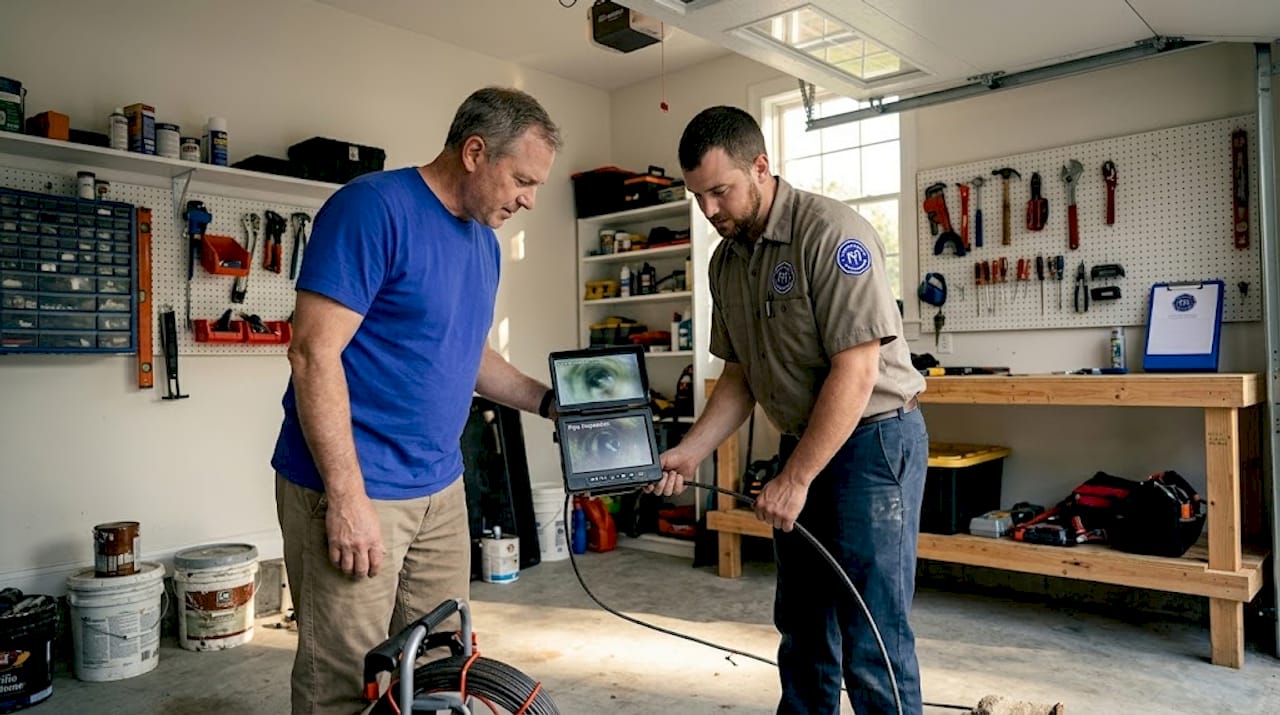
Hydro jetting is sometimes used as both a diagnostic and a cleaning tool. High-pressure water blasts through the pipe to clear obstructions, and the camera run after jetting shows the true condition of the pipe wall once debris is removed.
Understanding the condition of your lateral line before committing to any repair approach is critical. You can explore non-invasive repair options once you have a confirmed diagnosis in hand, so you are choosing the right tool for the actual problem.
Modern repair solutions: Non-invasive options for Maine homes
If your diagnosis confirms that the problem is on your section of the lateral line, the good news is that you do not have to tear up your yard to fix it. Municipal boundaries and legal responsibility may not always match public assumptions, but modern trenchless technology has made lateral sewer repairs faster, cleaner, and far less disruptive than the old dig-and-replace method.
Traditional excavation requires heavy equipment, multiple workers, and days of work. Your landscaping, driveway, walkways, and even foundation plantings can all be damaged in the process. Restoration costs alone can add thousands of dollars to the overall project price.
Trenchless repair methods change that equation significantly:
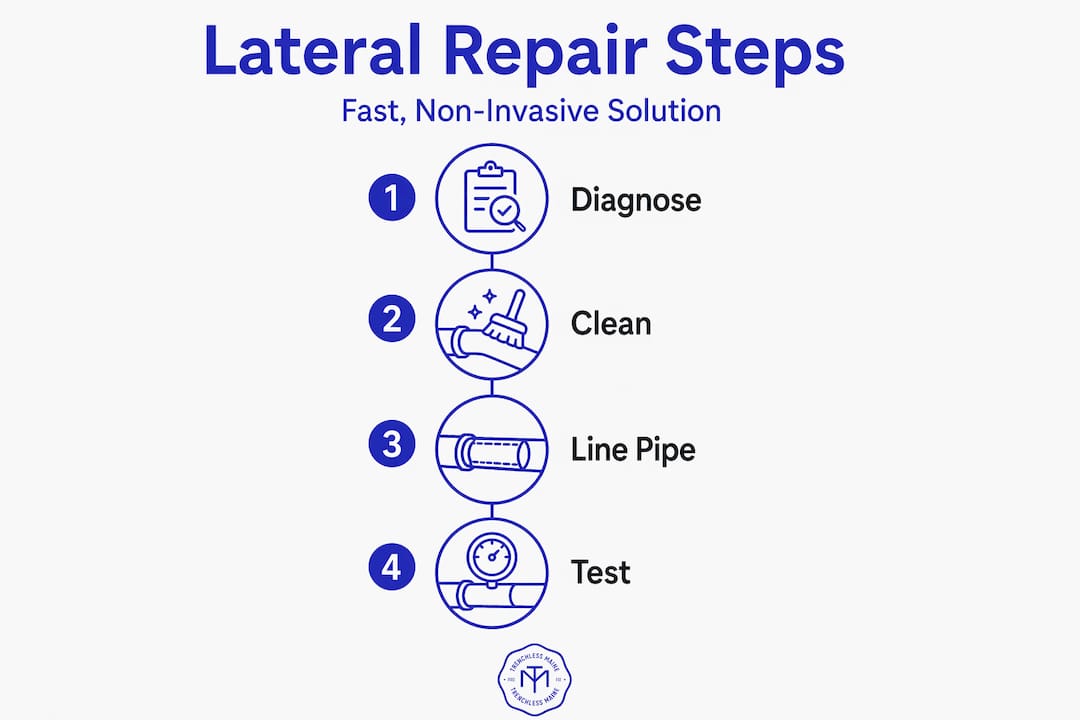
- CIPP lining (Cured-In-Place Pipe lining): A resin-saturated liner is inserted into the damaged pipe and cured in place, forming a smooth, jointless new pipe inside the old one. This method works on most lateral pipe materials, requires minimal access points, and is typically completed within one day. With trenchless pipe lining, your yard stays intact and the repaired pipe can last 50 years or more with a proper warranty.
- Pipe bursting: For severely damaged or collapsed lateral pipes, a bursting head is pulled through the old pipe, fracturing it outward while simultaneously pulling a new pipe into place. This method also requires no trenching along the pipe route.
- Hydro jetting: High-pressure water (often 4,000 PSI or more) is used to clear root intrusion, grease buildup, and debris from the lateral pipe. This is especially effective as a first response when the pipe structure is still intact but heavily obstructed.
- Spot repair: When only a small section of the lateral is damaged, a localized liner patch can be installed without addressing the entire pipe run, saving time and money.
Why trenchless matters for Maine properties specifically:
Maine's landscaping, mature trees, and frost-affected soil make excavation particularly disruptive and expensive. Many lateral lines run beneath mature trees, established gardens, or paved driveways. Removing and replacing those features after a dig adds significant cost. Trenchless technology sidesteps that problem almost entirely.
Most fast repair solutions using trenchless methods are completed within 24 hours, meaning your household is back to normal with minimal downtime. You can also review no-dig repair technology to understand exactly how these systems work before you commit to a repair plan.
One more practical point: trenchless lateral repairs often cost 30 to 50 percent less than full excavation when you factor in the restoration costs that traditional digging requires. You can review a detailed breakdown in the trenchless vs excavation cost comparison if you want to see real numbers before making a decision.
Our perspective: The biggest mistake Maine homeowners make about sewer laterals
After years of working with Maine homeowners on sewer repairs, the single most costly mistake we see is not the repair itself. It's the assumption made before any diagnosis happens.
Homeowners call the city, report a backup, and assume the municipality will take care of it. The city sends a crew, confirms the municipal main is clear, and leaves. Now the homeowner is stuck, still has a backup, still doesn't know what's wrong, and has lost valuable time. In some cases, people have paid contractors to excavate the wrong section of pipe, only to find the actual damage was in a different location entirely.
We recently worked with a homeowner in central Maine who spent over $4,000 on partial excavation based on a neighbor's recommendation and a guess about the pipe location. When we ran a camera inspection afterward, the actual blockage was 15 feet further down the lateral, well within an area that could have been addressed with CIPP lining at a fraction of the total cost spent.
The uncomfortable truth is that guessing costs more than knowing. A camera inspection typically runs a few hundred dollars. That investment gives you a documented visual record of your pipe's condition, precise damage location, pipe material, and the information needed to choose the right repair method. Without it, you're making expensive decisions blind.
We also strongly recommend that you review your insurance for sewer repair before any work begins. Some policies cover lateral repairs under specific conditions, and knowing your coverage before signing a repair contract can save you a significant amount out of pocket.
Verify the lateral boundary. Get the camera inspection done. Then choose your repair method based on facts, not assumptions.
Next steps: Expert, non-invasive sewer repairs for Maine homes
You now understand what your lateral sewer line is, where your responsibility begins, how to recognize warning signs, and what modern repair options look like. The next step is getting a professional assessment before a slow drain becomes a full sewage backup in your basement.
At Trenchless Maine, we specialize in non-invasive sewer diagnostics and repairs across Maine's cities and towns. Our team brings over 50 years of combined experience, and we complete most repairs within 24 hours with minimal disruption to your property. From sewer camera inspections to CIPP lining and hydro jetting, we give you a clear diagnosis, an honest repair recommendation, and a lasting solution. Our CIPP lining repairs come backed by industry-leading warranties of up to 50 years. If you're ready to get answers and protect your home, request a free quote today and find out if we service your area.
Frequently asked questions
How can I tell if my sewer problem is in the lateral or main line?
A professional camera inspection will pinpoint whether the issue is in your private lateral or the municipal main, giving you documented evidence before any repair decisions are made.
What non-invasive options exist for lateral sewer repairs in Maine?
Trenchless pipe lining and hydro jetting are the most common property-friendly methods, and non-invasive repairs like these minimize property disruption while delivering quick turnarounds, often within a single day.
Who pays for lateral line repairs, me or the city?
You typically pay for the section on your private property, and the municipality covers repairs in the public right-of-way. Homeowners usually own the segment from the building foundation to the property line.
Do lateral sewer lines affect home buying in Maine?
Yes, unrecognized lateral issues can become major repair costs after closing. Lateral sewer scope inspections during the home buying process can identify these problems before they become your financial burden.