
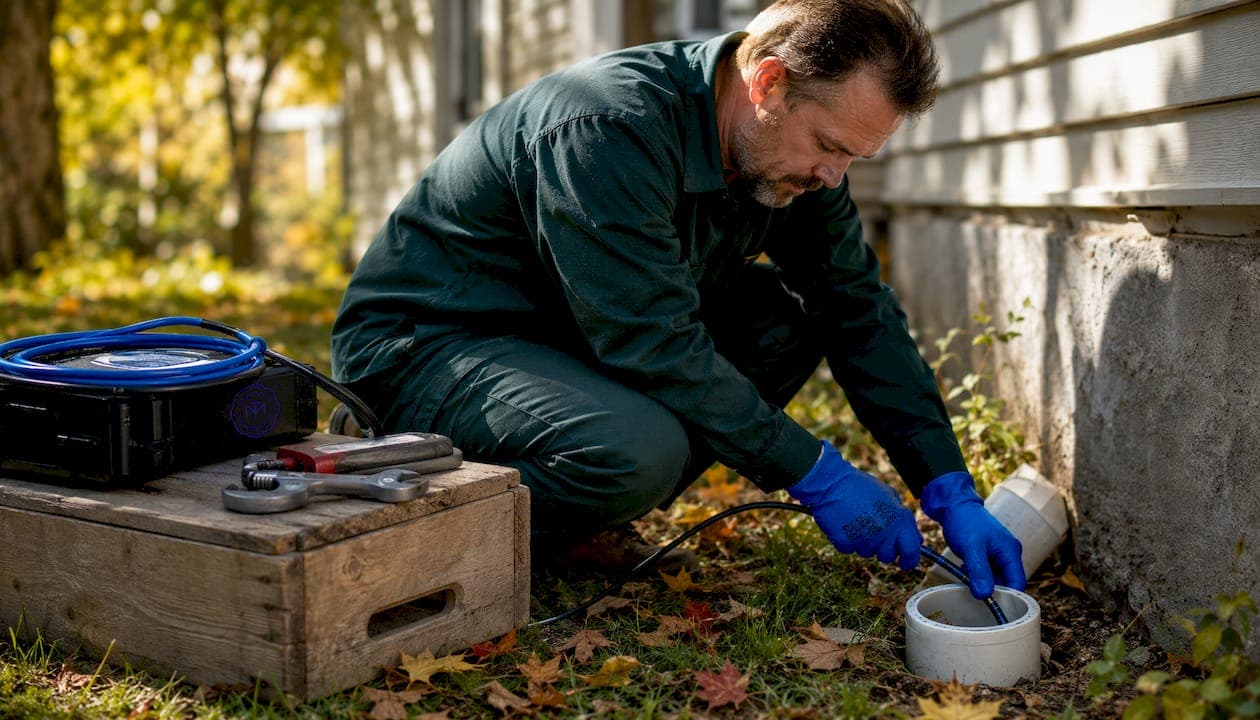
Hire a professional drain clean out service the moment more than one fixture backs up, sewage appears at floor level, or your cleanout cap is overflowing. Single-fixture clogs — a slow bathroom sink or a shower that drains sluggishly — are often DIY-fixable in 10–20 minutes with a plunger or a handheld snake. Hair catcher tools resolve about 90% of shower and bath hair clogs located near the drain. Main-line problems are a different situation entirely: they need powered cable augering, hydro-jetting, or a camera inspection to diagnose and clear safely. Delaying that call risks sewage backing up into your home, which is both a health hazard and a costly cleanup.
Before you call, have this ready for dispatch:
- Your full address and the best access point (basement, yard cleanout, or crawlspace)
- A symptom list: which fixtures are affected, how long, and whether there is any sewage odor or visible overflow
- Whether the cleanout cap is missing, cracked, or actively overflowing
- Any recent changes: new trees planted, recent heavy rain, or a sudden onset after years of normal drainage
Trenchlessmaine serves residential, commercial, and municipal clients across Maine with licensed, insured technicians and camera-verified results. For drain clearing in Maine, call or book online to get a same-day or next-business-day appointment scheduled.
Table of Contents
- What is a drain cleanout, and why does it matter?
- What methods does a professional drain clean out service use?
- What can a pro clear, and what causes these clogs?
- How long does the job take, and what does it cost?
- What should you do immediately during a sewer backup?
- How do you choose a qualified drain clean out service?
- What can you safely try before calling a pro?
- What does Trenchlessmaine's drain clean out process look like?
- Key Takeaways
- Why camera-first beats guess-and-clear every time
- Trenchlessmaine: drain clearing, hydro-jetting, and trenchless repair across Maine
- Useful sources and further reading
What is a drain cleanout, and why does it matter?
A drain cleanout is a capped access fitting — usually PVC or brass — installed along your sewer lateral (the pipe connecting your home to the municipal main). It gives technicians a direct entry point to feed a cable, camera, or jetting hose into the main line without dismantling fixtures. Think of it as the service door to your underground plumbing.
Where to find your cleanout:
- Outside, near the foundation wall, at or just above grade
- In the basement or crawlspace, on the main drain pipe before it exits the house
- In the yard, marked by a round or square cap flush with the ground (sometimes buried under mulch or grass)
- Older Maine homes may have a two-way cleanout near the street, or none at all if the system predates modern code
A missing or cracked cap is a red flag. Sewage odor near the foundation, wet soil in a straight line from the house toward the street, or a cap that is actively bubbling or overflowing all point to a main-line blockage that has pressurized the system.
Why cleanout access changes the job: A technician who can access the main line through a cleanout can run a 75–100 ft cable, position a camera at the exact blockage, or deliver a hydro-jetting nozzle to the right section of pipe. Without cleanout access, the crew must work through a toilet or floor drain, which limits reach and diagnostic accuracy. Before the crew arrives, note the cap location, clear any debris around it, and mark it with a flag or cone if it is in the yard.

What methods does a professional drain clean out service use?
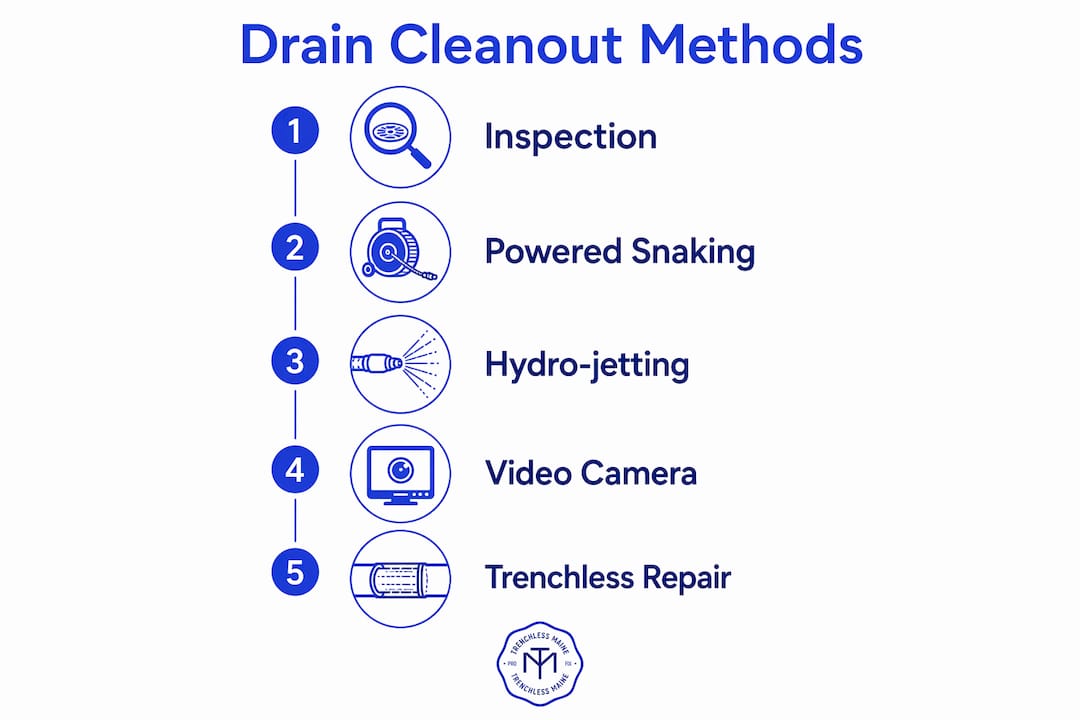
Professional sewer line cleaning service covers a range of methods, and the right one depends on what is blocking the pipe and the condition of the pipe itself.
| Symptom / Clog Type | Recommended Method | Why It Fits | Follow-Up Recommended |
|---|---|---|---|
| Single fixture, hair or soap | Powered cable auger | Fast, low-cost, safe for all pipe types | No, unless recurring |
| Kitchen grease buildup | Hydro-jetting | Scours pipe walls, removes grease film | Camera inspection |
| Root intrusion | Cable + root-cutting head, then jetting | Cuts roots, jetting flushes debris | Annual camera check |
| Multiple fixtures slow | Camera inspection first | Identifies exact location and cause | Method chosen after diagnosis |
| Collapsed or offset joint | Camera inspection + trenchless repair | Structural fix required, cleaning alone won't hold | CIPP lining or pipe bursting |
| Mineral scale | Hydro-jetting | High-pressure water breaks scale | Camera to confirm clearance |
Powered cable augering (snaking)
A motorized auger drives a steel cable with a cutting or corkscrew head through the pipe. It breaks up soft blockages and retrieves debris. Cable augering works on virtually every pipe material and diameter, costs less than jetting, and is the right first step for most residential clogs. The limitation: it punches a hole through a clog rather than cleaning the pipe walls, so grease and root fibers often return within months.
Pro tip: When a cable meets firm resistance at a joint, that resistance may be a fitting, not a clog. Forcing the cable past that point can crack the pipe. A trained technician withdraws, re-evaluates, and switches to a camera before proceeding.
Hydro-jetting
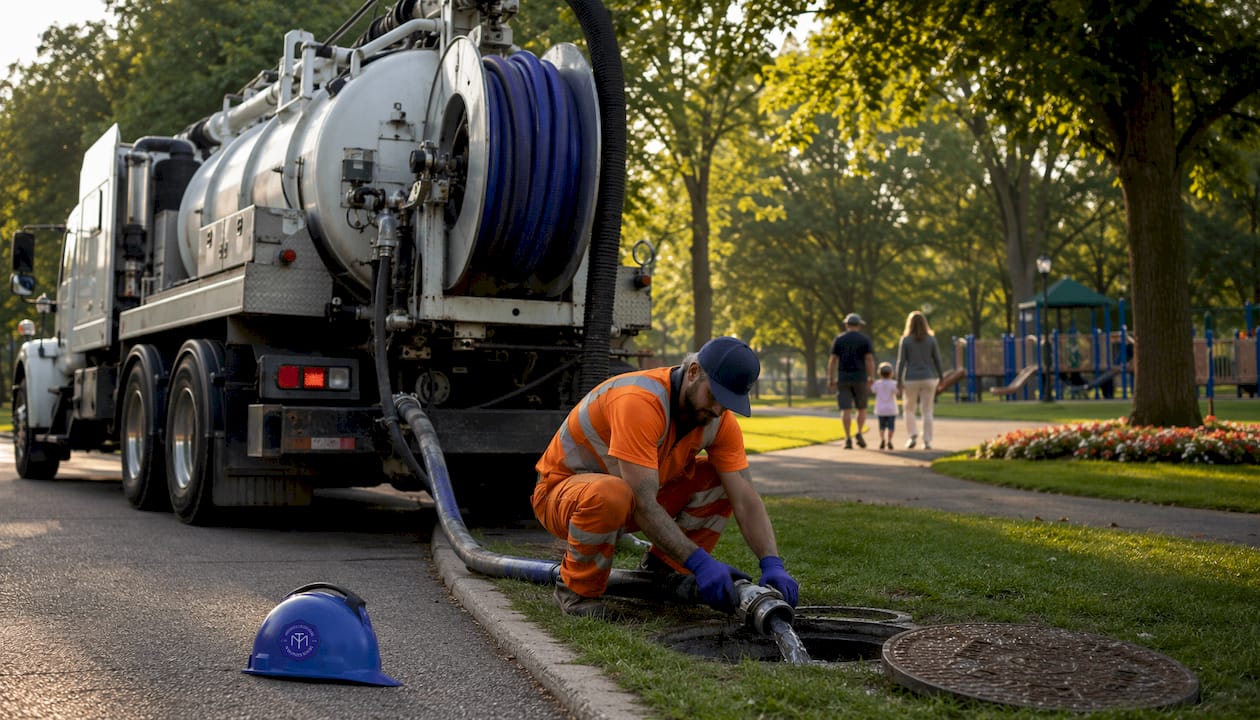
Jetting uses water at 2,000–4,000 PSI to scour pipe walls clean of grease, root fibers, and mineral scale. The result is a pipe that flows like new, not just a pipe with a hole punched through the blockage. The trade-off: jetting is not appropriate for structurally compromised, thin-wall, or severely corroded pipes. A camera inspection before jetting confirms the pipe can handle the pressure. For Maine homes with heavy grease use or mature trees near the sewer lateral, hydro-jetting in Maine is often the most durable single-visit solution.
Video (camera) inspection
An HD camera on a flexible cable travels through the pipe and transmits live footage. It pinpoints the exact location, depth, and cause of a blockage and reveals structural problems (cracks, offset joints, root intrusion) that no other method can detect from the surface. Camera inspection is an add-on on many jobs but should be treated as standard for recurring clogs, main-line issues, or any job where jetting is planned.
Trenchless repairs as a follow-up
When a camera reveals a cracked, collapsed, or root-invaded pipe, cleaning alone will not solve the problem. Trenchless sewer repair — specifically cured-in-place pipe (CIPP) lining — installs a new pipe inside the old one without excavation. The liner cures in place, restoring structural integrity and flow capacity, typically within 24 hours.
What can a pro clear, and what causes these clogs?
Most clogs fall into a handful of categories, and the symptom pattern usually points to the cause before a camera even enters the pipe.
Common clog causes and their symptoms:
- Hair and soap scum: Slow bathroom sink or shower drain; clog typically lives within the first 6 inches below the stopper or in the P-trap
- Kitchen grease: Slow kitchen sink, often with odor; grease solidifies on pipe walls over time and narrows the bore
- Wipes and foreign objects: Sudden complete blockage, often in the toilet branch line; "flushable" wipes do not break down and are a leading cause of main-line stoppages
- Root intrusion: Multiple fixtures slow simultaneously, gurgling when a toilet flushes, or a gurgling drain when another fixture runs; roots enter at joints and grow into a mass that traps debris. Industry guidance recommends planting trees at least 30 feet from sewer lines to reduce this risk
- Mineral scale: Gradual flow reduction across multiple fixtures in hard-water areas; scale builds on pipe walls and eventually restricts flow significantly
- Collapsed or offset joints: Sudden or progressive backup with no obvious cause; common in older clay or cast-iron lines in Maine homes built before 1970
Grease and hair clogs are usually resolved by cleaning alone. Root intrusion and structural damage require cleaning plus a follow-up inspection, and often a trenchless repair to prevent recurrence within months.
How long does the job take, and what does it cost?
Most residential drain cleaning appointments finish in 30 minutes to 2 hours. A single-fixture clog with straightforward access is typically cleared and tested in under an hour. A main-line job with camera inspection and hydro-jetting can run 2–4 hours, longer if root cutting or a trenchless repair follows.
| Service | Typical Low | Typical High |
|---|---|---|
| Camera inspection (add-on) | $100 | — |
Ranges reflect typical residential market rates; actual pricing varies by market, access difficulty, and job scope.
Factors that push cost up:
- Emergency or after-hours dispatch
- Limited cleanout access (working through a toilet or floor drain)
- Root cutting attachments required
- Camera inspection added to the scope
- Follow-up trenchless repair needed after cleaning
Routine professional cleaning every 2–5 years keeps most homes clear; busy households with heavy cooking or mature trees near the lateral benefit from annual or biannual service. Preventive cleaning costs far less than emergency dispatch plus repair. For more on scheduling and timely drain cleaning, the math on prevention versus emergency repair is straightforward.
What should you do immediately during a sewer backup?
A sewage backup is a health emergency, not just a plumbing inconvenience. Raw sewage contains pathogens that pose serious risks to people and pets, and standing water in a basement creates electrical hazards. Act fast and in this order:
- Stop all water use immediately. Every flush, sink run, or appliance drain adds volume to an already-pressurized system.
- Do not use any fixture that is backing up. Toilets, sinks, and tubs connected to the affected line will overflow if used.
- Turn off the washing machine and dishwasher. Both discharge large volumes quickly and will worsen the backup.
- Keep people and pets away from any standing sewage. Do not walk through it without waterproof boots, and do not let children near the area.
- Open the lowest available cleanout cap (if accessible and safe) to relieve pressure and direct overflow outside rather than into the home.
- Shut off the main water supply if sewage is actively rising inside the home and you cannot stop the source.
- Call for emergency drain service. Give the dispatcher your address, which fixtures are affected, whether sewage is inside the home, and whether the cleanout is overflowing.
Do not pour chemical drain cleaners into a backed-up line. Chemical cleaners create hazardous fumes in an enclosed space, leave corrosive residue that complicates mechanical clearing, and do nothing for a main-line blockage.
Pro Tip: If your basement floods and water contacts electrical outlets, panels, or appliances, do not enter until the power to that circuit is confirmed off at the breaker. Call your utility if you are unsure.
How do you choose a qualified drain clean out service?
The difference between a provider who solves your problem and one who creates a new one often comes down to a few specific questions asked before anyone shows up.
Selection checklist:
- Licensed and insured in Maine (ask for license number and verify)
- Upfront, written pricing before work begins — no "we'll tell you after we open it up"
- Camera inspection available, not just offered as an upsell
- Written warranty or service guarantee on the work performed
- Documented local reviews and references you can check
- Clear emergency availability and response time commitment
Questions to ask on first contact:
- What method do you plan to use, and why is it right for my symptoms?
- Is a camera inspection included, or is it an add-on?
- What is your warranty on this service, and what does it cover?
- What is your cleanup policy after the job?
- What is the estimated timeframe from arrival to completion?
Red flags to walk away from:
- Pressure to approve additional work immediately, before you have seen camera footage
- Insistence that chemical treatment is the first or only option
- Refusal to camera-inspect before recommending a major repair
- No proof of insurance or a vague answer when you ask for the license number
- No local references or reviews you can independently verify
For property managers: negotiate a service-level agreement that specifies emergency response time (typically 2–4 hours), a capped emergency rate, and itemized invoicing that separates labor, materials, camera add-on, and disposal. A provider who resists those terms is telling you something.
What can you safely try before calling a pro?
For a single slow or blocked fixture, a few simple steps are worth trying first. Most bathroom hair clogs accumulate near the stopper, which means a $5 plastic hair-catcher tool often clears them in two minutes.
Safe DIY steps, in order:
- Plunger first: Use a cup plunger for sinks and tubs. Seal the overflow opening with a wet rag before plunging — without that seal, you lose all downward pressure and the plunger does nothing. Ten firm strokes, then test flow.
- Hair-catcher tool: For bathroom sinks and showers, a thin plastic or wire tool with barbs pulls hair and soap scum out of the drain opening and P-trap. No disassembly needed.
- Remove and clean the P-trap: Under a sink, the curved pipe (P-trap) catches debris. Place a bucket underneath, unscrew the slip joints by hand, clean the trap, and reinstall. Takes about 10 minutes.
- Set a timer: If the clog is not cleared in 20 minutes of effort, stop. Continuing risks damaging the pipe or pushing the blockage deeper.
What not to do:
- Do not use lye or acid-based chemical drain cleaners. They damage PVC and rubber seals, create toxic fumes, and leave residue that makes professional clearing harder and more expensive.
- Do not force a manual snake past firm resistance at a joint. That resistance is often a fitting, not a clog.
- Do not attempt power-jetting or any pipe excavation yourself.
Pro Tip: Pour 1–2 gallons of water into floor and fixture traps monthly if a drain sees infrequent use. Dried-out traps let sewer gas into living spaces — a simple habit that prevents a surprisingly common problem.
Call a pro immediately if you smell sewage, if more than one fixture is affected, or if a DIY attempt causes any fixture to back up. For safe DIY drain methods and when to stop, Trenchlessmaine's blog covers the line between manageable and professional territory clearly.
What does Trenchlessmaine's drain clean out process look like?
Trenchlessmaine's approach is built around diagnosing first and cleaning second — because the wrong method on the wrong pipe wastes time and can cause damage.
Step-by-step job flow:
- Intake and triage: When you call or book online, a dispatcher collects your address, symptom description, and cleanout access details to route the right crew with the right equipment.
- On-site inspection: The technician assesses the cleanout location, checks fixture symptoms, and determines whether the issue is localized or main-line.
- Cleanout access or fixture work: The crew accesses the line through the cleanout fitting or, where no cleanout exists, through the nearest appropriate fixture.
- Camera inspection (when indicated): An HD camera run confirms the blockage location, pipe condition, and the presence of roots, scale, or structural damage before any cleaning method is chosen.
- Cleaning: The technician applies the appropriate method — powered cable augering for most clogs, hydro-jetting for grease or root fiber buildup, root-cutting attachments where needed.
- Verification: A post-cleaning camera pass or flow test confirms the line is clear and flowing at full capacity.
- Cleanup and closeout: The crew cleans the work area, documents the camera footage, and walks you through findings before leaving.
Trust signals you can count on:
- Licensed and insured in Maine
- HD camera video provided as proof of condition before and after cleaning
- Written warranties on select trenchless repairs up to 50 years
- Over 50 years of combined team experience in Maine sewer systems
- Local references and documented customer reviews
Invoices itemize labor, materials, camera add-on (if applicable), and disposal separately — no surprise line items. If a follow-up recheck is needed within the warranty period, Trenchlessmaine's team returns to verify. For the full service area coverage across Maine, check availability for your address before booking.
Key Takeaways
A professional drain clean out service is the right call for any main-line issue, sewage backup, or recurring clog — and Trenchlessmaine delivers camera-verified results with warranties up to 50 years across Maine.
| Point | Details |
|---|---|
| When to DIY | Single-fixture clogs cleared in 10–20 minutes with a plunger or hair tool (about 90% of hair clogs are removed this way); stop if not resolved quickly. |
| When to call a pro | Multiple fixtures affected, sewage present, gurgling sounds, or cleanout overflowing — call immediately. |
| Cost expectations | Cable clearing runs —–—; hydro-jetting —–—; camera inspection adds $100–— to any job. |
| Prevent recurrence | Schedule professional cleaning every 2–5 years; annually for heavy-use homes or those with mature trees nearby. |
| Trenchlessmaine | Licensed, insured Maine provider offering drain clearing, hydro-jetting, camera inspection, and trenchless repair with warranties up to 50 years. |
Why camera-first beats guess-and-clear every time
Most drain cleaning calls I see go sideways for the same reason: a technician cables the line, clears the immediate blockage, and leaves — without ever looking at what caused it. The homeowner calls back six weeks later with the same problem, pays again, and still does not know whether they have a root mass, a grease-coated pipe, or a cracked joint that will keep catching debris until it is repaired.
The camera-first approach changes that equation entirely. When you see the footage, you know whether cleaning solved the problem or whether a structural fix is the only real answer. That transparency protects you from repeat service calls and from being sold a repair you do not need. It also protects a contractor's reputation — a technician who shows you the pipe before and after has nothing to hide.
Trenchlessmaine's emphasis on HD camera verification is not just a marketing point. It reflects a straightforward philosophy: a clean pipe you can see is worth more than a cleared pipe you have to take on faith. For Maine homeowners dealing with aging clay lines, root-prone yards, or a sewer lateral that has never been inspected, that footage is often the first honest look at what is actually underground.
Trenchlessmaine: drain clearing, hydro-jetting, and trenchless repair across Maine
When a clog goes beyond what a plunger can reach, Trenchlessmaine brings the full toolkit: drain clearing, high-pressure hydro-jetting, HD camera inspection, and trenchless sewer repair — all from a licensed, insured Maine crew that has been solving these problems for decades.

Same-day service is available for emergencies across Maine; non-emergency appointments are typically scheduled next business day. When you call or book online, have your address, a description of which fixtures are affected, and your cleanout location ready. That information gets the right crew dispatched with the right equipment on the first visit — no return trips to grab a different machine.
For homes where cleaning reveals a damaged lateral, trenchless repair options including CIPP lining can restore the pipe without excavation, often within 24 hours. Get a quote and check service availability for your Maine address today.
Useful sources and further reading
- Drain Clearing Maine | Fast Sewer & Drain Cleaning — Trenchlessmaine's primary drain clearing service page
- Hydro Jetting Maine | High Pressure Drain Cleaning — Details on high-pressure jetting for grease, roots, and scale
- What Causes Sewer Blockages: A Homeowner's Guide — Root intrusion, grease, and foreign objects explained
- How to Clear Blocked Drains: Safe DIY Methods — Step-by-step safe homeowner techniques
- 5 Warning Signs You Need Sewer Repair — When a clog is actually a structural problem
- How to Protect Sewer Lines From Root Intrusion — Tree placement and preventive measures
- Sewer Gas Smell in Your Maine Home? Here's What It Means — Trap priming and sewer gas causes
- How to Maintain Sewer Lines and Prevent Costly Repairs — Long-form maintenance guide for homeowners and property managers
- Flat Roof Drainage Solutions: A Complete 2026 Guide — Relevant for property managers dealing with building-wide drainage planning, including roof and floor drain systems