

Municipal sewer inspection scheduling is the formal process of coordinating regulated pipe assessments between public works staff, contractors, and property owners to meet compliance deadlines and protect infrastructure integrity. Knowing how to schedule municipal sewer inspections correctly prevents costly re-excavation fees, failed inspections, and safety violations that can shut down an entire project. This guide covers the prerequisites, step-by-step workflow, digital tools, and troubleshooting strategies that municipal employees and inspectors need to run an efficient, compliant program in 2026. Tools like CCTV robotic crawlers, SewerAI, and Optimatics are reshaping how scheduling teams operate.
What requirements must be met before scheduling sewer inspections?
The municipal sewer inspection process begins long before the crew arrives on site. Most municipal codes require 24-hour advance notice at minimum before any sewer inspection can proceed. Skipping this step shifts excavation costs to the contractor or property owner and can trigger mandatory reinspection fees.
Site readiness checklist
Site readiness is a hard prerequisite, not a suggestion. Under the Spokane Municipal Code, contractors must provide ladders or sloped ditches for safe inspector entry. If the site does not meet these standards, the inspector has the authority to refuse entry and reschedule, which delays the entire project.
Before you submit an inspection request, confirm the following:
- Safe access is provided via ladders or properly sloped trench walls
- Confined space entry protocols are in place, including continuous air monitoring
- Required permits are obtained and on file before the inspection date
- Contractor and crew contacts are confirmed and available during the inspection window
- Documentation including pipe specifications and prior inspection records is ready for review
Field safety protocols such as air monitoring and confined space entry training are mandatory. Failure to comply does not just delay the inspection. It can cancel it entirely and trigger a reinspection fee.
Pro Tip: Create a pre-inspection checklist specific to your municipality's code and share it digitally with contractors at least 48 hours before the scheduled date. This single step eliminates most day-of cancellations.
| Tool or Method | Primary Use | Best For |
|---|---|---|
| CCTV Robotic Crawlers | Live pipe video feed | High-risk and older pipe sections |
| Online Scheduling Portals | Request submission and tracking | Routine inspection coordination |
| SewerAI Smart Project Builder | Automated defect coding and risk scoring | Rehabilitation prioritization |
| Optimatics Scheduling | Adaptive, budget-aware scheduling | Long-term inspection program planning |
| GIS-Integrated Platforms | Real-time spatial data syncing | Multi-site scheduling management |
How do municipal employees coordinate sewer inspection scheduling?
The standard municipal sewer inspection process follows a defined communication chain. Inspections are initiated through phone requests, online portals, or direct coordination with public works dispatch. Each method has its place depending on urgency and the complexity of the site.
Routine sewer inspections typically run on a 10-year cycle, with higher-risk or older pipe sections inspected every 3 years or sooner. That frequency pattern directly shapes how you build your scheduling calendar and allocate crew time.
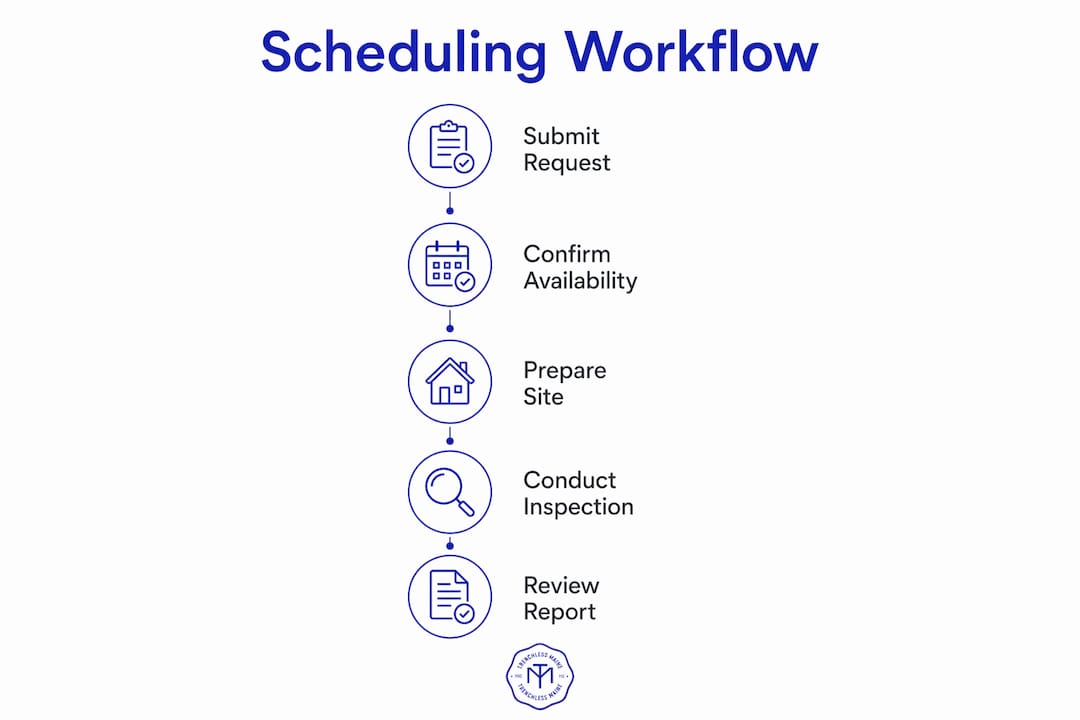
Step-by-step inspection scheduling workflow
- Submit the inspection request at least 24 hours in advance through your municipality's online portal or by phone to the public works department.
- Confirm site readiness by verifying that access, safety equipment, and required permits are in place before the scheduled time.
- Notify all stakeholders including contractors, property owners, and field crews of the confirmed date, time, and site requirements.
- Assign inspection crew and equipment based on pipe type, risk level, and the scope of the inspection (routine vs. high-risk).
- Conduct the inspection using CCTV cameras or robotic crawlers with live video feeds, which allow crews to assess up to 1,000 feet of pipe per day.
- Document findings in real time using mobile field tools that sync directly to your central database.
- Issue the inspection report and flag any defects for immediate repair prioritization or follow-up scheduling.
Pro Tip: When you schedule sewer inspection online, use platforms that send automated confirmation emails to contractors and property owners. This reduces no-shows and miscommunication without adding administrative work.
The most common mistake teams make is treating scheduling as a one-way notification. Effective coordination requires two-way confirmation from every party involved. If a contractor does not confirm receipt of the inspection notice, follow up directly. A missed confirmation is the leading cause of failed inspections and avoidable reinspection fees.
You can also review how to prepare for a sewer inspection in Maine for a practical breakdown of what property owners and contractors need to have ready before your crew arrives.
What technologies improve sewer inspection scheduling efficiency?
Digital tools have fundamentally changed the municipal sewer inspection process. Modern digital-first utilities cut rehabilitation planning from months to weeks by integrating automated CCTV data with risk-prioritization software. That time savings translates directly into faster scheduling decisions and fewer backlogs.

The biggest efficiency gain comes from eliminating data silos. Integrated software syncing inspection footage, defect codes, and GIS data in real time removes the manual file transfer step that delays repair prioritization by days or weeks. When your field crew captures a defect on camera, that data should appear in your scheduling dashboard within minutes, not after a manual upload at the end of the day.
Key benefits of connected digital workflows
- Real-time risk scoring flags high-priority pipes automatically, so you schedule repairs before failures occur
- Automatic scheduling updates adjust crew assignments when new defect data changes a pipe's risk level
- Mobile field entry eliminates paper logs and reduces transcription errors in inspection reports
- GIS integration maps inspection coverage visually, showing gaps in your scheduling program at a glance
- Automated reporting generates compliance documentation without additional staff time
Disconnected manual data entry is the most common workflow bottleneck for scheduling teams. Shifting to connected platforms converts static inspection reports into live intelligence that drives faster decisions. For municipalities evaluating camera technology, the best sewer inspection cameras for municipalities guide covers the top options for 2026.
| Platform | Core Function | Scheduling Benefit |
|---|---|---|
| SewerAI Smart Project Builder | AI defect coding and risk scoring | Cuts planning time from months to weeks |
| Optimatics | Adaptive program scheduling | Quarterly updates based on budget and regulations |
| GIS-Integrated Platforms | Spatial data mapping | Visual gap analysis for inspection coverage |
| Mobile Field Tools | On-site data capture | Instant sync eliminates manual reporting delays |
How do you troubleshoot common sewer inspection scheduling challenges?
Scheduling conflicts, unsafe sites, and incomplete inspections are predictable problems. The best practices for sewer inspections treat these as manageable variables, not emergencies, when you plan for them in advance.
Managing unsafe sites and rescheduling
An inspector who arrives at an unsafe site has two options: wait for the contractor to correct the issue or reschedule. Both options cost time and money. The smarter approach is to build a pre-inspection site verification step into your workflow at least 24 hours before the scheduled time. A brief phone confirmation with the contractor that access and safety equipment are in place prevents most on-site refusals.
Tiered emergency policies improve operational trust and balance staff workload. A practical tiered model looks like this:
- Immediate response for active sewer overflow or collapse
- Same-day scheduling for confirmed saturation or backup affecting occupied properties
- Next-day scheduling for high-risk pipe sections flagged during routine inspections
- Routine queue for standard inspection cycle requests
Reactive emergency scheduling damages public trust and burns out staff. A tiered policy gives your team a clear decision framework that keeps urgent cases moving without derailing the routine inspection calendar.
Adaptive prioritization scheduling updated quarterly based on budgets and regulations helps cities minimize inspection risks and maximize coverage. A static annual schedule cannot account for budget changes, new regulatory requirements, or unexpected pipe failures. Reviewing and adjusting your schedule every quarter keeps your program aligned with current conditions.
Pro Tip: Build a shared scheduling calendar that your contractors, field crews, and public works office can all view in real time. When everyone sees the same schedule, rescheduling conflicts get resolved in minutes instead of days.
Clear communication with property owners is equally critical. When you arrange sewer checks that affect private property access, send written notice at least 48 hours in advance. Include the inspection date, time window, contact name, and what the owner needs to do before your crew arrives. This reduces access denials and keeps your schedule on track.
Key takeaways
Effective municipal sewer inspection scheduling requires advance notice, site readiness verification, and integrated digital tools working together to maintain compliance and operational efficiency.
| Point | Details |
|---|---|
| 24-Hour Advance Notice | Submit inspection requests at least 24 hours early to comply with most municipal codes and avoid reinspection fees. |
| Site Readiness Is Non-Negotiable | Confirm safe access, air monitoring, and permits before the inspection date to prevent on-site cancellations. |
| Digital Tools Cut Planning Time | Platforms like SewerAI reduce rehabilitation planning from months to weeks through automated risk scoring. |
| Tiered Emergency Policies Work | Structured response tiers balance urgent demands with routine scheduling without overloading staff. |
| Quarterly Schedule Reviews | Updating your inspection program every quarter based on budgets and conditions improves long-term coverage. |
What i've learned about scheduling sewer inspections that most guides miss
After working through dozens of municipal sewer projects across Maine, the pattern I see most often is not a technology problem. It is a communication problem that technology then makes worse. Teams adopt a new scheduling platform, but they never fix the underlying habit of treating inspection requests as one-way notifications. The platform sends a confirmation. Nobody follows up. The contractor shows up without a ladder. The inspector refuses entry. The project loses two days.
The fix is simple but requires discipline. Every inspection request needs a two-way confirmation loop, regardless of what your software says it sent. A 30-second phone call the day before an inspection eliminates more scheduling failures than any platform feature I have seen.
The other insight worth sharing is that adaptive scheduling models are not just for large cities with big budgets. Even a small public works team can review its inspection priorities quarterly and adjust based on what the data shows. That habit alone separates municipalities that stay ahead of their infrastructure from those that spend most of their budget on emergency repairs.
Modern tools like SewerAI and GIS-integrated platforms are genuinely useful. But they work best when your scheduling process is already sound. Get the fundamentals right first, then let the technology multiply your efficiency.
— John
How Trenchlessmaine supports your post-inspection repair needs
Once your inspection identifies defects, the next step is repair. Trenchlessmaine specializes in no-dig sewer repair technologies that work directly alongside your inspection findings to minimize disruption and project time. Methods like CIPP pipe lining and hydro jetting address the root intrusion, pipe deformation, and joint failures that CCTV inspections most commonly flag.

Trenchlessmaine serves municipal, commercial, and residential clients across most of Maine with over 50 years of combined expertise. Repairs are often completed within 24 hours, and solutions are backed by warranties up to 50 years. If your inspection results point to pipe deterioration, sewer camera inspection services from Trenchlessmaine can confirm the scope before any repair work begins. Contact Trenchlessmaine to discuss how your inspection findings translate into a repair plan that protects your infrastructure without unnecessary excavation.
FAQ
What is the minimum notice required to schedule a sewer inspection?
Most municipal codes require at least 24 hours advance notice before a sewer inspection. Noncompliance typically shifts excavation costs to the contractor and triggers mandatory reinspection fees.
How often should municipal sewer pipes be inspected?
Routine sewer inspections run on a 10-year cycle for standard pipes, with higher-risk or older sections inspected every 3 years or sooner based on condition data.
Can i schedule a sewer inspection online?
Many municipalities now offer online portals to schedule sewer inspection requests. Digital platforms also send automated confirmations to contractors and property owners, reducing scheduling errors.
What happens if a site fails safety requirements on inspection day?
Inspectors can legally refuse to conduct the inspection if the site does not meet safety standards such as proper access or air monitoring. A reinspection fee typically applies, and the project is delayed until the site is corrected.
How do digital tools improve sewer inspection scheduling?
Platforms like SewerAI integrate CCTV data with automated risk scoring, cutting rehabilitation planning from months to weeks and enabling real-time scheduling adjustments based on current pipe conditions.