
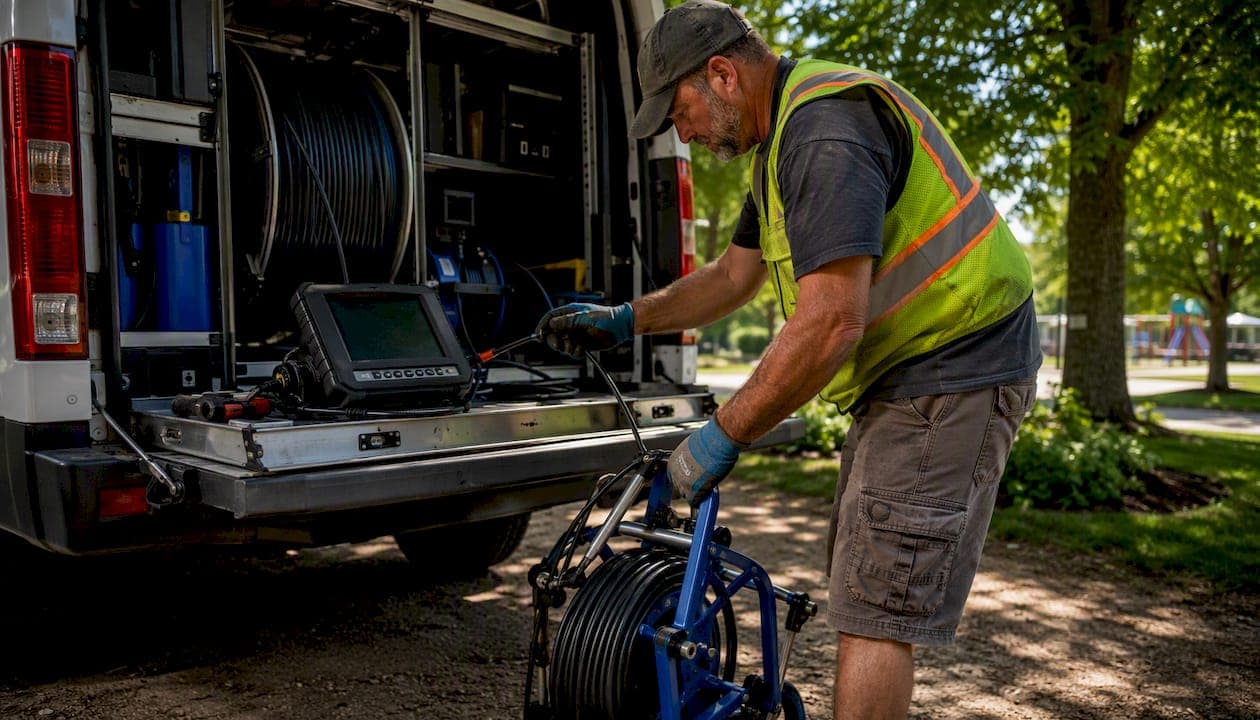
Hire a local trenchless contractor that runs an HD sewer-camera inspection with a sonde locator and delivers timestamped video plus a written condition report. That combination gives you a clear, documented diagnosis without digging a single trench. The industry term for this service is a CCTV drain survey), and it's the standard professional tool for diagnosing pipe and sewer conditions. When you call a contractor, confirm these minimum requirements before you book:
- Licensed and insured in Maine, with proof available on request
- HD push or tractor camera matched to your pipe diameter
- Sonde transmitter and surface locator for pinpointing defect depth and position
- Timestamped video and still frames delivered after the inspection
- Written condition report with repair recommendations
- PACP/NASSCO familiarity if you need municipal-grade documentation
- Clear pricing model: flat fee or bundled with cleaning/repair, and whether the inspection cost credits toward repair
- Expected on-site time: 30–60 minutes for a standard residential lateral
If your property has no cleanout, ask whether the technician can access the line through a temporary toilet removal rather than cutting a new access point.
Table of Contents
- How do you verify a contractor's credentials in Maine?
- Do sewer-camera inspections require permits in Maine?
- What camera technology do contractors actually use?
- Key Takeaways
- Why the inspection report matters more than the camera brand
- Trenchlessmaine serves Maine homeowners, managers, and municipalities
- Useful sources for further reading
How do you verify a contractor's credentials in Maine?
Maine does not issue a single statewide "sewer camera" license, but any contractor working on sewer laterals must hold a valid Maine plumbing or contractor license. Ask for the license number and verify it through the Maine Department of Professional and Financial Regulation. General liability insurance and workers' compensation coverage protect you if something goes wrong on your property, so request certificates before work begins.
Beyond the paperwork, ask for references from similar jobs: residential lateral inspections, commercial mainline runs, or municipal projects. A contractor with municipal experience has almost certainly worked to tighter documentation standards, which benefits every client. Familiarity with PACP/NASSCO defect codes is a reliable signal of that higher standard.
Do sewer-camera inspections require permits in Maine?
A standalone camera inspection is diagnostic, not structural, so it typically does not require a permit in Maine. No material is removed or installed, and no excavation occurs. Permits become relevant when the inspection findings lead to repair work: pipe lining, spot repairs, or lateral replacement each carry their own permit requirements under Maine plumbing codes.
If your municipality requires a permit for any work touching the public sewer connection, your contractor should handle that paperwork. Ask upfront whether the scope they propose triggers a permit, and confirm who pulls it.
What camera technology do contractors actually use?
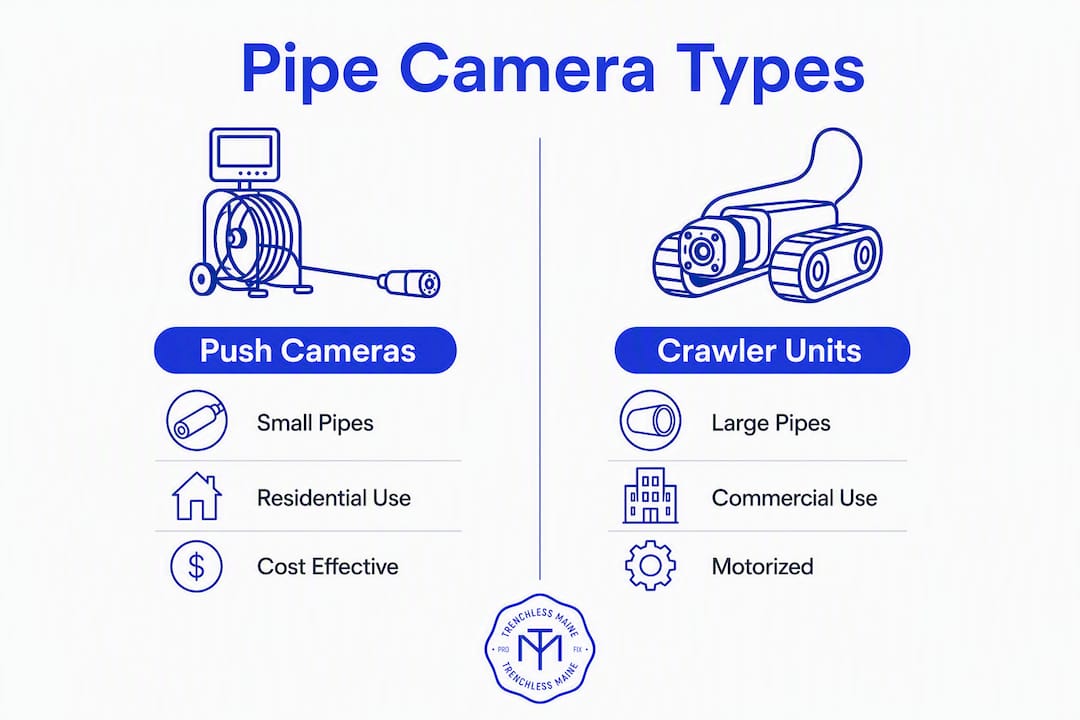
Professional contractors use two main systems, and the right one depends on your pipe size. Push cameras handle most residential laterals, typically covering 100–200 feet through a 3-inch to 6-inch pipe. They're compact, fast to deploy, and well-suited to standard home sewer lines.
Tractor or motorized crawler units are built for larger-diameter mains, 8 inches and above, where a push camera loses traction or can't maintain a stable image. These systems offer pan-and-tilt camera heads and are standard for municipal mainline work.
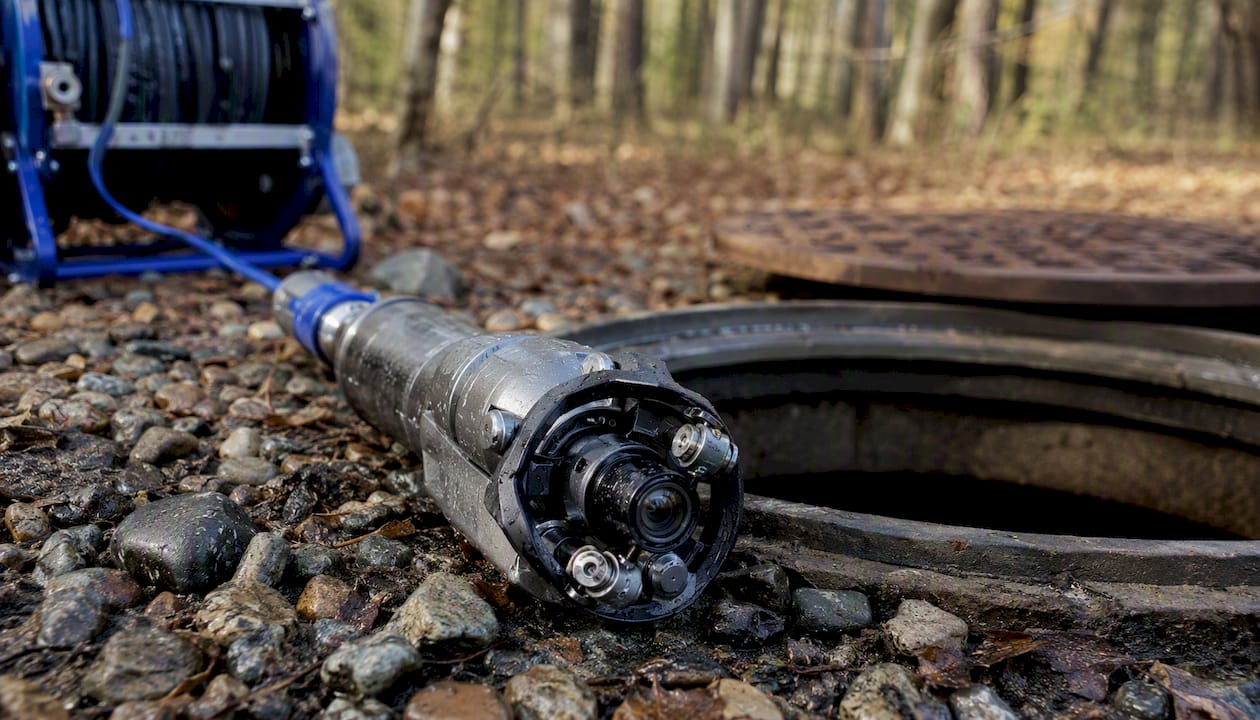
HD resolution and self-leveling camera heads matter more than most buyers realize. A self-leveling head keeps the image upright regardless of pipe orientation, so cracks, root intrusion, and pipe deformation are readable without guesswork. A sonde transmitter paired with the camera lets the technician mark the exact surface location and depth of any defect, which is what makes targeted repair possible without unnecessary excavation.
Camera inspections show interior condition clearly, but they can't measure internal pressure or verify the external integrity of buried joints. For pressurized lines or suspected slow leaks, additional testing such as hydrostatic pressure tests may be needed alongside the camera run.
Key Takeaways
A qualified Maine contractor running an HD sewer-camera inspection with sonde locating and a written condition report gives you the clearest, least-invasive diagnosis available before committing to any repair.
| Point | Details |
|---|---|
| Typical inspection time | Most residential lateral inspections complete in under an hour when a cleanout is accessible. |
| Cost range | A typical residential sewer camera inspection costs $100–$400; with locating or extended runs, prices often reach $300–$500. |
| Core deliverables | Timestamped video, still frames, sonde depth readings, and a written condition report with repair recommendations. |
| Permit requirement | Standalone camera inspections rarely require a permit in Maine; permits apply to repair work that follows. |
| Trenchlessmaine | Offers HD sewer-camera inspections with sonde locating, timestamped video, and trenchless repair options across Maine. |
Why the inspection report matters more than the camera brand
Most buyers focus on whether a contractor has "good equipment." That's reasonable, but the deliverable that actually protects you is the written condition report, not the camera model. A timestamped video file you can share with an insurer, a property buyer, or a municipal engineer is worth far more than a verbal summary from a technician you'll never see again.
Trenchlessmaine brings over 50 years of combined experience to every inspection, including municipal and commercial projects that demand tighter documentation standards. The trust signals worth verifying before you hire any contractor:
- Before/after project gallery — showing real inspection and repair outcomes
Ask any contractor for a sample report before you book. If they can't produce one, that tells you something.
Trenchlessmaine serves Maine homeowners, managers, and municipalities
Trenchlessmaine is the local alternative to a generic plumber for HD sewer-camera inspections in Maine. Where a standard plumber may offer a basic camera pass, Trenchlessmaine pairs every inspection with sonde locating, timestamped video, and a written condition report you can actually use. When the inspection finds grease buildup or scale, hydro-jetting services are available in the same visit, followed by a verification pass to document the cleared line.
Warranties up to 50 years on lining work and a track record of municipal projects mean larger buyers get the documentation and confidence they need. When you call, have your address, property type, known symptoms, and cleanout location ready.
Pro Tip: If your property has no cleanout, Trenchlessmaine technicians can access the line through a temporary toilet removal, a non-invasive option that avoids cutting a new access point.
Learn what to expect from trenchless repair options after your inspection, or check service availability for your Maine address and schedule your inspection today.
Useful sources for further reading
-
Sewer Camera Inspection: What to Expect, Step by Step | 535 Plumbing — Covers the full inspection process, access options including toilet removal, and the limitations of camera-only diagnostics. Useful for understanding what to expect on inspection day.
-
Sewer Camera Inspection Process | Fraser Plumbing — Explains sonde locating, depth readings, and the verification pass after cleaning. Supports pricing and deliverables discussions.
-
Sewer Camera Inspection Guide | Novi Plumbing Co — Provides residential pricing context ($100–$400 base; $300–$500 with locating or extended runs) for benchmarking local quotes.
-
Understanding Homeowner Camera Inspection Process | Sewer Gurus — Details the deliverables a buyer should request: timestamped video, defect markers, and a written condition report.
-
Sewer Camera Inspection Guide | Illyrian Plumber — Explains push vs. tractor camera systems and their appropriate pipe-diameter ranges.
Note for municipal and commercial buyers: Request that your contractor's written report uses PACP/NASSCO defect codes. Standardized codes make reports comparable across contractors and usable for asset management and capital planning.